
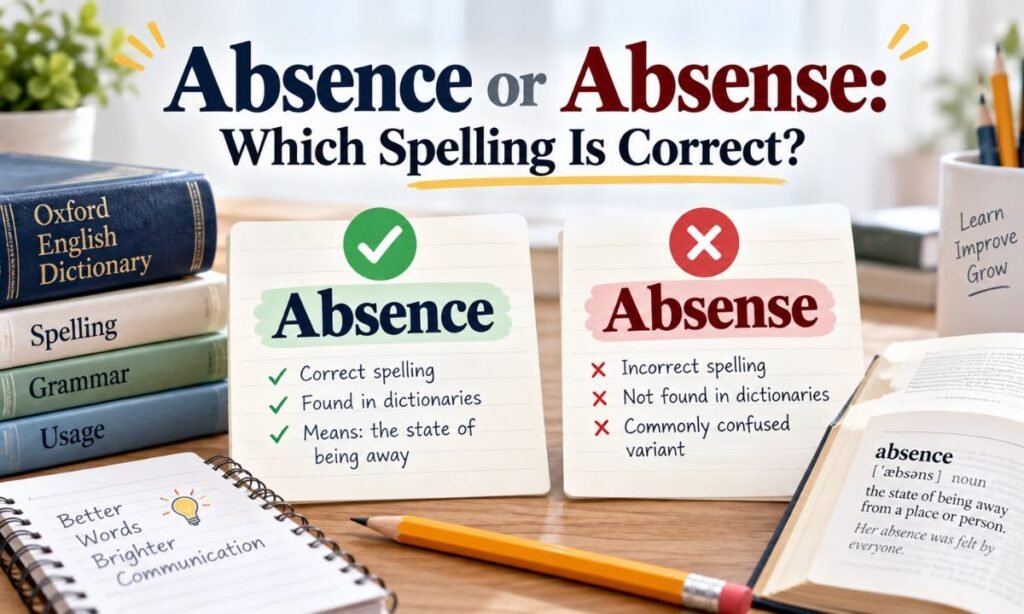

You are typing a note to your manager, a teacher, or a client. You need the word for “not being there,” and your fingers hesitate. Is it absence or absense? Both look right at a glance, and both sound identical when spoken. That is exactly why the question comes up so often.
The short version: absence is correct. Absense is a misspelling, and no major dictionary lists it as a variant.
This guide goes beyond the one-line answer. You will see where the word came from, why the wrong spelling tempts so many writers, how the British and American habits compare, and which memory tricks work best. There are plenty of real-world examples, a comparison table, and a short FAQ at the end. By the time you finish, you should never second-guess this word again.
Absence or Absense – Quick Answer
The correct spelling is “absence.” It ends in -ence, not -ense. This is true in American English, British English, Canadian English, Australian English and every other standard variety.
Here is the answer in a format you can scan in two seconds:
| Spelling | Status | Use it? |
|---|---|---|
| Absence | Correct | Yes, always |
| Absense | Misspelling | No, never |
A few quick facts to lock it in:
- “Absence” is a noun.
- It is spelled A-B-S-E-N-C-E.
- The ending matches words like presence, essence and silence.
- It is the same in the UK and the US, so there is no regional exception to worry about.
If a spell checker underlines “absense” in red, trust it. The tool is right.
Absence Meaning
Absence means the state of being away from a place, a person, or a situation where you would normally be expected. It can also mean the lack of something altogether.
The word works in two main ways:
- A person is not present. Example: “Her absence from the meeting was noticed by everyone.”
- A thing or quality does not exist or is missing. Example: “The absence of clear instructions caused confusion.”
Dictionaries such as Merriam-Webster, Oxford and Cambridge describe it in much the same way: a time when someone is away, or a situation in which something is lacking.
You will also see it in many fixed phrases:
- Leave of absence: official permission to be away from work or study for a set period
- Excused absence: an absence that has been approved or explained
- Unexcused absence: an absence with no accepted reason
- Absence of mind: a lapse in attention, being lost in thought
- Absence makes the heart grow fonder: a familiar saying about missing people you care about
- In the absence of: when something is not available, as in “In the absence of proof, the claim stands unverified”
The plural is absences, as in “She had three absences this term.”
One small pronunciation note. Say it as AB-sence, with the stress on the first syllable. The final sound is a soft “s,” which is part of the reason writers sometimes reach for the letter s in the spelling.
The Origin of Absence or Absense
Understanding where a word comes from is one of the best ways to remember how it is spelled. The story of “absence” is short and clear.
The word traces back to Latin. The root is absens, the present participle of abesse, which means “to be away.” That Latin verb is built from two pieces: ab (“away from”) and esse (“to be”). From absens came the noun absentia, meaning “a being away.”
The word then passed into Old French as absence, and English borrowed it in the Middle English period. The French form already carried the -ence ending, and English kept it.
That ending matters. Latin nouns formed from participles ending in -ens or -ent usually gave English words ending in -ence or -ency. Look at the pattern:
| Latin root | English word |
|---|---|
| absens / absentia | absence |
| praesens / praesentia | presence |
| essentia | essence |
| scientia | science |
| differentia | difference |
| evidentia | evidence |
Notice that “absence” is a close cousin of “presence.” They are mirror images in meaning, and they are mirror images in spelling. If you can spell presence, you can spell absence. Just swap the front.
The same Latin root also gave English several relatives:
- Absent: the adjective, as in “He was absent on Monday.”
- Absentee: a person who is not present
- Absenteeism: a habit of being away, often used in workplace and school discussions
- Absently: done in a distracted way
- In absentia: a Latin phrase still used in law, as in “tried in absentia”
Every one of these keeps the b-s-e-n spine. None of them has an “s-e” ending after the n that would justify “absense.” The wrong spelling simply has no support in the word’s history.
British English vs American English Spelling
Many English words split into two spellings depending on region. Colour and color. Centre and center. Travelling and traveling. So it is fair to ask whether “absence” has a hidden twin.
It does not.
Absence is spelled the same way in British and American English. There is no UK version, no US version, and no accepted alternative with an s.
The confusion likely comes from a different group of words that really do change between regions. Here they are side by side:
| British English | American English | Part of speech |
|---|---|---|
| defence | defense | noun |
| offence | offense | noun |
| pretence | pretense | noun |
| licence | license | noun (UK) / noun and verb (US) |
| absence | absence | noun (same in both) |
Because writers see -ence in one country and -ense in another for words like defence and offence, they sometimes assume the same flip applies everywhere. It does not. “Absence” is not part of that family.
Some practical points:
- If you write for a British, Pakistani, Indian, Australian or South African audience, you will see defence and licence. You will still write absence.
- If you write for a US audience, you will see defense and license. You will still write absence.
- No style guide, from the Chicago Manual of Style to the Oxford style guidance, treats “absense” as acceptable.
So when someone asks, “How do you spell absence in the UK?”, the answer is simple. Exactly as you would in the US.
Which Spelling Should You Use?
Use absence. Every time. In every kind of writing.
That covers:
- Emails and cover letters
- School and university essays
- Medical forms and HR documents
- Legal notices and court filings
- Blog posts, captions and social media
- Text messages, if you want to look careful
There is no casual context where “absense” is acceptable. It is not slang, it is not an older form, and it is not a stylistic choice. It is simply an error.
Here are a few memory tricks that work well. Pick the one that sticks for you.
1. The presence partner. Presence and absence are opposites, and both end in -ence. Say them together: “presence, absence.” If you would never write “presense,” do not write “absense.”
2. The “ABSENCE has an E at the end” check. The last three letters are n-c-e. Think of “nice” with the letters shuffled: n, c, e. Silly, but it works for many people.
3. The “sent” trap. Some learners split the word as ab-sent because of the adjective “absent.” That is a smart instinct for the base, but the noun changes the ending. Remember: absent becomes absence by swapping t for ce.
4. The cents rule. Imagine paying a fine for being away, and the fine is a few cents. Ab-cents? No. But the sound is close enough to remind you that the end of the word uses a c, not a second s.
5. Copy-paste once, then type it five times. Physical repetition fixes spelling faster than reading rules. Type “absence” five times on a blank page and the shape will stay with you.
If you are an editor or teacher, a good habit is to keep a short list of “usual suspects” near your desk. Add this word to it, next to definitely, separate and receive.
Why Is This Mistake So Common?
The misspelling “absense” is not random carelessness. There are real reasons so many careful writers slip here.
The ending sounds like “sense”
Say the word aloud: AB-sense. The final syllable sounds just like the word sense. Since English has thousands of words ending in -ense that rhyme with it (dense, tense, expense, immense, intense), the brain reaches for a familiar pattern.
English has two common endings for the same sound
The sound /səns/ can be written -ence, -ense, -ance or even -ants. A learner has no way to guess which one a word uses from pronunciation alone. Spelling has to be memorized word by word.
The regional split makes it worse
As the previous section showed, defence/defense and offence/offense shift between UK and US writing. That makes -ence and -ense feel interchangeable, even though most words only allow one.
Autocorrect hides the error
Most phones and word processors silently fix “absense” as you type. The correction happens so fast that you never see the mistake, and you never learn from it. Then you write by hand, or use a tool without autocorrect, and the habit comes back.
The adjective pulls the wrong way
The adjective absent ends in -ent. Writers sometimes try to build a noun from it by guessing an ending, and -ense feels natural to some. The correct noun ending is -ence.
Reading is not the same as spelling
Most of us have seen “absence” thousands of times, but reading uses whole-word recognition. We do not stare at each letter. That is why a wrong spelling can look right at a quick glance and only feel off when we slow down.
None of this means you are a poor speller. It means the word sits in a genuine trouble zone of English.
Common Mistakes with absense vs absence
Beyond the main misspelling, writers run into a handful of related errors. Here are the ones that show up most often in school work, workplace emails and online posts.
1. Writing “absense” instead of “absence”
This is the core mistake.
- ❌ His absense from the class worried the teacher.
- ✅ His absence from the class worried the teacher.
2. Other wrong variants
Some writers produce stranger forms:
- ❌ absance
- ❌ abscence
- ❌ absnce
- ❌ apsence
Only absence is correct. The c goes before the final e, and there is only one c.
3. Mixing up absence and absent
These two words are related, but they do different jobs.
- Absence is a noun. It names the state.
- Absent is an adjective. It describes a person or thing.
| Wrong | Right |
|---|---|
| She was absence from work. | She was absent from work. |
| Her absent was noticed. | Her absence was noticed. |
| He is in absent today. | He is absent today. |
A fast test: if you can put “the” or “an” in front of it, you probably need the noun, absence. If you are describing someone, you probably need the adjective, absent.
4. Using “absence” as a verb
“Absence” is only a noun. You cannot “absence” yourself from a meeting. The verb form is absent, used in the slightly formal pattern “absent oneself.”
- ❌ He absenced himself from the meeting.
- ✅ He absented himself from the meeting.
5. Confusing “absence” with “abstinence”
Both words involve “not having” something, but they mean different things. Abstinence is the deliberate decision to stay away from something, such as alcohol. Absence is simply not being there, with no choice implied.
6. Dropping the preposition
“Absence” usually pairs with from (a place or event) or of (a thing or quality).
- ✅ absence from school
- ✅ absence of evidence
Writing “absence at school” is not a disaster, but “absence from school” is the standard form.
7. Forgetting the plural
Remember that “absences” is the plural, and it keeps the -ce before the s. The spelling “absenses” is wrong for the same reason “absense” is wrong.
Absence or Absense in Everyday Examples
Seeing a word in real sentences helps it settle in memory. Here are examples grouped by situation. In each case, the correct word is absence.
At school
- The teacher asked for a written note explaining the child’s absence.
- Three absences in one month triggered a call to her parents.
- An excused absence does not count against your attendance record.
- His long absence during exam week meant he had to sit a make-up paper.
At work
- Please submit your leave of absence request at least two weeks in advance.
- The manager covered the team’s workload during her absence.
- Frequent unplanned absence can lead to a formal review.
- In the absence of a clear policy, we followed past practice.
Health and science
- The absence of symptoms does not always mean the illness has gone.
- Doctors describe a short lapse of awareness as an absence seizure.
- The absence of oxygen in the sample stopped the reaction.
- A study found a surprising absence of side effects at lower doses.
Law and formal writing
- The defendant was tried in absentia because of his absence from the country.
- In the absence of a signed contract, the agreement was hard to enforce.
- The judge noted the absence of any witnesses.
In personal and emotional contexts
- Her absence left a quiet space at the dinner table.
- They say absence makes the heart grow fonder, but it also makes phone bills bigger.
- After a long absence, he returned to the village he grew up in.
- I felt the absence of my old friends most on holidays.
In everyday description
- There was a noticeable absence of noise on the street.
- The absence of a clear sign made the shop hard to find.
- Her absence of mind made her walk past the bus stop twice.
Read these aloud. Notice how smoothly the word fits whether the mood is formal, tender or humorous. Once you are comfortable in this many settings, the spelling will feel automatic.
Absence or Absense – Google Trends & Usage Data
A fair question: how common is the wrong spelling in the real world? Search behavior gives a useful clue.
I did not pull a live Google Trends chart while writing this piece, so I will not quote numbers I cannot verify. What I can do is describe the pattern that spelling-help searches usually follow, and show you how to check it yourself in about a minute.
What the usual pattern looks like
- Searches for “absence” dominate by a wide margin. It is a normal, everyday word used in schools, offices, medicine and law.
- Searches for “absense” appear in much smaller volume, and they tend to come from people double-checking their spelling.
- Queries such as “absence or absense,” “absense spelling,” and “is absense a word” are classic spelling-doubt searches. People type both versions because they want a verdict.
- Interest tends to rise during school terms and exam seasons, when absence notes, attendance records and leave applications are most common.
- Interest in the formal phrase “leave of absence” rises around the start and end of work and academic years.
How to check it yourself
- Open Google Trends.
- Type “absence” as the first term and “absense” as the second.
- Set the region to Worldwide, then try United States and United Kingdom one at a time.
- Choose a time range such as “Past 5 years.”
- Compare the lines. The correct spelling should sit far above the misspelling in every region.
You can also try Google Books Ngram Viewer. Enter “absence,absense” and see how often each form appears in printed books. The correct form should dominate the chart, and the wrong one should barely register.
What the data tells writers
The takeaway is practical rather than statistical. A misspelling that shows up mostly in “which is right?” searches is a misspelling that people already suspect is wrong. Your instinct to double-check is a good one.
Absence vs Absense: Comparison Table
Here is everything in one place. Bookmark this table if you need a quick reference later.
| Feature | Absence | Absense |
|---|---|---|
| Correct spelling? | Yes | No |
| Part of speech | Noun | None (not a word) |
| Found in dictionaries? | Yes, in all major ones | No |
| British English | Absence | Not accepted |
| American English | Absence | Not accepted |
| Latin root | absens, absentia | None |
| Ending | -ence | -ense (incorrect) |
| Plural | Absences | Absenses (incorrect) |
| Related adjective | Absent | None |
| Example | “Her absence was noticed.” | “Her absense was noticed.” (wrong) |
| Safe to use in formal writing? | Yes | Never |
And a second, shorter table for the word that most often gets mixed up with it:
| Absence | Absent | |
|---|---|---|
| Part of speech | Noun | Adjective (also a rare verb) |
| Meaning | The state of being away or lacking | Not present |
| Pronunciation | AB-sence | AB-sent (adjective) |
| Example | “His absence worried us.” | “He was absent today.” |
Frequently Asked Questions
How do you spell “absence” in the UK?
The same way as everywhere else: a-b-s-e-n-c-e. There is no separate British spelling.
What is the difference between absence and absent?
“Absence” is a noun that names the state of being away. “Absent” is an adjective that describes someone who is not present.
What does absence mean?
It means a period when someone is away, or a situation where something is missing or does not exist.
Is absence a correct spelling?
Yes. It is the only correct spelling, and “absense” is a common misspelling.
Conclusion
The debate between absence and absense has a clean ending. Absence is right. Absense is wrong. That holds in London, in Karachi, in New York and everywhere else English is written.
The mistake survives because the word’s last syllable sounds like sense, because English offers several endings for the same sound, and because words like defence and defense teach us that -ence and -ense swap places. They do not swap here. The word came from Latin through French with -ence, and it has stayed that way ever since.