

Type “pronounciation” into a document and you will probably see a red squiggle. Type “pronunciation” and it disappears. Yet plenty of people write the first version anyway, including teachers, YouTubers and university bookstores.
So which one is right?
Quick answer: Pronunciation is the only correct spelling. Pronounciation is a misspelling. It is not a regional variant, a British form or an older form. It is simply an error, and a very common one.
This guide explains why the mistake happens, where the real word came from, and how to fix it for good. You will also get examples, a decision guide and a short quiz.
Comparison Overview
The table below gives you the whole story at a glance.
| Feature | Pronunciation | Pronounciation |
|---|---|---|
| Correct spelling? | Yes | No |
| Found in standard dictionaries? | Yes | No |
| Part of speech | Noun | None (misspelling) |
| Syllables | 5 (pro-nun-ci-a-tion) | Not applicable |
| Related verb | Pronounce | Pronounce |
| Safe for essays, emails, exams? | Yes | No |
| Typical use | Describing how a word sounds | Appears only as a typo |
The confusion comes down to one letter. The verb pronounce has an “o” in its second syllable. The noun pronunciation does not.
Definition of Pronounciation
Here is the honest answer: pronounciation has no definition, because it is not a word in standard English.
People who write it usually mean the real noun, pronunciation. They are trying to spell the word the way it feels when spoken, and the verb pronounce nudges them toward the extra “o.” Web searches show the form turning up often enough that it starts to feel normal. Frequency does not make it correct, though.
Speech coaches have observed that even native speakers use the form in both speech and writing. You can find it on university websites and in popular videos. It is still not the standard form, and every English dictionary shows the spelling without the extra “o.”
Key Points
- It is a misspelling of pronunciation.
- It follows the spelling of the verb pronounce, which is why it looks logical.
- Spellcheckers flag it, and editors will correct it.
- It has no meaning of its own.
- It is worth knowing only so you can spot and fix it.
Definition of Pronunciation
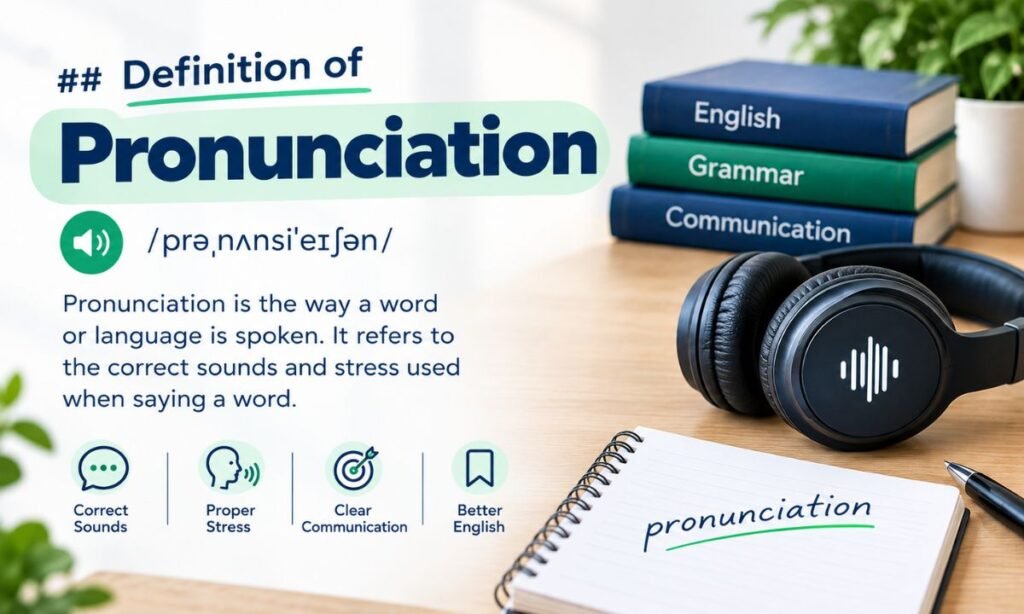
Pronunciation is a noun. It names the way a word, sound or language is spoken. Dictionaries also cover the accepted or standard way of saying a word, such as the difference between how one person says “tomato” and how another does.
Cambridge-style definitions describe it as the way in which a word or letter is said, or the way a language is spoken. In everyday use, you might talk about a student’s pronunciation, a city name’s pronunciation, or a dictionary’s pronunciation guide.
Phonetically, the word is often written /prəˌnʌnsiˈeɪʃən/. The main stress falls on the fourth syllable, “-a-.”
Key Points
- It is a noun, and it can be countable (“two pronunciations of often“) or uncountable (“her pronunciation improved”).
- It refers to sounds, stress and rhythm, not spelling or meaning.
- Common partners include correct, clear, standard, native-like and pronunciation guide.
- The related verb is pronounce, and the related adjective is pronounceable.
- Its everyday neighbours include articulation and diction, though these are not perfect matches.
Main Differences Between Pronounciation and Pronunciation
The gap is small on the page and large in credibility. Here is how the two forms compare across the details that matter.
| Point of comparison | Pronunciation | Pronounciation |
|---|---|---|
| Spelling | p-r-o-n-u-n-c-i-a-t-i-o-n | p-r-o-n-ou-n-c-i-a-t-i-o-n |
| Second syllable vowel | Short “uh” sound (like nun) | Spoken the same way, but spelled with “ou” |
| Dictionary status | Listed everywhere | Not listed as a standard word |
| Etymology | From Latin pronuntiatio | Wrongly modelled on pronounce |
| Formal writing | Correct | Marked as an error |
| Search results | Authoritative reference pages | Mostly “which is correct?” pages |
There is one more difference that most guides skip. The two related words do not share a vowel sound. The verb pronounce has the vowel from noun, while pronunciation has the vowel from nun. The spelling is trying to tell you something: different sound, different letters.
Why Do People Confuse These Words?
Several forces push the same way, and each one is understandable.
1. The verb is right there. Pronounce and pronunciation are close relatives, and most learners build the noun by adding “-ciation” to the verb. That leaves the “ou” in place. It feels like plain logic.
2. English usually keeps the root. Look at announce and announcement, or denounce and denouncement. The “ou” survives in each. Because the pattern is so common, pronunciation looks like the odd one out.
3. Speech hides the difference. In fast talk, the unstressed second syllable turns into a soft “uh.” Nobody hears an “ou” there, so the ear cannot help the spelling.
4. Sound change and analogy. One linguist explains that after English vowels shifted, a long vowel three syllables back tended to shorten. Words such as insane and insanity show the pattern, and a similar change gave pronounce and pronunciation different vowels. Over time, speakers pull some of these pairs back together by analogy, as happened with private and privacy. That same pull tempts people to say and write pronounciation.
5. Everyone else writes it. When you see a wrong spelling on a shop label or in a comment thread, it starts to feel acceptable. Repetition works on the eye.
None of this makes the writer careless. It makes the word a trap.
Historical Background of Pronunciation
The word has a long, tidy history, which is exactly why the modern spelling is stable.
Its Latin ancestor is pronuntiatio, meaning an act of speaking, delivery or public declaration. English picked it up in the early 1400s as pronunciacioun, borrowing from Old French prononciacion (13th century) and directly from Latin. The “t” from the Latin form was restored in the English word during the 1500s.
The verb followed a similar path. Pronounce entered English in the mid-1300s with the sense of declaring or proclaiming officially, and by the late 1300s it meant to speak or utter words. It comes from Old French prononcier and Latin pronuntiare, built from pro (“forth”) and nuntiare (“announce”).
Notice what that tells you. The noun’s spelling was pulled back toward the Latin root nuntiare, which explains the plain “u.” The verb, shaped by French and later English spelling habits, ended up with “ou.” The two words are cousins, not twins.
So pronounciation was never the historical form. It is a modern slip that sits beside a well-settled word.
Grammar Guide
How Each Term Is Used in Sentences
Pronounciation
Because it is a misspelling, you should not use it in your own writing. It only appears in sentences that discuss or correct the error.
- Many learners write “pronounciation” when they mean “pronunciation.”
- The teacher circled “pronounciation” and wrote the correct spelling above it.
- A search for “pronounciation” often leads to spelling guides.
Pronunciation
This is the form you use in every ordinary sentence.
- Her pronunciation of “thorough” was flawless.
- I am working on my English pronunciation every morning.
- The dictionary lists two acceptable pronunciations of the word “either.”
- Good pronunciation helps listeners follow you, even when your grammar has small errors.
- He asked for a pronunciation guide before reading the names aloud.
Grammar notes worth remembering:
- Pronunciation takes the preposition of: the pronunciation of a word.
- It can take an article: a clear pronunciation, the correct pronunciation.
- It can be plural when you mean different ways of saying something.
- Do not confuse it with pronounce, which is a verb: “How do you pronounce this?” not “How do you pronunciation this?”
Common Mistakes Learners Make
Mistake 1
Adding an “o” from the verb. Writing pronounciation is the classic error. It happens because pronounce has the “ou.” Fix: the noun drops that “o” completely.
Mistake 2
Getting the stress and syllables wrong. Many learners say something like PRO-noun-ci-A-tion, with a strong first syllable and a “noun” sound in the middle. The standard rhythm is closer to pruh-nun-see-AY-shun, with the strongest beat on “AY.” Native speakers typically use a da-DA-da-DA-da rhythm here, so practising that beat helps you sound more natural.
Mistake 3
Using the wrong word class or a look-alike. Some people write “pronounce” when they need the noun (“Her pronounce is great”), or they confuse the word with enunciation. Enunciation is about speaking each part of a word clearly. Pronunciation is about producing the right sounds and stress. They overlap, but they are not the same thing.
Simple Rules to Remember
- Rule 1: The verb is pronounce. The noun is pronunciation.
- Rule 2: Drop the “o” when the word turns into a noun.
- Rule 3: Say “there’s a nun in pronunciation.” The letters “nun” sit in the middle, not “noun.”
- Rule 4: When unsure, check a dictionary instead of trusting your ear.
- Rule 5: Read the word aloud in syllables: pro-nun-ci-a-tion.
Quick Tips for Writing and Speaking
For writing:
- Turn on spellcheck, but do not rely on it alone for names and brand words.
- Add “pronunciation” to your personal dictionary if you write about language often.
- Read the word slowly one final time before you publish.
For speaking:
- Split it into five beats and say them slowly.
- Stress the fourth syllable.
- Record yourself and compare with an online dictionary audio clip.
- Practise the sentence “My pronunciation is getting better every week.”
When to Use Each One
Use Pronunciation When
Use it whenever you mean the way a word is spoken. That includes:
- Language lessons, homework and essays.
- Emails, reports, résumés and job applications.
- Course descriptions, blogs and social media posts.
- Talking about accents, stress, sounds and speech.
- Labels such as “pronunciation guide” or “pronunciation practice.”
Use Pronounciation When
Almost never. The only fair exception is when you are writing about the mistake itself. For example:
- “Pronounciation” is one of the most searched misspellings in English.
- The student replaced “pronounciation” with “pronunciation” in her final draft.
Put it in quotation marks so the reader knows you are quoting the error and not making it.
When NOT to Use Each One
Do Not Use Pronounciation
- Do not use it in school work, exams or formal papers.
- Do not use it in business writing, where small errors can weaken trust.
- Do not use it in headlines, product names or web copy.
- Do not treat it as an acceptable variant. It is a misspelling, and readers with an eye for detail will notice.
Do Not Misuse Pronunciation
Even the correct word can go wrong. Avoid these traps:
- Do not use it as a verb. Say “I pronounce it this way,” not “I pronunciation it this way.”
- Do not use it to mean spelling. Pronunciation is about sound.
- Do not use it when you mean enunciation (speaking clearly) or accent (a regional or social speech pattern).
- Do not shorten it to “pronounce” in a noun slot. “The pronounce of this word” is wrong.
Which One to Use (Decision Guide)
Follow these steps whenever you hesitate.
- Ask what part of speech you need. If you need an action, use pronounce. If you need a thing, use pronunciation.
- Check for the “o.” If your noun has “ou” in the middle, remove it.
- Say the word in syllables. Pro-nun-ci-a-tion has five parts, and the second one rhymes with “run.”
- Read the sentence aloud. “Her pronunciation is excellent” sounds natural. If your sentence needs a verb, the noun will feel wrong.
- Confirm in a dictionary. If you cannot find your spelling there, it is not the standard form.
If you finish these steps and still see “pronounciation,” the answer is the same. Change it to pronunciation.
Real-World Practical Examples
Pronounciation Examples
These show the misspelling as it appears in the wild. They are examples of what to avoid, not sentences to copy.
- A test-prep quiz option reading “Pronounciation” beside the correct choice.
- A campus shop listing a dictionary title with the extra “o.”
- A video description saying “Old English pronounciation guide.”
- A student email: “I need help with my pronounciation.”
Every one of these should read pronunciation.
Pronunciation Examples
Here are correct uses across different settings.
Classroom:
- The teacher spent ten minutes on the pronunciation of “colonel.”
Workplace:
- Please add a pronunciation note beside each client name in the directory.
Travel:
- My pronunciation of the local place name made the driver smile.
Media:
- The presenter apologised for the incorrect pronunciation of the athlete’s name.
Learning:
- Apps that play native audio can improve your pronunciation quickly.
Dictionary work:
- The entry gives both the British and American pronunciation.
Self-Assessment (Fill in the Blanks)
Choose the correct word or spelling for each sentence: pronounce, pronunciation, pronunciations, or “misspelling” if the blank calls for that word.
- My English ________ has improved since I started reading aloud.
- How do you ________ the word “quinoa”?
- Writing “pronounciation” is a common ________.
- The dictionary gives two ________ for “schedule.”
- Please check the ________ guide before the event.
- Can you ________ his surname for me?
- Her ________ of “Worcestershire” surprised the tourists.
- In the quiz, the right spelling was ________, not the version with “ou.”
Answers
- pronunciation
- pronounce
- misspelling
- pronunciations
- pronunciation
- pronounce
- pronunciation
- pronunciation
Frequently Asked Questions
Why do people say pronounciation instead of pronunciation?
The verb pronounce has an “ou,” so people carry it over into the noun. Fast speech also hides the difference in sound.
What is the real spelling of pronunciation?
The real spelling is p-r-o-n-u-n-c-i-a-t-i-o-n, with no “o” after the “n” in the second syllable. Remember: there is a “nun” in it.
What does pronunciation mean?
It means the way a word or language is spoken, including its sounds, stress and rhythm.
Which is correct, pronounce or pronunce?
Pronounce is correct. Pronunce is a misspelling that does not exist in standard English.
Conclusion
The choice is simple even if the trap is clever. Pronunciation is the correct spelling, and pronounciation is an error that borrows the “ou” from a related verb. History supports this: the noun grew from Latin pronuntiatio and settled into its current form centuries ago.
Keep two habits and you will be safe. First, remember that the verb and the noun do not share a vowel: pronounce has “ou,” while pronunciation has the “u” of “nun.” Second, use the misspelling only inside quotation marks when you are writing about mistakes.