

You write a sentence, pause, and stare at it. “I have taken the bus” or “I have taking the bus”? Something feels off, but you can’t quite name it. That small hesitation is normal — “taken” and “taking” both come from the same root verb, yet they behave nothing alike in a sentence.
This guide breaks the confusion down piece by piece, with plain examples, comparison tables, and a short quiz at the end so you can check whether it stuck. By the time you finish reading, picking between “taken” and “taking” will feel automatic instead of guesswork.
Taken vs Taking: The Core Difference
Here’s the short answer before we go deeper.
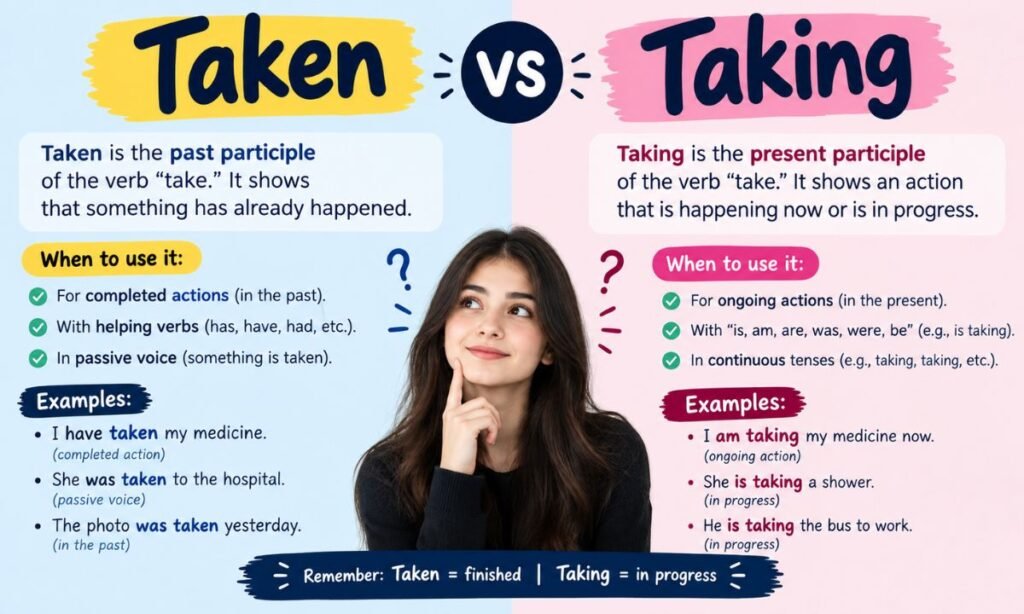
- Taking is the present participle of “take.” It shows an action that is happening right now, or it works as a noun (a gerund).
- Taken is the past participle of “take.” It shows a completed action and always needs a helping verb such as “has,” “have,” “had,” or a form of “be.”
| Word | Type | Needs a helper? | Example |
|---|---|---|---|
| Taking | Present participle / gerund | Sometimes (with “am/is/are/was/were”) | She is taking notes. |
| Taken | Past participle | Always | She has taken notes. |
The confusion usually starts because both words look like they could stand alone. Neither one can. “Taking” appears without a helper only when it acts as a noun (“Taking risks pays off”). “Taken,” on the other hand, never works alone in a sentence — it always leans on another verb for support.
Taken vs Taking Explained Clearly With Grammar Rules
To use these words correctly, you need to know one grammar fact: English verbs change shape depending on tense, and “take” has five forms in total.
- Base form: take
- Third person singular: takes
- Past tense: took
- Present participle: taking
- Past participle: taken
Only two of these — taking and taken — cause regular mix-ups, mostly because writers assume they’re interchangeable tense markers. They’re not. One marks an ongoing action; the other marks a finished one wrapped inside a larger verb phrase. Once you separate “when it’s happening” from “when it’s already done,” the rest of the grammar falls into place on its own.
Understanding the Verb “Take”
Before comparing the two forms, it helps to get comfortable with the base verb itself.
Meaning of “Take”
“Take” is one of the most flexible verbs in English. Depending on context, it can mean:
- To grab or receive something (“Take the keys.”)
- To transport someone or something (“I’ll take you home.”)
- To undergo an experience (“Take a test.”)
- To require time or effort (“This will take an hour.”)
- To accept or tolerate something (“I can’t take this heat.”)
Because “take” pairs with so many nouns — take care, take place, take part, take a break — its meaning shifts constantly. That flexibility is exactly why “taken” and “taking” show up in so many everyday phrases.
Forms of “Take”
Here’s the full conjugation table for quick reference:
| Tense/Form | Word | Example |
|---|---|---|
| Base | take | I take the train daily. |
| Present (3rd person) | takes | He takes the train daily. |
| Past simple | took | She took the train yesterday. |
| Present participle | taking | They are taking the train now. |
| Past participle | taken | We have taken the train before. |
Notice that “took” never needs a helping verb, while “taken” cannot exist without one. That single rule solves half the confusion people have with this verb.
Quick Summary of Grammatical Functions
| Function | Taking | Taken |
|---|---|---|
| Continuous tenses | ✅ (is/am/are/was/were + taking) | ❌ |
| Perfect tenses | ❌ | ✅ (has/have/had + taken) |
| Passive voice | ❌ | ✅ (is/was/were + taken) |
| Gerund (noun) | ✅ (Taking photos is fun) | ❌ |
| Adjective before a noun | Rare (a taking manner — old-fashioned) | ✅ (a taken seat) |
| Stands alone in a sentence | Only as a gerund | Never |
Taken vs Taking
Both words trace back to “take,” but they split into two very different grammatical jobs. “Taking” belongs to the present participle family, which handles ongoing action and noun-like uses. “Taken” belongs to the past participle family, which handles completed action, perfect tenses, and passive constructions.
Understanding Participles and Gerunds
A participle is a verb form that can act like an adjective or combine with helping verbs to build a tense. English has two kinds:
- Present participle (ending in -ing): describes ongoing action or modifies a noun. Example: a running tap, She is running.
- Past participle (often ending in -ed, -en, or irregular): describes completed action or a passive state. Example: a broken vase, She has broken the vase.
A gerund looks identical to a present participle (-ing form) but functions as a noun instead of a verb. “Taking” does both jobs:
- Participle: She is taking a shower. (part of the verb phrase)
- Gerund: Taking a shower relaxes me. (acts as the subject, a noun)
“Taken” only ever works as a past participle — it never becomes a gerund or a stand-alone noun.
When to Use “Taking”
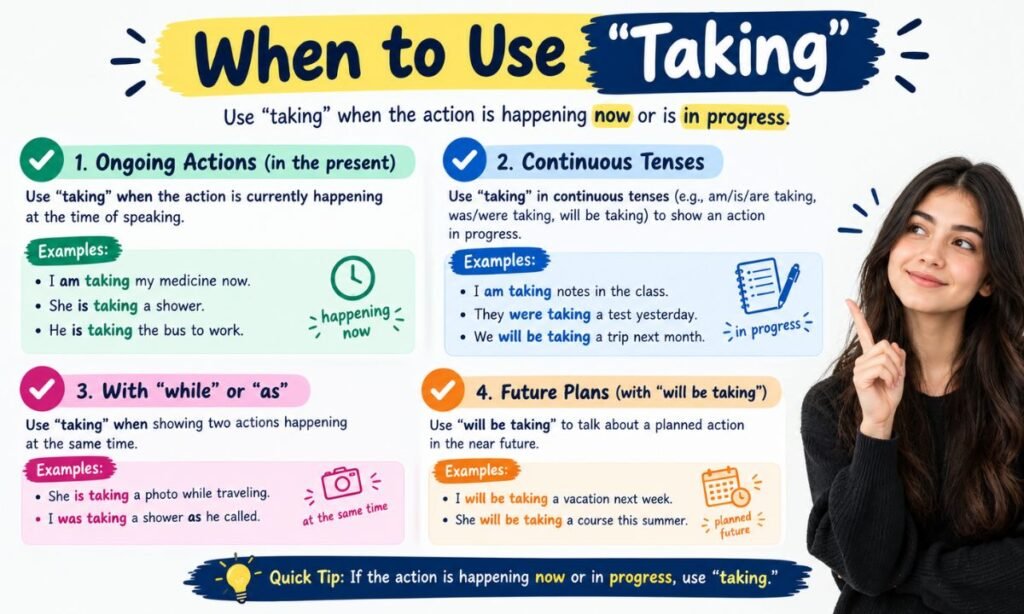
Use “taking” whenever you need to describe an action in progress or turn the verb into a noun.
“Taking” in Continuous (Progressive) Tenses
Continuous tenses always pair a form of “be” with the -ing form of the main verb.
- Present continuous: I am taking a break.
- Past continuous: We were taking photos when it started raining.
- Future continuous: She will be taking the exam next week.
- Present perfect continuous: They have been taking classes since March.
Each of these describes an action that stretches over time rather than one that’s already finished.
“Taking” as a Gerund (Noun Form)
When “taking” functions as a noun, it can serve as a subject, object, or complement in a sentence.
- Subject: Taking breaks improves focus.
- Object: I enjoy taking long walks.
- After a preposition: She’s nervous about taking the exam.
This is a common trap for learners, since a gerund looks exactly like a verb but behaves grammatically like a noun.
Common Expressions with “Taking”
- Taking care of (someone/something)
- Taking place
- Taking a chance
- Taking notes
- Taking turns
- Taking a stand
- Taking a toll on
Quick Reference Table for “Taking”
| Structure | Example |
|---|---|
| am/is/are + taking | He is taking a nap. |
| was/were + taking | They were taking a break. |
| will be + taking | I will be taking the 6 p.m. flight. |
| have/has been + taking | She has been taking piano lessons. |
| Taking + noun (gerund) | Taking risks builds confidence. |
Common Prepositions Used with Taken and Taking
Certain prepositions pair naturally with each form:
- Taken by: I was taken by surprise.
- Taken aback: He looked taken aback by the news.
- Taken with: She was taken with the idea immediately.
- Taking on: The company is taking on new staff.
- Taking up: He’s taking up painting this year.
- Taking after: She takes after her mother. (note: base form “takes,” not “taking,” in this fixed idiom)
Active vs. Passive Voice with Taken and Taking
Voice describes whether the subject performs an action or receives it.
- Active voice with “taking”: She is taking the photo. (subject performs the action)
- Active voice: Someone is taking the photo.
- Active voice, perfect aspect: Someone has taken the photo.
Passive constructions almost always rely on “taken,” never “taking,” because passive voice needs a past participle plus a form of “be.”
Common Expressions with “Taken”
- Taken aback
- Taken for granted
- Taken into account
- Taken by surprise
- Taken ill
- Taken hostage
- Taken seriously
Quick Reference Table for “Taken”
| Structure | Example |
|---|---|
| has/have + taken | We have taken every precaution. |
| had + taken | By the time I arrived, they had taken the last seat. |
| is/was + taken (passive) | The decision was taken by the board. |
| has been + taken (passive perfect) | The medicine has been taken already. |
Understanding the Verb “Take” (Recap in Context)
It helps to see “take” moving through its full life cycle in one place. A sentence like “I take the exam every year, but last year I took it twice, and this year I am taking it again — by June, I will have taken it three times in total” uses four different forms of the same verb without repeating itself awkwardly. That’s the flexibility English speakers rely on daily, often without noticing.
When to Use “Taken”
Use “taken” for anything already completed, especially inside perfect tenses or passive sentences.
“Taken” in Perfect Tenses
Perfect tenses connect a past action to a later point in time, using “has,” “have,” or “had” plus the past participle.
- Present perfect: I have taken this route before.
- Past perfect: She had taken the last train by the time we got there.
- Future perfect: By next year, he will have taken every course in the program.
“Taken” in the Passive Voice
Passive sentences shift focus from the doer of the action to the receiver of it.
- A first-time author took the award.
- We have taken all precautions.
- Someone has taken this seat.
Note that last example: “Someone has taken this seat” describes an action that has already happened and its current result. The seat is occupied now because someone took it earlier.
Common Expressions with “Taken” (Extended)
- Taken at face value
- Taken out of context
- Taken to task
- Taken under someone’s wing
- Taken advantage of
Quick Reference Table for “Taken” (Extended)
| Sentence Type | Example |
|---|---|
| Statement of fact | He has taken responsibility for the mistake. |
| Passive description | The photos were taken last summer. |
| State/result | The parking spot is already taken. |
| Formal/legal | The oath was taken in front of witnesses. |
Comparing “Taken” vs “Taking”
Common Confusions
Here are the mix-ups that show up most often in student writing and casual emails:
- ❌ “I have taking the medicine.” → ✅ “I have taken the medicine.”
- ❌ “She was taking to the hospital.” → ✅ “They took her to the hospital.”
- ❌ “He is taken photos right now.” → ✅ “He is taking photos right now.”
- ❌ “The seat is taking.” → ✅ “Someone is taking the seat.”
A simple test: if a sentence needs “has,” “have,” “had,” or “is/was/were” to describe something already finished or received, reach for “taken.” If the sentence describes something still happening, or the -ing word is acting as a noun, reach for “taking.”
Tricky Pairs Explained
| Sentence A | Sentence B | Difference |
|---|---|---|
| He is taking the blame. | He has taken the blame. | A describes it happening now; B describes it as done. |
| She is taken with the city. | She is taking a tour of the city. | “Taken with” means charmed by; “taking a tour” describes an activity. |
| The offer is being taken seriously. | They are taking the offer seriously. | Same meaning, different voice — passive vs. active. |
Real English in Action
News writing, casual conversation, and formal reports all lean on these two words constantly:
- “Investors are taking a cautious approach this quarter.”
- “The decision has already been taken.”
- “She’s taking her final exams next week.”
- “Every precaution has been taken to protect the site.”
- “He was taken aback by how quickly things changed.”
Notice how naturally native speakers switch between the two forms without thinking about grammar labels — the trick is training your ear to recognize the pattern rather than memorizing rules in isolation.
Quick Grammar Hacks to Remember
- If you can replace the word with “is/am/are/was/were” + the verb and it still makes sense as an ongoing action, use taking.
- If the sentence already needs “has/have/had” or “is/was/were” to show something finished, use taken.
- When the -ing word acts as the subject or object of a sentence (a thing rather than an action happening right now), we call it a gerund—and we still spell it taking.
- “Taken” never stands alone. If you can delete the helping verb and the sentence still works, you’ve picked the wrong word.
Common Mistakes to Avoid
- Using “taken” without any helping verb: ❌ “He taken the bus.”
- Using “taking” in a passive sentence: ❌ “The car is taking to the shop.”
- Confusing “took” (simple past, no helper needed) with “taken” (needs a helper): ❌ “I have took the exam.”
- Dropping “been” in passive perfect tenses: ❌ “It has taken care of already” → ✅ “It has been taken care of already.”
Examples Section: Taken vs Taking in Sentences
Taking:
- I’m taking my dog for a walk.
- They were taking notes during the lecture.
- Taking a nap helped her focus better.
- He’ll be taking over the project next month.
- We enjoy taking road trips in the summer.
Taken:
- She has taken the wrong turn twice.
- The tickets were taken before we arrived.
- He had taken every step to prepare.
- That seat is taken, I’m afraid.
- All measurements have been taken accurately.
Self Assessment: Test Yourself
Fill in the blank with “taken” or “taking”:
- She is _______ a photography class this year.
- By the time we got there, they had _______ all the good seats.
- He was _______ aback by her honesty.
- _______ breaks during work actually boosts productivity.
- The medicine should be _______ twice a day.
- We are _______ the train instead of driving.
- All necessary steps have been _______.
- I love _______ pictures of sunsets.
Self Assessment Answers
- taking
- taken
- taken
- Taking
- taken
- taking
- taken
- taking
Frequently Asked Questions
Is “taken” grammatically correct?
Yes, as long as it’s paired with a helping verb like “has,” “have,” “had,” or a form of “be.” On its own, without a helper, it’s incorrect.
When to use taking and taken?
Use “taking” for ongoing actions or as a noun (gerund); use “taken” for completed actions in perfect tenses or passive voice, always with a helping verb.
What is the difference between “taken” and “took”?
“Took” is the simple past tense and stands alone (“I took the bus”), while “taken” is the past participle and needs a helper (“I have taken the bus”).
What’s the difference between “taken” and “taking”?
“Taken” marks a finished action and requires a helping verb, while “taking” marks an action in progress or works as a noun on its own.
Conclusion
“Taken” and “taking” split off from the same verb but do very different work in a sentence. “Taking” lives in the present, describing what’s happening right now or naming an action as a thing in itself. “Taken” lives in the past-but-relevant, describing what’s already done, often through passive voice or perfect tenses. Once that distinction sits comfortably in your head, you’ll stop second-guessing yourself mid-sentence — and your writing will read cleaner for it.