
You’re halfway through an email. You type “the system fixed…” and then your fingers freeze. Is it its self or itself? You’ve seen both online, and now you’re second-guessing a word you’ve probably used correctly a thousand times.
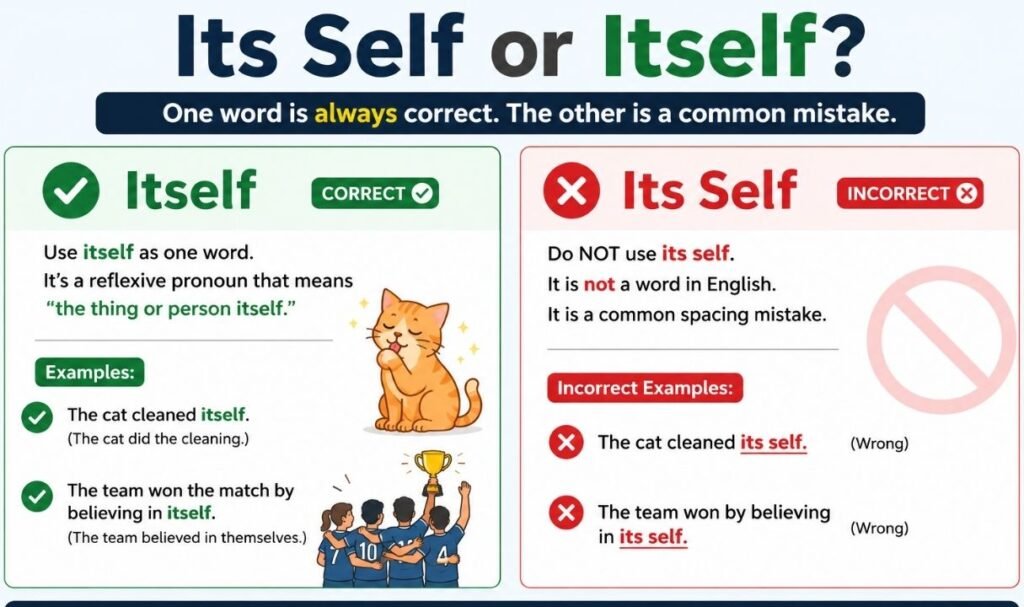
Here’s the short version: “itself” is the word you need almost every time you write. “Its self” exists, but it lives in a completely different neighborhood of English — one built for philosophy essays and identity discussions, not everyday sentences.
This guide walks through both forms, shows where each one belongs, and clears up the related “its vs. it’s” mix-up that trips up even confident writers. By the end, you’ll spot the right word without pausing.
Understanding “Its Self or Itself” — Why People Mix Them Up
The confusion starts with pattern-matching. English learners notice that “my self” became “myself,” “your self” became “yourself,” and “her self” became “herself.” So it seems logical that “its self” should follow the same path and become “itself” — which it did, centuries ago.
The problem is that once a compound reflexive pronoun forms, splitting it back into two words usually signals a mistake, not a stylistic choice. A few things fuel the mix-up:
- Visual similarity. “Its self” and “itself” differ by one space, so a quick read can miss the error.
- Autocorrect gaps. Spell checkers don’t always flag “its self” because both words are spelled correctly on their own.
- Old texts. Readers occasionally run into “its self” in older or philosophical writing and assume it’s simply an alternate spelling.
- Confidence gap with possessives. Writers already juggling “its” vs. “it’s” have less mental bandwidth left for the reflexive form.
Once you separate the grammar function from the spelling, the fog lifts fast.
What “Itself” Actually Means (And Why It’s the Standard Form)
“Itself” is a reflexive pronoun. It shows up when the subject of a sentence performs an action, and that same action lands back on the subject. No second party is involved — the thing acts, and the thing receives the action.
Consider: The washing machine cleans itself. The machine is both the doer and the one affected. That circular relationship is exactly what a reflexive pronoun signals.
Every major style guide and dictionary — Merriam-Webster, the Chicago Manual of Style, Oxford — lists “itself” as the only standard reflexive form for a non-human, non-plural subject. There’s no competing spelling in modern usage guides. If you’re writing a report, an email, a story, or a school essay, “itself” is the form to reach for.
What Are Reflexive Pronouns?
A reflexive pronoun reflects the action of a verb back onto the subject that performed it. English has a fixed set of them, one for each personal pronoun:
| Subject Pronoun | Reflexive Pronoun |
|---|---|
| I | myself |
| you | yourself / yourselves |
| he | himself |
| she | herself |
| it | itself |
| we | ourselves |
| they | themselves |
Notice the pattern: every reflexive pronoun is a single, closed compound word. None of them keep a space between the possessive and “self.” That’s the core reason “its self” looks off the moment you compare it to its cousins.
Key Features of “Itself”
A few traits define how “itself” behaves in a sentence:
- It’s always one word. No hyphen, no space, no apostrophe.
- It refers to non-human or non-personified subjects. Animals, objects, machines, ideas, companies, and abstract systems all take “itself.”
- It’s singular only. For plural subjects, English switches to “themselves.”
- It can intensify a noun. Beyond reflexive use, “itself” can add emphasis, as in “The house itself was fine, but the yard was a mess.”
- It never shows possession. That job belongs to “its,” a separate word entirely.
How “Itself” Works in Real Sentences
Everyday Usage
Daily conversation and casual writing lean on “itself” constantly, usually to describe something happening on its own or without outside help.
- The cat groomed itself in the sunlight.
- The printer jammed and then cleared itself.
- The plant seemed to water itself with the new drip system.
Formal Usage
Business writing, academic papers, and technical documentation use “itself” just as often, typically to describe automated processes or institutional behavior.
- The committee reviewed the policy itself before voting.
- The software updates itself every Sunday night.
- The organization restructured itself after the merger.
Emphatic Usage
Sometimes “itself” isn’t reflexive at all — it’s there purely to stress a point.
- The building itself survived the storm, even though the roof didn’t.
- The idea itself wasn’t bad; the timing was.
Below are some quick answers to searches people commonly run alongside this topic:
Its self or itself examples: “The engine cools itself” is correct; “the engine cools its self” is not, unless you’re discussing the engine’s identity as a philosophical subject — which almost never happens in real writing.
Its self or itself exercises: Practice by rewriting sentences with “the thing did it to the same thing” logic — if that phrase fits, “itself” is correct.
Itself in a sentence: “The company prides itself on fast shipping” shows the standard reflexive pattern in a business context.
Itself plural: There is no plural form of “itself.” When the subject is plural, use “themselves” instead — “the machines shut themselves down.”
In itself meaning: “In itself” means considered alone, apart from other factors, as in “The plan, in itself, wasn’t risky.”
Why “Its Self” Is Not Standard in Modern Grammar
“Its self” splits a fixed compound word into two separate pieces, and modern English doesn’t allow that split for reflexive use. “Self” on its own is a noun meaning identity or inner character. Pair it with the possessive “its,” and grammatically you’ve built a possessive noun phrase — not a pronoun.
That distinction matters. A possessive noun phrase describes ownership of a thing (“its self” = the self belonging to it), while a reflexive pronoun describes an action returning to its source. Most sentences that people try to write with “its self” are actually describing an action, which means they need “itself.”
Why “Its Self” Is Grammatically Wrong Today
Three reasons explain the current rule:
- Standardization. As dictionaries and grammar instruction formalized in the 18th and 19th centuries, reflexive pronouns were locked into single-word spellings.
- Function mismatch. “Its self” reads as possessive + noun, not as a pronoun, so it can’t do reflexive work in a sentence like “the system restarted its self.”
- No dictionary entry. No current dictionary lists “its self” as an accepted reflexive spelling. Only “itself” appears under pronoun entries.
When “Its Self” Does Appear (Rare but Valid Situations)
“Its self” isn’t a myth — it shows up when “self” functions as a genuine noun meaning identity, essence, or inner being, and “its” simply possesses that noun.
Examples from Philosophical, Psychological, or Religious Writing
- The consciousness became aware of its self for the first time.
- The organism, in Jungian terms, sought to integrate its self with its shadow.
- The nation seemed to lose its self during decades of conflict.
In each case, “self” is a standalone concept — something that can be discovered, lost, or examined — not a reflexive marker attached to a verb.
Historical Examples
Older English, especially before spelling was standardized in the 1600s and 1700s, used “its self” more loosely, sometimes simply as an older spelling convention rather than a deliberate philosophical choice. Texts from that period predate modern grammar rules, so seeing “its self” there doesn’t validate using it today.
Clear Examples of Correct “Its Self” Usage
| Sentence | Why “Its Self” Works Here |
|---|---|
| The brand tried to rediscover its self after the scandal. | “Self” means identity/reputation, a noun being possessed. |
| The AI model updated its self-representation. | “Self” is part of a noun phrase (self-representation), not a reflexive pronoun. |
| The culture protected its self against outside influence. | “Self” refers to cultural identity, a concept, not an action. |
If you can replace “self” with a noun like “identity” or “character” and the sentence still makes sense, “its self” is doing legitimate work. If replacing it breaks the sentence, you need “itself.”
Clearing Up a Related Confusion: “Its” vs. “It’s”
This mix-up trails right behind the “itself” question, and it trips up experienced writers just as often as beginners.
“Its” = Possessive Pronoun
“Its” shows ownership, the same way “his,” “her,” or “their” does. No apostrophe, ever.
- The dog wagged its tail.
- The company raised its prices.
- The app lost its connection.
“It’s” = Contraction
“It’s” always stands in for “it is” or “it has.” Nothing else.
- It’s raining outside. (It is raining.)
- It’s been a long week. (It has been a long week.)
Common Mistakes
- ❌ The team announced it’s new schedule. → ✅ The team announced its new schedule.
- ❌ Its going to rain later. → ✅ It’s going to rain later.
- ❌ The company updated it’s policy. → ✅ The company updated its policy.
Why “Its” Has No Apostrophe in Possession
English possessive pronouns as a group skip the apostrophe: his, hers, ours, yours, theirs, and its. Only nouns take an apostrophe to show possession (“the dog’s bone”). Because “its” is a pronoun, not a noun, it follows the pronoun rule and stays apostrophe-free. The apostrophe in “it’s” exists purely to mark missing letters in a contraction, not ownership.
Quick Tests to Avoid Errors
Three fast checks settle almost any “its / it’s / itself” question in seconds.
Substitution Test
Swap the word for “it is” or “it has.” If the sentence still makes sense, you need “it’s.” If it sounds wrong, you need “its.”
Ownership Test
Ask whether the word is showing that something belongs to “it.” If yes, use “its.”
Reflexive Test
Ask whether “it” is doing something to itself — the subject and object are the same thing. If yes, use “itself.”
Examples to Strengthen Your Grammar with “Itself”
- The heater shuts itself off after two hours.
- The story itself was gripping, even with a weak ending.
- The virus can replicate itself inside a host cell.
- The market corrected itself within a week.
- The puzzle solves itself once you find the pattern.
Practice Exercises
Choose the Right Word: Its, It’s, or Itself
- The robot vacuum cleans ___ sensors automatically.
- ___ getting late; we should head home.
- The cat curled up and licked ___ paw.
- The company changed ___ logo last year.
- The engine restarted ___ after the reset.
Answers
- its
- It’s
- itself
- its
- itself
Case Study: How One Misused Word Changed a Brand Message
A mid-sized appliance company once ran a product page describing a new dishwasher that “cleans it’s self during the wash cycle.” The line went live across dozens of retail listings before anyone caught the error. Customers didn’t just notice a typo — several left reviews questioning the company’s attention to detail, and one comment thread joked that if the copy couldn’t get pronouns right, maybe the appliance couldn’t get dishes clean either.
The fix took five minutes once flagged: “cleans itself” replaced the error everywhere. But the incident became an internal reminder that small grammar slips carry outsized weight in customer-facing copy. A single misplaced apostrophe or split pronoun can quietly undercut trust in a brand’s professionalism, even when the product itself works exactly as promised.
Expert Grammar Tip
Read the sentence aloud and ask what the word is doing: showing ownership, replacing “it is,” or sending an action back to its source. Match that function to “its,” “it’s,” or “itself,” and you’ll rarely need to guess again. When in doubt, default to “itself” — it covers the vast majority of real-world sentences, and “its self” should only surface when you’re genuinely discussing identity as a concept.
Frequently Asked Questions
How do you use itself in a sentence?
Use “itself” when the subject performs an action that returns to that same subject, as in “The oven turns itself off after an hour.”
Which is correct, himself or his self?
“Himself” is correct. “His self” follows the same outdated pattern as “its self” and isn’t standard in modern grammar.
Which is correct, their self or themselves?
“Themselves” is correct for plural subjects. “Their self” is not accepted in standard English.
Is itself one or two words?
“Itself” is always one word, with no space, hyphen, or apostrophe.