
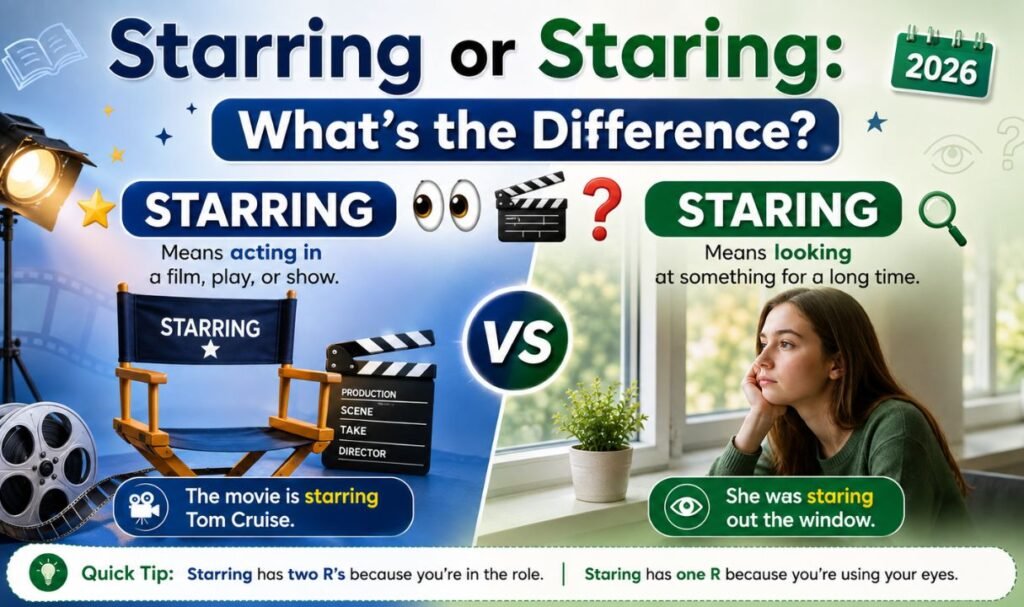

You’re texting a friend about the new Marvel movie, and autocorrect throws you a curveball. Do you type “staring Tom Holland” or “starring Tom Holland”? One letter separates two words that mean completely different things, and mixing them up is one of the most common typing slips in English.
This guide breaks down exactly when to use each word, why people confuse them, and how to remember the difference for good.
Starring
“Starring” is the word you use when someone plays a lead role in a movie, TV show, or play. It comes from the noun “star,” as in a famous performer.
Staring
“Staring” is the word you use when someone looks at a person or object for a long stretch of time, often without blinking. It comes from the verb “stare.”
Starring or Staring: Quick Answer ✅⚡
✔ Main Difference:
- Starring = acting in a lead role (movies, shows, plays)
- Staring = looking fixedly at someone or something
The words sound nearly identical when spoken, but the spelling gives away the meaning instantly. “Star” gives you starring. “Stare” gives you staring.
📌 Examples:
- The new thriller is starring Zendaya. (a lead actor)
- He kept staring at his phone during dinner. (a long, fixed look)
Starring or Staring: Definitions with Examples 📖✍️
🟢 Starring (Definition)
Starring is the present participle of the verb “star,” meaning to feature someone in a leading or headline role in a film, series, play, or advertisement. It’s the word directors, critics, and streaming platforms use when they credit a movie’s main cast.
📌 Examples:
- The film is starring two Oscar winners.
- She’s starring opposite her real-life partner in the new series.
- Netflix just released a comedy starring a comedian turned actor.
🔵 Staring (Definition)
Staring is the present participle of the verb “stare,” meaning to look steadily and intently at something, usually for longer than feels normal or polite. It can express curiosity, confusion, shock, admiration, or plain distraction.
📌 Examples:
- The toddler was staring at the fish tank for ten straight minutes.
- Stop staring at me, it’s making me uncomfortable.
- He sat staring out the window, lost in thought.
🟡 Simple Meaning
If it involves a screen credit or a cast list, it’s starring. If it involves eyes locked on something, it’s staring. That one-letter difference — the extra “r” — separates a red carpet from a blank stare.
What Does “Starring” Mean in Movies and Films? 🎬
In entertainment writing, “starring” always introduces the lead cast. A poster that reads “Starring Ryan Gosling and Margot Robbie” tells you exactly who carries the film. Reviewers, trailers, and press releases use the word constantly because it signals star power and helps audiences recognize familiar faces before they buy a ticket.
The word also shows up in casual conversation whenever someone talks about their own on-screen work, however small. A student in a school play might say, “I’m starring as the narrator this year,” and the meaning holds even outside a professional production. Scale doesn’t matter; the leading, credited role does.
Streaming platforms lean on this word heavily too. Show descriptions almost always open with something like “A gripping drama starring [actor name],” because that single word answers the first question most viewers ask: who’s in it?
You May Like: Window Seal or Sill? The Complete Guide to the Difference
The Origin of Starring or Staring 📜⏳
Starring:
The word traces back to “star,” originally used for celestial bodies and later borrowed to describe someone who shines above the rest in a field. By the 1800s, theater critics were already calling top performers “stars,” and “starring” followed naturally as the verb form describing their billing.
Staring:
“Stare” has Old English roots in “starian,” meaning to gaze fixedly. It’s one of the older verbs still used almost unchanged today, and it originally carried a sense of rigidity or fixedness, the same quality we associate with a long, unblinking look.
Both words evolved from completely separate sources, which is why native speakers can confuse the spelling but almost never confuse the underlying idea once it’s explained.
Starring or Staring: Usage Differences 🌍
Starring example: “The action film is starring a former stuntman in his first lead role.”
Staring at me: “Why does that dog keep staring at me?”
Staring in a show: This is a common mistake. The correct phrase is “starring in a show,” not “staring in a show,” unless someone is literally fixated on watching it with a blank expression.
Staring vs starring pronunciation: Both words sound almost identical in fast, casual speech, which is exactly why the spelling mix-up happens so often in texts, captions, and social posts.
Starring synonym: featuring, headlining, top-billed, leading.
Staring someone: Native speakers don’t say “staring someone” on its own; the correct form always needs a preposition, as in “staring at someone” or “staring someone down.”
📊 Comparison Table:
| Feature | Starring | Staring |
|---|---|---|
| Root word | Star | Stare |
| Meaning | Playing a lead role | Looking fixedly |
| Used in | Movies, shows, plays, ads | Everyday actions, emotions |
| Common phrase | “Starring in a film” | “Staring at someone” |
| Part of speech | Verb (gerund/participle) | Verb (gerund/participle) |
| Feels like | Recognition, spotlight | Focus, intensity |
Which Word Should You Use? 🎯📝
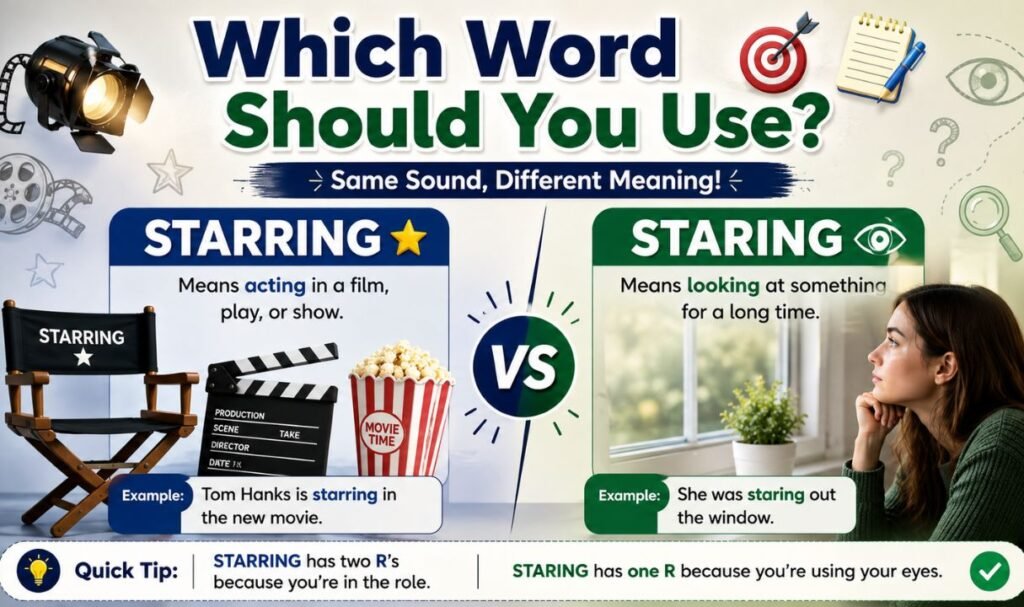
✔ Use “Starring” When:
- You’re talking about a movie, TV show, play, or commercial cast
- Someone holds the lead or a headline role
- You’re writing a film credit, poster caption, or review
✔ Use “Staring” When:
- Someone is looking at a person, object, or scene for a long time
- The look feels intense, awkward, or fixed
- You’re describing body language or a facial expression
🧠 Easy Memory Trick
Star has no “e,” and neither does starring. Stare has an “e,” and so does staring. If the sentence is about a celebrity or a screen credit, drop the “e” and double the “r.” If it’s about eyes, keep the “e” and only one “r.”
Common Mistakes with Starring or Staring ❌⚠️
1. Mixing Both Words
Writers often swap the two mid-sentence, especially when typing quickly on a phone. “She was starring at the sunset” should be “staring.”
2. Wrong Context
Using “staring” for a film credit is a frequent error: “The movie is staring Chris Evans” should read “starring.”
3. Spelling Confusion
Because both words share five identical letters, spell-checkers sometimes miss the swap entirely since both are real, correctly spelled words.
4. Ignoring Meaning
Some writers pick whichever word looks more familiar without checking the context, which leads to sentences that technically read fine but mean something completely different from what was intended.
Difference Between Staring and Starring 👀🎭
At its core, the difference comes down to eyes versus billing. Staring describes a physical action anyone can do, anywhere, without an audience or a script. Starring describes a professional credit tied to performance and recognition. One happens in silence on a park bench; the other happens under studio lights with a camera crew watching.
There’s also an emotional layer worth noting. Staring can carry discomfort — think of someone staring at a stranger on the train — while starring almost always carries a positive, celebratory tone, since it marks achievement in an actor’s or performer’s career.
Starring or Staring in Everyday Examples 💬📱
🏠 Daily Life
“My cat spends half the day staring out the window at birds.”
📱 Social Media
“New trailer dropped! Starring our favorite duo from last year’s hit show.”
📚 School
“During the assembly, half the class was caught staring at their phones instead of the stage.”
💼 Professional Use
“Our agency’s client is starring in a national ad campaign this fall.”
You May Like: Next Friday vs This Friday: The Clear Guide to Never Miss a Date Again
Starring or Staring: Usage Trends & Popularity 📊📈
Search interest for both spellings spikes around major movie releases, award season, and viral trailer drops, when fans rush to type cast credits into search bars and often type the wrong one on the first try. “Staring” tends to trend higher in everyday casual writing and text messages, simply because looking at things happens far more often than acting in a film.
📌 Trend Insight:
Autocorrect tools have gotten better at flagging the swap, but voice-to-text still mixes the two frequently, since the spoken words sound almost the same.
Comparison Table 📋⚖️
| Category | Starring | Staring |
|---|---|---|
| Grammar role | Verb form of “star” | Verb form of “stare” |
| Typical subject | Actor, performer | Person, animal, eyes |
| Emotion conveyed | Achievement, spotlight | Focus, awkwardness, wonder |
| Common error direction | Written as “staring” by mistake | Written as “starring” by mistake |
| Best used in | Entertainment writing | Descriptive, narrative writing |
Common User Queries 🔍🔥
People searching this topic usually want a fast confirmation before sending a text, finishing a caption, or fixing a school essay. The short version: check whether the sentence is about a screen credit or a fixed gaze, and the correct word follows immediately.
Frequently Asked Questions
Is it starring or staring in a movie?
It’s “starring” — a movie stars its lead actors, so the correct phrase is “starring in a movie.”
How do you spell starring as in looking?
“Looking” is spelled “staring,” not “starring” — starring refers to acting, not looking.
How do you spell staring at people?
It’s spelled “staring at people,” with one “r” and an “e” dropped from “stare” before adding “-ing.”
Is it starring or staring at me?
It’s “staring at me,” since this describes someone’s eyes fixed on you, not a film credit.
Conclusion
Starring and staring look almost like typos of each other, but they belong to entirely different situations. Starring belongs on a movie poster; staring belongs to a long, fixed look. Once you connect each word to its root — star for the spotlight, stare for the eyes — the confusion clears up for good, and you’ll never second-guess the spelling again.