
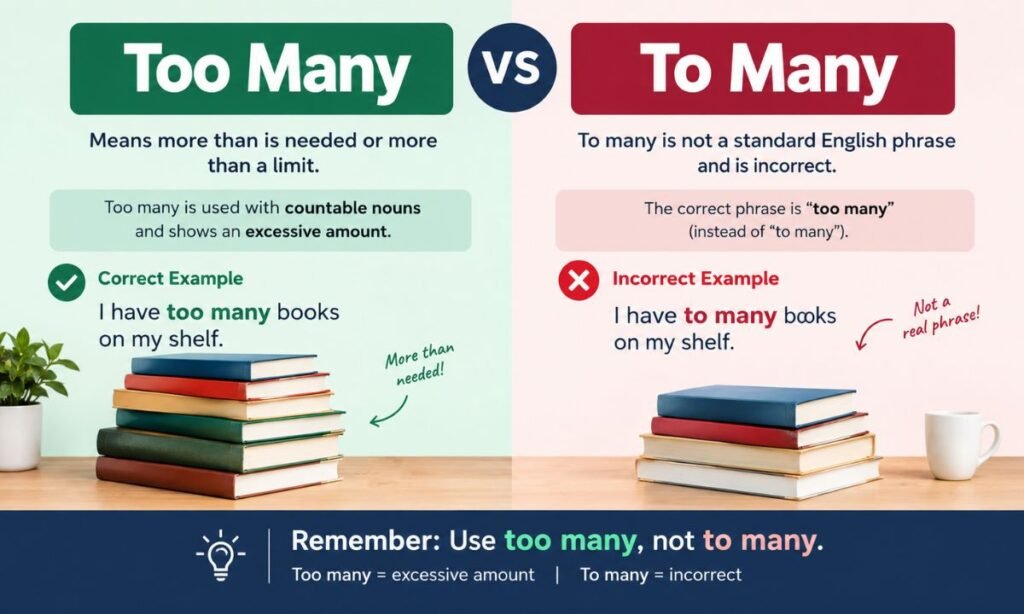

You are typing a quick message and your fingers stall. Is it “too many emails” or “to many emails”? The two spellings sound identical, so your ear is no help.
The answer is short. “Too many” is correct whenever you mean an excessive number of countable things. “To many” is not a quantity phrase at all. It appears only when the preposition “to” happens to sit next to “many,” as in “She spoke to many people.”
This guide explains the rule behind “too many” and compares it with “too much” and “too few.” It also gives you real examples, a comparison table, and a few habits that stop the mistake for good.
Too Many vs To Many
Quick answer: Use “too many” to say there are more countable things than you want, need, or can handle. Use “to many” only when “to” is a preposition and “many” comes right after it.
The two phrases at a glance
- Too many means an excessive number. Example: “There are too many tabs open.”
- To many means the preposition “to” plus “many.” Example: “That idea appeals to many students.”
The difference comes down to one word. “Too” is an adverb that adds intensity. “To” is a small connector that links a verb, noun, or pronoun to whatever follows. Swap them and the sentence either breaks or says something you never meant.
Why the two get mixed up
They are homophones, so they sound the same in speech. The only clue lives on the page, and a fast typist or an aggressive autocorrect can wipe it out. That is why the error shows up even in polished drafts.
Grammar Rule Behind “Too Many”
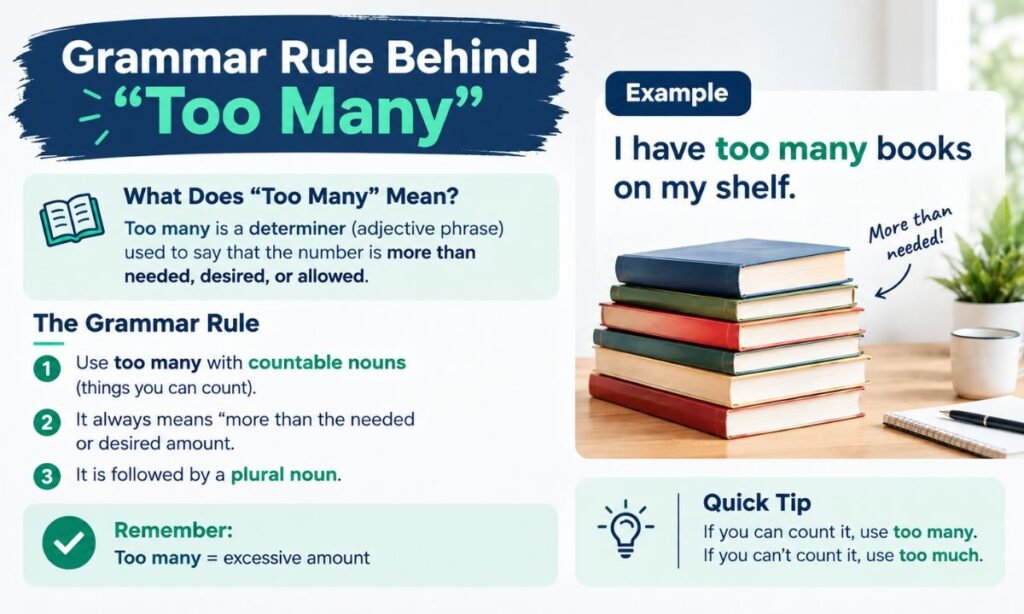
“Many” is a quantifier. It answers the question “how many?” “Too” is an adverb placed in front of it to signal excess. Together they form a unit that sits before a plural countable noun.
The formula: too many + plural countable noun
- too many books
- too many mistakes
- too many meetings
Grammar references describe “too many” as a phrase used before plural nouns to mean more than we need or more than is necessary. It also carries a negative judgment. As one English school lesson puts it, “too” signals that you are unhappy with the situation. “There are too many people” is a complaint. “There are many people” is just a fact.
Verb agreement
The noun is plural, so the verb is plural too. “Too many cooks spoil the broth” is correct. “Too many cooks spoils the broth” is not.
This holds even when the noun is dropped. Editors at TextRanch confirm that “too many” acts as a plural subject and takes a plural verb, as in “Too many make the same mistake.”
Using “too many of”
Add “of” when a determiner or pronoun follows:
- too many of the students
- too many of us
- too many of these reports
Difference Between Too Many, Too Much, and Too Few
All of these phrases judge quantity, but each one needs a specific kind of noun.
| Phrase | Works with | Meaning | Example |
|---|---|---|---|
| Too many | Plural countable nouns | More than needed | Too many chairs |
| Too much | Uncountable nouns | More than needed | Too much noise |
| Too few | Plural countable nouns | Fewer than needed | Too few volunteers |
| Too little | Uncountable nouns | Less than needed | Too little time |
| Not enough | Both types | Insufficient | Not enough chairs / not enough water |
A grammar wiki summarizes the split neatly: “too much” pairs with uncountable nouns and “too many” pairs with countable ones, and both carry a negative sense of more than is desirable.
“Too much” has one more trick. It can stand after a verb, as in “He talks too much.” “Too many” cannot do that. “He talks too many” is simply wrong, because there is no plural noun for “many” to describe.
“Too few” and “too little” are the mirror images. They warn of a shortage rather than a surplus. “Too few” counts things (“too few seats”), while “too little” measures amounts (“too little sugar”).
How to Identify Countable and Uncountable Nouns
Since the choice between “many” and “much” depends on the noun, it helps to sort nouns quickly. The British Council explains that countable nouns can be counted, like apples, while uncountable nouns such as air, rice, and water cannot.
Try these tests:
- The number test. Can you put a number in front? “Three apples” works. “Three rices” does not.
- The plural test. Does the noun have a natural plural form? “Chairs” does. “Furniture” does not.
- The question test. Would you ask “how many” or “how much”? “How many chairs?” fits. “How much furniture?” fits.
- The article test. Does “a” or “an” sound natural? “A book” does. “A information” does not.
Some nouns trip up learners because their native language treats them as countable. The British Council lists bread, rice, coffee, information, money, advice, luggage, and furniture among the uncountable ones.
| Uncountable noun | How to count it | Example |
|---|---|---|
| Advice | a piece of advice | Too much advice / too many pieces of advice |
| Furniture | an item of furniture | Too much furniture / too many items of furniture |
| Luggage | a bag, a suitcase | Too much luggage / too many suitcases |
| Bread | a loaf, a slice | Too much bread / too many loaves |
A few nouns shift category depending on meaning. “Hair” is uncountable in “too much hair,” but countable in “too many hairs in the sink.” “Coffee” is uncountable as a drink, but “too many coffees” works when you mean cups.
Common Real-Life Usage of Too Many
You will spot “too many” in everyday talk, in workplace chat, and in headlines. Here are some familiar spots:
- Work: “We have too many meetings and too few decisions.”
- Shopping: “Too many options make it hard to choose.”
- Tech: “Too many notifications ruin my focus.”
- Home life: “There are too many shoes by the door.”
It also lives inside fixed expressions:
- Too many cooks spoil the broth. Too many people in charge ruin the result.
- One too many / a few too many. A polite way to say someone drank more than they should have.
- Too many to count. Merriam-Webster labels this an idiom meaning a great many, or simply a lot, and its recent examples show news writers still using it in 2024.
- Far too many, way too many, entirely too many. Intensifiers that stack extra emphasis on the complaint.
Notice that in every one of these, “too” carries the sense of excess.
Tips to Avoid Confusing Too Many and To Many
Fixing the habit takes a few small checks rather than memorizing rules.
- Use the extra-o rule. “Too” has an extra “o,” and it means an extra amount. If you are describing excess, give the word its extra letter.
- Try adding “way” or “far.” “Way too many” and “far too many” sound natural. “Way to many” does not make sense. If the insertion works, “too” is the right spelling.
- Look for what follows “many.” If a plural noun follows, as in “too many apples,” you almost certainly want “too.” If a noun phrase with “of” follows, ask whether “to” belongs to a verb before it.
- Search your draft. Press Ctrl+F (or Cmd+F) and look for “to many.” Every hit deserves a second look.
- Read the sentence aloud with stress on “too.” Excess deserves emphasis, and your voice will tell you whether the meaning is “more than enough.”
- Slow down on autocorrect. Some keyboards change spellings without asking. Reread short messages before you send them.
What Does Too Many Mean?
“Too many” means a number of countable things that is greater than you need, want, or can accept. It always contains a judgment. Someone thinks the amount is a problem.
Business Writing Blog describes it as something disproportionate, excessive, or exhausting, more than you wanted or more than you can handle. That covers everything from an overloaded inbox to a crowded elevator.
A quick way to test the meaning: replace “too many” with “an excessive number of.” If the sentence still makes sense, you have used it correctly.
Should I Write To Many or Too Many?
Ask yourself one question: am I describing an excessive number of things?
- If yes, write too many.
- If no, and “to” is linking a verb, noun, or pronoun to a group, write to many.
Compare these pairs:
- “She gave the credit to many people.” (She gave it toward a large group.)
- “She gave the credit to too many people.” (The group was larger than it should have been.)
The second sentence uses both words correctly in a row, which shows how different their jobs are.
A special case: “Here’s to many more years”
Toasts confuse people. In “Here’s to many more years,” the word is “to” because the phrase means “let us drink to” the years ahead. It is a wish. “Too many more years” would be a complaint about how long something is lasting. So “cheers to many more years” is correct, and it is one of the few everyday places where “to many” is exactly right.
Too Many Sentence Examples
Everyday life
- I bought too many apples, so I’m making a pie.
- There are too many cars on the road during rush hour.
- She ate too many cookies and felt sick.
- We have too many plants and nowhere to put them.
Work and school
- The report has too many slides for a ten-minute talk.
- Too many people are copied on this email thread.
- He asked too many questions before anyone could answer the first one.
- Our team is juggling too many priorities at once.
Formal and general writing
- Too many young graduates struggle to find work in their field.
- The committee received too many applications to review individually.
- Too many drafts can slow a project down.
- Even one mistake is too many in a medical setting.
To Many Sentence Examples (Why They’re Wrong)
The following sentences use “to many” where an excess is meant. Each one is a spelling error, not a matter of style.
| Incorrect | Correct | Why it’s wrong |
|---|---|---|
| There are to many people in the room. | There are too many people in the room. | Excess needs the adverb “too.” |
| I have to many emails to answer. | I have too many emails to answer. | “To” cannot express excess. |
| She made to many mistakes. | She made too many mistakes. | “Too many” describes the mistakes. |
| We ordered to many pizzas. | We ordered too many pizzas. | “To” adds no meaning of excess. |
| Are there to many chairs? | Are there too many chairs? | Questions still need “too.” |
When “to many” really is correct
The phrase is legitimate when “to” is a preposition. Business Writing Blog notes that “to many” is used as a preposition, often to introduce a common thought or opinion. Here are some valid examples:
- It is obvious to many of us that the deadline is unrealistic.
- The offer was open to many applicants.
- She wrote letters to many friends abroad.
- To many, the answer seemed simple.
In each sentence, remove “to” and the meaning falls apart, because “to” links something to the group that follows.
Comparison Table: Too Many vs To Many
| Feature | Too many | To many |
|---|---|---|
| Part of speech | Adverb + quantifier | Preposition + quantifier |
| Meaning | An excessive number | Toward or directed at a large group |
| Followed by | Plural countable noun | A noun phrase or “of” phrase |
| Sense | Negative or critical | Neutral |
| Frequency | Very common | Uncommon |
| Example | Too many rules confuse people. | The rules matter to many people. |
| Safe to use as a quantity phrase? | Yes | No |
Common Grammar Mistakes Learners Make
Even advanced writers slip in predictable ways:
- Writing “to many” for excess. This is the main error covered here. Adding the extra “o” fixes it.
- Using “too many” with uncountable nouns. “Too many information” is wrong. Say “too much information.”
- Using “too much” with plural nouns. “Too much words” is wrong. TextRanch’s editors point out that “too many” goes with countable items like words, while “too much” goes with uncountable ones.
- Treating “too” like “very.” “Very many” simply means a lot. “Too many” means more than acceptable. They are not interchangeable.
- Using “too many” as a compliment. “I have too many great friends” sounds odd unless the speaker is playfully complaining.
- Mixing up verb agreement. “Too many is causing problems” should be “Too many are causing problems.”
- Forgetting “of” before pronouns. “Too many us” is wrong. It should be “too many of us.”
- Dropping the noun where it is needed. “There are too many” can stand alone in speech, but in writing readers may want to know what is in excess.
Linguistic Insight: Why This Confusion Happens
English has many sets of words that sound alike but split into different spellings. “To,” “too,” and “two” are probably the most famous set.
The reason goes back centuries. Etymology sources trace “too” to the same Old English word as the preposition “to.” In early English, one form covered both jobs. Over time, writers began using a doubled “o” to separate the meaning of “also” or “excessively” from the plain connector. The split spelling is a written convenience, and it never changed how the words sound.
That history explains why the mistake feels natural. In fast speech, the two words often reduce to the same weak syllable. Only spelling separates them, so the error lives in typing, not talking. Add phone keyboards and predictive text, and “to many” slips through more often than any of us would like.
A second factor is frequency. “To” is one of the most common words in English. Writers type it thousands of times, so the fingers can produce it without a thought, even when the brain wanted “too.”
Expert Opinion on Correct Usage
Dictionaries, grammar references, and ESL teaching sources all agree on the core rule: “too many” is the only accepted way to express excess with a countable noun. No major style reference treats “to many” as an acceptable variant for that meaning.
What varies is tone. In formal writing, “too many” is often paired with a specific figure or example, because vague complaints weaken an argument. In casual writing, intensifiers such as “way too many” are common and perfectly fine.
Anyone who proofreads for a living will tell you that this error sits high on the list of frequent typos. It rarely appears because the writer does not know the rule. It appears because the writer stopped checking. For that reason, a slow final read is worth more than any memorized rule.
If you teach or edit, one habit pays off: ask the writer to say what the noun is. Once someone identifies the noun as plural and countable, the “many” and “too” choices tend to fall into place.
Wrapping Up: Should I Use Too Many or To Many?
Use too many when you are describing an excessive number of countable things. It is the correct choice in nearly every sentence where you mean “more than enough.”
Use to many only when “to” is a preposition that connects a verb, noun, or pronoun to a large group, as in “It matters to many people” or “Here’s to many more years.”
Keep the extra-o rule in mind, add a quick “way” test when you are unsure, and reread short messages before you hit send. The mistake is small, but fixing it makes your writing look far more careful.
Frequently Asked Questions
Which is correct to many or too many?
“Too many” is correct when you mean an excessive number of things. “To many” is correct only when “to” is a preposition, as in “She spoke to many people.”
Which is correct: “to many more years” or “too many”?
In a toast, “Here’s to many more years” is correct because “to” is a preposition. “Too many more years” means an unwanted excess.
Do you say too many people or to many people?
Say “too many people” for an excessive crowd. Write “to many people” only when “to” links a verb to the group, as in “He explained the plan to many people.”
What does too many mean?
“Too many” means more countable things than you need, want, or can handle. It always carries a mild complaint.