


You are drafting a job ad, a client email, or a note to a contractor, and you stop mid-sentence. Is it “onsite support” or “on site support”? Or “on-site support”? All three look fine, and at least one probably has a red squiggle under it.
Short answer: all three spellings point to the same idea, something happening at the place where the work or event is located. The grammar differs slightly. “On site” (two words) is a phrase that works best after a verb or noun. “Onsite” (one word) and “on-site” (hyphenated) work as modifiers, and the hyphenated “on-site” is the safest choice for formal writing. Whatever you pick, stay consistent within a document.
This guide breaks down each form, shows where dictionaries disagree, and gives you simple rules you can apply in seconds.
Comparison Overview
Here is the quick version before we go deeper.
- Onsite is a one-word modifier. It is common in business, IT, and hiring language.
- On-site is the hyphenated modifier. It is the form most style-conscious writers prefer.
- On site is a two-word phrase that simply states where something is.
Think of it this way: “onsite” and “on-site” describe things (“onsite training”), while “on site” locates things (“the trainer is on site”). The lines blur because English is flexible, and the sections below explain where the blur is safe and where it isn’t.
Definition of Onsite
“Onsite” is the closed, one-word spelling. It works as an adjective (“an onsite technician”) and as an adverb (“she works onsite”).
Cambridge Dictionary lists “onsite” as one word for both the adjective and adverb forms. That gives the spelling real dictionary backing, especially in British and international usage.
Merriam-Webster is a different story. Its entry sits under the hyphenated spelling, defining it as at a particular place, especially of business. One Australian writing centre goes further and notes that Merriam-Webster does not recognise “onsite” as a word.
So “onsite” is not an error. It is a variant that some references list and others skip. Job boards and tech companies lean on it heavily, which is why you see it in phrases like “onsite interview” and “onsite support.”
Definition of On Site
“On site” is two separate words: the preposition on plus the noun site. It is not a compound word. It is a prepositional phrase that tells the reader where someone or something is.
Because it is a phrase, it usually appears after the thing it describes:
- The inspector is on site.
- We keep spare parts on site.
- Please stay on site until the shift ends.
Notice that none of these sentences puts the phrase in front of a noun. That is the giveaway. When “on site” follows a verb like is, stay, or remain, or trails a noun as a plain location, the two-word form fits naturally.
One useful side note: the hyphenated “on-site” has a surprisingly specific history. One source traces it to the middle of the 20th century, apparently from Cold War “on-site inspections” in the military sense. Today it applies to any location.
Main Differences Between Onsite and On Site
The two forms overlap in meaning, but they differ in structure. Here are the differences that matter in practice.
- Grammatical role. “Onsite” modifies a noun or verb. “On site” is a preposition plus a noun.
- Position in a sentence. “Onsite” usually comes before a noun (“onsite parking”). “On site” usually comes after a verb or noun (“parking is on site”).
- Formality. “On-site” (hyphenated) reads as the most polished. “Onsite” feels a bit more modern and casual. “On site” is neutral.
- Dictionary support. Cambridge lists “onsite.” Merriam-Webster lists “on-site.” Neither treats the two-word form as its own entry, because it is just a normal phrase.
- Clarity. The hyphen in “on-site” helps the eye group the two words as one idea, which matters in a long sentence.
None of this makes one spelling wrong in every context. It just means each has a home where it fits best.
Why This Confusion Happens
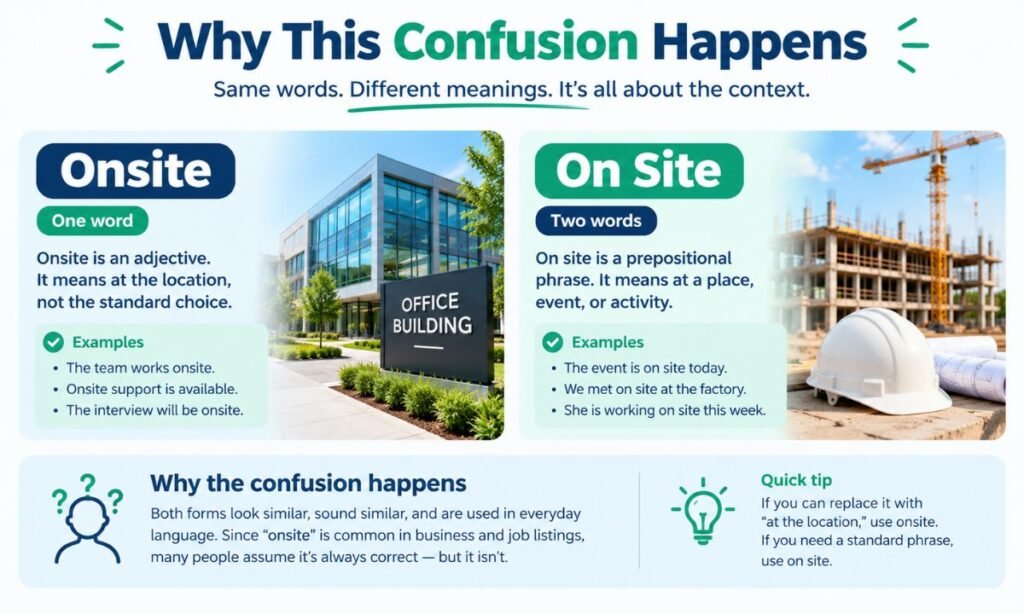
Several things push people back and forth on this one.
English keeps merging words. Many compounds start as two words, pass through a hyphenated stage, and end up as one. “On-line” became “online” this way. Writers see “onsite” as the next step in that trend, and they may be right. One writing blog points out that “bumble-bee” and “ice-cream” once carried hyphens and now look strange.
References disagree. Look up the word in three places and you may get three answers. One roundup notes that Merriam-Webster lists on-site, Cambridge accepts both onsite and on-site, and the American Heritage dictionary lists only onsite. When the authorities split, writers guess.
Regional habits differ. The hyphenated form is more popular globally than the one-word form, and the gap is much wider in the UK than in the US. So a British editor and an American marketer may correct each other in opposite directions.
Spellcheck is no help. Most word processors accept both, so nothing flags the inconsistency.
Workplace language changed. Since hybrid and remote work became normal, people label roles and events as onsite, remote, or hybrid all the time. The word gets typed constantly, often in a hurry.
Finally, there are the look-alikes. “On sight” (as in “shoot on sight”) is a different phrase entirely. And “in site” is not standard English at all, as one editing service puts it.
Comparison Table with Sentence Examples
| Form | Part of speech | Usual position | Formality | Example sentence |
|---|---|---|---|---|
| Onsite | Adjective or adverb | Before a noun, or after a verb | Informal to neutral | We offer onsite training for new hires. |
| On-site | Adjective or adverb | Before a noun, or after a verb | Formal to neutral | The on-site nurse handles minor injuries. |
| On site | Preposition + noun | After a verb or noun | Neutral | The nurse is on site until 6 p.m. |
| On site (as adverbial) | Adverbial phrase | After a verb | Neutral | Our engineers work on site every Tuesday. |
A quick pattern: if a noun follows directly, choose the one-word or hyphenated form. If the phrase ends the clause, the two-word form is usually the cleanest.
Grammar Guide
How Each Term Is Used in Sentences
As an adjective (before a noun). Use “onsite” or “on-site.”
- The hotel has an on-site restaurant.
- Onsite childcare is a major perk at our office.
As an adverb (after a verb). All three can appear, though some editors prefer one.
- The team will work onsite next week.
- The team will work on-site next week.
- The team will work on site next week.
As a predicate phrase (after “be”). The two-word form is the natural choice.
- The manager is on site.
- Are the auditors on site yet?
Merriam-Webster’s live entry shows the adjective use well. Its current examples, refreshed in mid-September 2026, include a report on on-site energy generation projects across heavy industry and a travel piece praising a hotel’s on-site boutique. The hyphenated form is still going strong in professional journalism.
Common Mistakes Learners Make
Here are the slips I see most often when editing business copy.
- Mixing forms in one document. A report that says “onsite” on page one and “on-site” on page four looks careless. Pick one.
- Dropping the hyphen or space in a modifier. Writing “on site support” before a noun leaves the reader to guess the grouping. Say “on-site support” or “onsite support.”
- Confusing site with sight. “On sight” means the moment someone sees something, as in “the guard will arrest trespassers on sight.” It has nothing to do with location.
- Writing “in site.” This is not standard. The correct phrase is “on site.”
- Forgetting the opposite. If you write “on-site,” pair it with “off-site.” Writing “on-site” and “offsite” in the same paragraph looks inconsistent.
- Assuming the two-word form is always wrong. It isn’t. “The crew is on site” is perfectly good English.
Simple Rules to Remember
- Noun coming next? Use on-site or onsite.
- Location at the end of the sentence? Use on site.
- Formal document? Use on-site.
- Company style guide says otherwise? Follow the guide.
- Whatever you choose, use it the same way every time.
Quick Tips for Writing and Speaking
Spoken English has no hyphens, so the whole issue disappears out loud. Nobody hears the difference between “onsite” and “on site.”
For writing, a few habits help:
- Set your spellcheck or style sheet to one preferred form.
- Search your finished draft for “site” and check every hit.
- Read the sentence aloud. If “on site” comes right before a noun, add the hyphen.
- Match your off-site spelling to your on-site spelling.
If you write for a publication, ask which dictionary the editors follow. Chicago-style shops and newsroom desks often have a written preference, and it beats general advice every time.
When to Use Each One
1. Use “onsite” when:
- You write for a tech, HR, or marketing audience that already uses the one-word form.
- Your company brand or job template uses it.
- You are writing informally, such as a chat message or quick email.
2. Use “on-site” when:
- You write reports, contracts, proposals, or academic papers.
- You want the clearest reading of a compound modifier.
- Your style guide follows Merriam-Webster, Oxford, or Chicago. One source states that these references treat on-site as the correct spelling regardless of its role in the sentence.
3. Use “on site” when:
- The phrase follows the verb “be” or another linking verb.
- You are giving a plain location at the end of a clause.
- You want a neutral spelling nobody will question.
When NOT to Use Each One
1. Avoid “onsite” when:
- A formal editor or publisher has told you to use the hyphenated form.
- You are writing for an audience that uses Merriam-Webster as its standard.
- Another form of the word already appears in the same document.
2. Avoid “on-site” when:
- Your brand guidelines specifically call for “onsite.”
- You are copying text from a source that uses another spelling, and consistency matters more than preference.
3. Avoid “on site” when:
- The words sit directly before a noun and act as a modifier (“on site inspection” should be “on-site inspection”).
- You mean “at first glance.” That is “on sight,” a different phrase.
Which One to Use (Decision Guide)
Run through these questions in order.
- Does a noun come right after the phrase? If yes, choose “on-site” (formal) or “onsite” (casual). If no, go to step 2.
- Does the phrase follow “is,” “are,” “was,” or a similar verb? If yes, use “on site.”
- Does it follow an action verb like “work” or “train”? Any form is acceptable. Pick “on-site” for formal writing or “on site” for a plain, neutral tone.
- Does your employer, client, or publisher have a style guide? Follow it.
- Have you used another form earlier in the piece? Match it.
Quick answer: use “on-site” before a noun in formal writing, “onsite” in casual business copy, and “on site” after a verb or noun.
Real World Practical Examples
Onsite Examples
These show the one-word form in the settings where it usually appears.
- Our onsite technician will replace the router this afternoon.
- The candidate was invited to an onsite interview on Friday.
- Onsite parking is free for all conference attendees.
- We run onsite safety checks before every shift.
- She prefers to work onsite because the office has faster internet.
- The vendor offers onsite installation and a one-year warranty.
The last example shows how the word often appears in service contracts and product descriptions.
On Site Examples
Here the two-word phrase does its usual job of stating where something is.
- The site manager is on site every morning by seven.
- All building materials are stored on site.
- Please remain on site until the fire drill ends.
- Is the client already on site, or are they joining online?
- The documents you need are on site, so I will scan them for you.
- Medical staff will be on site throughout the festival.
Note the difference: in each sentence, “on site” answers the question “where?” and ends the thought.
Self Assessment (Fill in the Blanks)
Choose the best option from the brackets. Assume a formal business context unless the sentence suggests otherwise.
- The contractor will provide ______ training for the whole department. (on-site / on site)
- The engineer is already ______. (on-site / on site)
- Our building has an ______ gym and a small cafe. (onsite / on site)
- Please leave your bags ______ until the meeting ends. (on site / on sight)
- The guard was told to remove intruders ______. (on site / on sight)
- We store all backups ______ and at a second location. (on site / in site)
- The ______ inspection is scheduled for Monday. (on-site / on site)
- She prefers working ______ rather than from home. (onsite / on sight)
Answers
- on-site. A noun (“training”) follows, so use the modifier.
- on site. The phrase follows “is” and states a location.
- onsite. Also correct as “on-site.” The two-word form does not work before a noun.
- on site. You are stating where the bags stay.
- on sight. The order is to act the moment intruders are seen.
- on site. “In site” is not standard English.
- on-site. The word “inspection” follows, so the hyphenated modifier is right.
- onsite. It works as an adverb after “working.” “On-site” and “on site” would also be acceptable, but “on sight” is not.
Frequently Asked Questions
Is onsite one word or two words?
Both exist. “Onsite” is one word (a modifier), and “on site” is a two-word phrase. The hyphenated “on-site” is a third accepted form.
Is it working onsite or on site?
Either can work. “Working onsite” or “working on-site” treats it as an adverb, and “working on site” treats it as a phrase. Choose the hyphenated form for formal writing.
Are you onsite or on site?
“Are you on site?” is the safest version because the phrase follows a linking verb. Some sources accept “onsite” here too.
What does “onsite” mean?
It means located at or happening at the place where the work or event takes place, rather than remotely or elsewhere.
Conclusion
The difference between “onsite” and “on site” comes down to grammar, style, and habit. “Onsite” and “on-site” are modifiers that describe nouns or actions. “On site” is a plain phrase that states where something is. Dictionaries and style guides split on which modifier spelling is best, so no single answer covers every situation.
Your safest path is simple. Use “on-site” for formal writing before a noun, “on site” after a verb, and “onsite” only where your audience or brand already uses it. Then stay consistent from the first paragraph to the last. Readers rarely notice which spelling you picked, but they do notice when you switch.