
Your manager asks for the annual report. In other side your dentist books a yearly checkup. Your cousin says the family gathers at the lake every year. The frequency is identical, yet the wording changes each time, and most of us never wonder why.
The choice does matter, a little. All three describe something that happens once per year. They differ in tone, grammar and the kind of sentence where they sound right. This guide explains each one in plain English, with examples, comparison tables and quick rules you can apply today. I also looked at how the current top-ranking guides treat the topic, so the article covers the questions readers actually ask, including the confusing relatives like biannual and triannual.
Annual vs Yearly vs Every Year
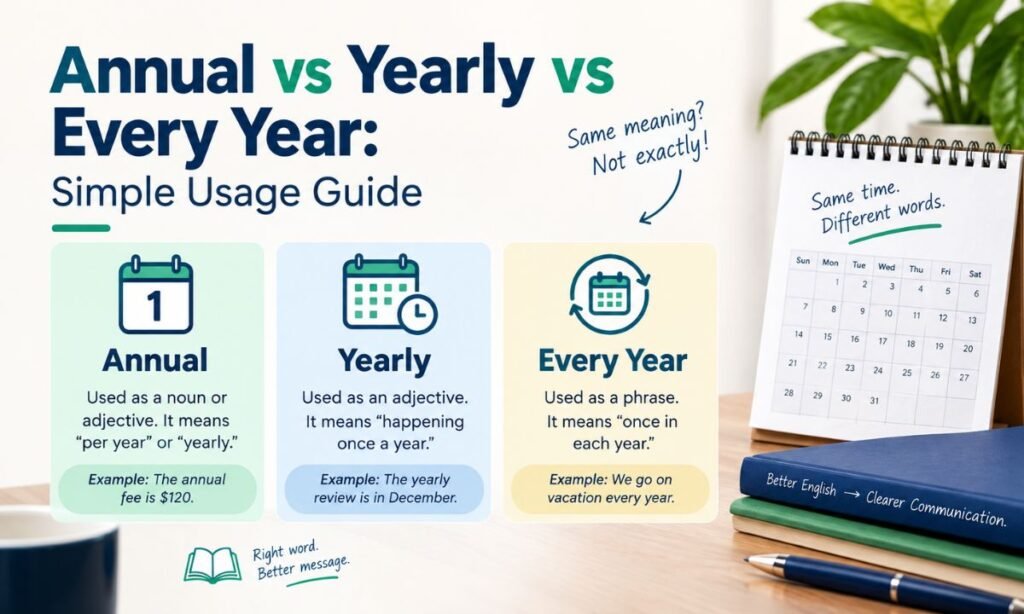
Short answer: all three mean “once a year.” The difference is style and grammar, not meaning.
- Annual is the formal adjective. Use it before a noun in professional, academic or official writing: annual report, annual review.
- Yearly is the flexible middle option. It works as an adjective and as an adverb, and it suits most everyday writing.
- Every year is the conversational phrase. It sounds natural in speech, stories and personal messages.
Current guides tend to agree that annual is the most formal, yearly is neutral, and every year feels friendly and conversational. Since the core meaning is shared, the smart move is to choose by audience and setting rather than by definition.
Why These Three Terms Confuse So Many People
Nobody gets confused about what the words mean. The trouble comes from everything around the meaning.
First, the three overlap almost completely. Swap one for another and the sentence still communicates. That makes it hard to feel where the boundary sits.
Second, they belong to different grammatical categories. “Annual” is an adjective. “Yearly” is both an adjective and an adverb. “Every year” is a phrase that behaves like an adverb. A sentence that works with one may break with another.
Third, the words have different backgrounds. Annual carries a Latin flavor, while yearly feels plainer and rooted in English. The Latin root is annus, meaning year, which is why “annual” shows up in legal and financial vocabulary so often.
Fourth, there is a crowd of look-alikes nearby: annually, biannual, biennial, semiannual, triannual, triennial. Once those enter the picture, even confident writers second-guess themselves.
What Does “Annual” Mean?
“Annual” describes something that happens once every year or that relates to a single year. It is almost always placed directly before a noun.
Common pairings:
- annual report
- annual general meeting (AGM)
- annual leave
- annual percentage rate (APR)
- annual fee
- annual performance review
- annual conference
Notice that many of these belong to business, finance and HR. That is where “annual” feels most at home.
The word has a second job that people often forget. It can describe a quantity measured across twelve months, even if nothing “recurs.” An annual salary of $72,000 is the total for a year, not an event that returns on schedule. Likewise, annual rainfall is the amount that falls in a year.
“Annual” also works as a noun. A gardener talks about annuals, plants that finish their life cycle in one growing season. Publishers use it too: comic book annuals began as reprint collections and later moved toward all-new stories, treated as special once-a-year publications. Schools have their own version, the yearbook.
One caution: “annual” cannot stand on its own as an adverb. “The board meets annual” is wrong. You need “annually,” which we will cover shortly.
What Does “Yearly” Mean?
“Yearly” also means once a year, but it sounds less stiff. Dictionaries list it as both an adjective and an adverb, which gives it more freedom than “annual.”
As an adjective:
- The company offers a yearly bonus.
- She books a yearly physical.
As an adverb:
- The lease renews yearly.
- Prices are reviewed yearly.
Yearly can serve as either an adverb or an adjective, whereas annual is strictly an adjective. That flexibility is the main reason many writers reach for it. You do not have to reshuffle a sentence to make it fit.
In tone, “yearly” lands between formal and casual. It shows up on subscription pages (“Choose monthly or yearly billing”), in personal finance, in health reminders and in everyday reporting. It rarely feels out of place, though in a legal contract or an academic paper “annual” usually looks more polished.
What Does “Every Year” Mean?
“Every year” is a plain two-word phrase, not a single word. It means the same as the others, but it puts the spotlight on repetition. Something comes back, and it keeps coming back.
That is why it fits stories and memories so well:
- We drive to the coast every year.
- Every year, the first snow makes my dad grumpy.
Grammatically, “every year” is a noun phrase doing adverb duty. It tells you when something happens. It moves around easily: at the start of a sentence (with a comma), at the end, or after the verb.
What it cannot do is sit before a noun the way an adjective does. “Our every year picnic” sounds wrong. You would say “our annual picnic” or “our yearly picnic,” or rephrase: “the picnic we hold every year.”
Comparing Annual, Yearly, and Every Year
A side-by-side look makes the differences concrete.
| Feature | Annual | Yearly | Every year |
|---|---|---|---|
| Grammatical role | Adjective (and sometimes a noun) | Adjective and adverb | Adverbial phrase |
| Formality | High | Medium | Low to medium |
| Sits before a noun? | Yes | Yes | No |
| Works as an adverb? | No (use annually) | Yes | Yes |
| Typical setting | Reports, contracts, academic writing | General writing, billing, health | Conversation, storytelling, blogs |
| Example | The annual audit begins in March. | The fee is charged yearly. | We repaint the fence every year. |
| Emotional tone | Official, structured | Neutral, practical | Warm, personal |
A quick way to remember it: annual is dressed for the office, yearly is business casual, and every year is in jeans.
Real-World Examples and Contexts
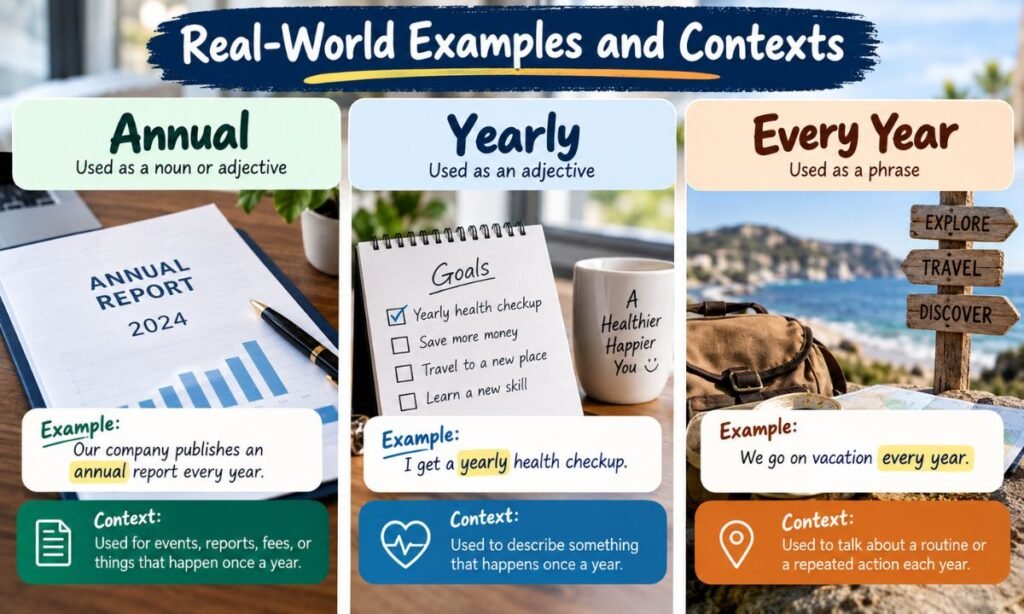
Seeing the words in action helps more than any rule. Each set below shows where the term feels most natural.
Using “Annual” in Sentences
- The nonprofit released its annual report in June.
- Employees receive 25 days of annual leave.
- The annual percentage rate on the card is 21.9%.
- She presented her findings at the annual conference in Lisbon.
- Every department must complete an annual risk assessment.
- The town’s annual harvest fair draws visitors from three counties.
Most of these could be swapped with “yearly” without breaking anything. But the first four would sound slightly less official if you did.
Using “Yearly” in Sentences
- The gym gives a discount if you pay yearly.
- My brother gets a yearly flu shot, no exceptions.
- The software license renews yearly unless you cancel.
- Property taxes are assessed yearly in our county.
- He sets a yearly reading goal and usually beats it.
Look at how often “yearly” sits after the verb. That is the adverb use, and it is where “annual” cannot follow.
Using “Every Year” in Sentences
- Every year, we forget where we stored the holiday lights.
- They visit her grandmother in Lahore every year.
- The river floods every year around late July.
- I promise to call you every year on your birthday.
- Every year the team says this is the one, and every year the season ends in April.
These sentences carry a story feel. The phrase invites the reader to picture the cycle repeating.
Common Variations and Confusions
“Annual” vs “Annually”
This is the most frequent slip. One word describes a noun, and the other describes an action.
- Annual (adjective): The annual audit is complete.
- Annually (adverb): The audit is conducted annually.
A handy contrast: “The annual interest rate is 5%” uses the adjective, while “Interest compounds annually” uses the adverb.
Test yourself with a simple check. Can you place the word directly before a noun? Then you want “annual.” Is it modifying a verb? Then you want “annually.”
Also watch for redundancy. “An annual event that happens every year” says the same thing twice. Trim it to “an annual event.”
“Every Year” vs “Each Year”
Both work, and in most sentences they are interchangeable. The subtle difference is one of perspective.
“Each” treats members of a group as separate individuals, while “every” sees the group as a series. Apply that to time and you get a small shift:
- Each year, the committee picks one winner. (Focus on the individual year and its own decision.)
- Every year, the committee picks one winner. (Focus on the unbroken pattern.)
Honestly, most readers will never notice. “Each year” tends to appear a bit more in written, structured prose, while “every year” leans spoken. If your sentence needs to sound crisp and slightly formal without the word “annual,” “each year” is a solid substitute.
Related frequency words that trip people up. Once you are comfortable with the big three, the neighbors are worth a quick look:
| Term | Usual meaning | Note |
|---|---|---|
| Semiannual | Twice a year, about six months apart | Clear and safe |
| Biannual | Twice a year (sometimes read as every two years) | Some sources define biannual as twice a year and others as every two years, so it invites mistakes. |
| Biennial | Every two years | Distinct from biannual |
| Triannual | Three times a year | Dictionaries note it can also be read as every three years, so plain wording is the safest choice. |
| Triennial | Every three years | Often confused with triannual |
| Quarterly | Four times a year | Common in finance |
When precision matters, skip the prefix and write “twice a year,” “every two years,” or “every four months.” Nobody will misread those.
Choosing the Right Word: Practical Usage Tips
You do not need to memorize grammar tables. A few working habits will carry you.
- Ask who is reading. A regulator, a client or a professor expects “annual.” A friend or a blog audience expects “every year.”
- Check the sentence position. If the word must sit before a noun, pick “annual” or “yearly.” If it follows the verb, pick “yearly,” “annually” or “every year.”
- Match the surrounding tone. A stiff sentence with a casual phrase looks mismatched. So does the reverse. “The Company shall remit payment every year” reads oddly in a contract, and “Join our annual pizza night!” feels overdressed on a party invite.
- Stay consistent inside one document. Switching between “yearly” and “annual” for the same idea within a page can make readers wonder whether you mean two different things.
- Cut the doubling. “Annual yearly review” and “annually each year” both say the idea twice.
- When in doubt, use “yearly.” It rarely draws attention in either direction.
- Spell out awkward frequencies. For anything other than once a year, plain phrases win.
Case Study: Business vs Everyday Communication
The clearest way to see the difference is to watch the same idea travel through two very different settings. The scenarios below are illustrative, not drawn from a specific company.
Business Context
Imagine a mid-sized firm updating its employee handbook and its pricing page in the same week.
In the handbook, the HR team writes: “Staff are entitled to annual leave, and each manager completes an annual performance review.” Both uses are attributive, sitting before nouns, and both fit the official register. Legal and finance teams lean this direction for a reason. The word signals a fixed obligation, so it reads as a commitment rather than a habit.
On the pricing page, the marketing team writes: “Save 20% when you pay yearly.” Here, a shopper is making a quick decision. “Yearly” is shorter to say aloud, works as an adverb, and feels friendly. Some companies still use “Annual plan” as a label, and that is fine, since a plan name is a noun phrase and benefits from a formal tag. The point is that both words can live on the same website, doing different jobs.
Other business habits worth noting:
- Investor materials and filings use “annual report” as a fixed term. Replacing it with “yearly report” would look odd.
- Contracts prefer “annually” for payment schedules.
- Internal emails usually relax into “yearly” or “every year.”
One small modern wrinkle: in the United States, the free credit report service still carries “annual” in its name, even though the major bureaus made weekly free access permanent in 2023. Names stick around long after the reality shifts, which is one more reason “annual” works best when you want an official label.
Casual Context
Now picture a group chat about summer plans.
“We do the lake trip every year, right?” is exactly what people type. It is warm and quick. Swap in “annually” and the message sounds like a memo from legal.
Personal writing follows the same instinct. A wedding speech might say, “Every year, without fail, Uncle Raza burns the kebabs.” A caption might say, “Our yearly tradition of getting lost on the way to the beach.” Neither would benefit from “annual.”
The casual rule is simple: if you would say it out loud to a friend, “every year” is usually the safest pick, and “yearly” is a good backup.
Grammar Insights and Linguistic Notes
A few technical points explain why the three words behave as they do.
Word class. “Annual” is an adjective in standard usage. “Yearly” is both adjective and adverb, which is unusual for words ending in -ly. Most -ly words are adverbs, but “yearly,” like “daily,” “weekly” and “monthly,” has a dual role. “Every year” is an adverbial noun phrase, a common English pattern that includes “every day,” “this morning” and “last week.”
Position. Adjectives such as “annual” go before the noun. Adverbial phrases such as “every year” are movable. Compare “Every year, we travel,” “We travel every year,” and “We, every year, travel,” the last of which is legal but stylized.
Punctuation. When “every year” opens a sentence, a comma after it is standard: “Every year, the museum hosts a lecture.” A comma is optional for very short sentences, but it never hurts.
Register. Register is the level of formality a word carries. “Annual” belongs to the higher register because of its Latin lineage, the same reason “commence” sounds more formal than “begin.” “Every year” is Germanic in structure and sits lower.
The adverb pair. “Annually” and “yearly” both work as adverbs, but “annually” is again the more formal choice. “Per annum” is stricter still and belongs mainly to finance and law.
Compounds. Writers sometimes coin hyphenated forms such as “year-long” (lasting a year) or “year-end” (the close of the year). These are separate ideas from frequency. “Yearlong” describes duration, not repetition.
Meaning beyond repetition. As noted earlier, “annual” and “yearly” can both describe a measurement over twelve months. “Yearly income” and “annual income” both mean the total earned across a year. “Every year” cannot do this, because it only expresses recurrence.
Expert Opinion: Which Term Sounds Most Natural?
There is no single winner, but there is a fairly reliable pattern.
In speech, “every year” is by far the most natural. People rarely say “annually” in casual talk unless they are quoting a policy. In professional writing, “annual” wins because it is compact and carries authority. In neutral prose, such as blogs, newsletters and product copy, “yearly” tends to read smoothest.
My editorial view, based on the patterns above and on how the leading guides describe them, is this: choose the word your reader would use if they were explaining the idea to a colleague. If you are unsure, err toward the plainer option. Readers forgive a slightly casual word more easily than a stiff one that slows them down.
One more test that editors often use: read the sentence aloud. If it sounds like you are giving a press briefing when you meant to chat, the word is too formal. If it sounds like a text message in the middle of a compliance manual, it is too loose.
Quick Reference Summary Table
| Situation | Best choice | Example |
|---|---|---|
| Formal report, contract, academic paper | Annual / annually | The annual review is due in October. |
| Neutral writing, billing, health reminders | Yearly | The plan renews yearly. |
| Conversation, storytelling, personal messages | Every year | We go every year. |
| Adjective before a noun | Annual or yearly | An annual meeting; a yearly fee |
| Adverb after a verb | Annually, yearly, every year | Reviewed annually |
| Emphasizing the pattern of repetition | Every year | Every year, it rains on the parade. |
| Highlighting each separate year | Each year | Each year brings new challenges. |
| Twice a year | Semiannual or “twice a year” | Semiannual checkups |
| Three times a year | “Three times a year” | Inspections happen three times a year. |
Frequently Asked Questions
Should I say annual or yearly?
Use “annual” for formal, official or professional writing, and “yearly” for everyday or neutral contexts. Both mean the same thing.
Does “annual” mean “every year”?
Yes. It describes something that happens once a year or covers a one-year period, such as an annual salary.
Do you say “each year” or “every year”?
Either works. “Every year” stresses the repeating pattern, while “each year” highlights individual years and reads a little more formal.
What is 3 times per year called?
It is usually called triannual, though the word can be misread as every three years. Writing “three times a year” or “every four months” avoids any doubt.
Conclusion
Annual, yearly and every year are three ways to say the same thing, and the real skill lies in matching the word to the moment. Reach for “annual” when the text is official, “yearly” when you want a neutral and flexible choice, and “every year” when the tone is personal or spoken. Keep “annually” for verbs, remember that “annual” belongs before nouns, and spell out anything more complicated than once a year.