
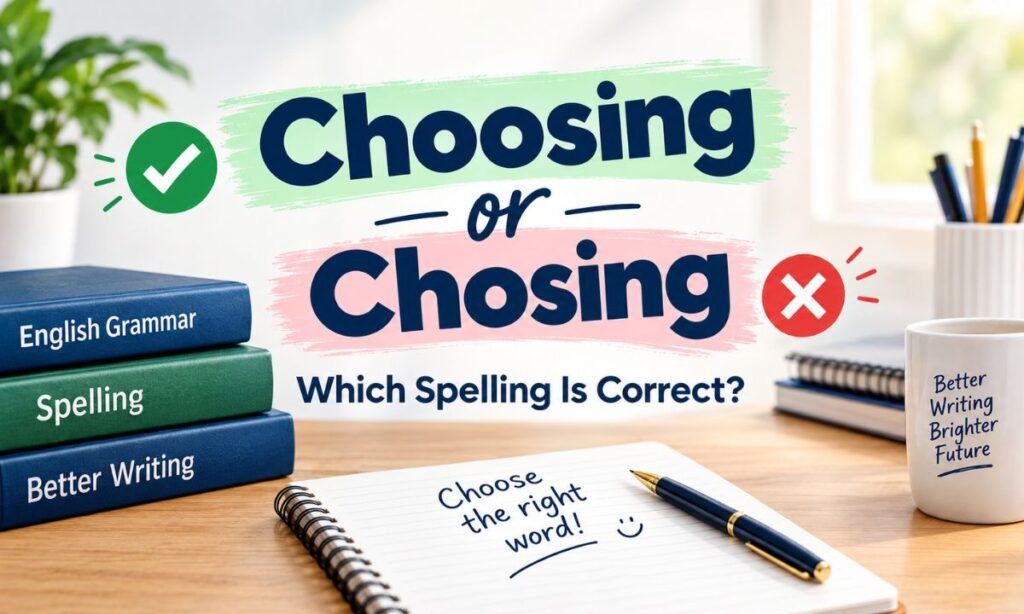

If you’ve typed “chosing” into a search bar wondering whether you spelled it right, you’re not alone. This mix-up shows up constantly in emails, essays, and social media captions. The short answer: only one of these words actually exists in English. This guide explains exactly which one, why the confusion happens, and how to lock the correct spelling into memory for good.
Comparison Overview
Before getting into the grammar details, here’s a side-by-side look at both terms.
| Feature | Choosing | Chosing |
|---|---|---|
| Standard English word? | Yes | No |
| Part of speech | Present participle / gerund of “choose” | Not applicable — misspelling |
| Correct spelling | ✅ Correct | ❌ Incorrect |
| Number of “o” letters | Two | One (missing an “o”) |
| Pronunciation | /ˈtʃuːzɪŋ/ (choo-zing) | No standard pronunciation |
| Used in formal writing | Yes, always acceptable | Never acceptable |
| Common in | Essays, business emails, everyday speech | Typos, quick texts, autocorrect slips |
Definition of Choosing
“Choosing” is the present participle (or gerund) form of the verb “choose.” It describes the act of selecting, deciding, or picking something out from a set of options, either right now or as an ongoing activity.
A few defining features:
- It’s formed by adding “-ing” to “choose” and dropping only the silent “e” at the end.
- It functions as a gerund (“Choosing a career is stressful”) or as part of a continuous verb tense (“She is choosing a dress”).
- It appears constantly in professional, academic, and casual English.
Dictionaries list “choosing” as a standard, recognized inflection of “choose,” alongside “chooses” and “chose.” There’s no ambiguity here — this is the word you want in nearly every situation involving selection or decision-making.
Definition of Chosing
“Chosing” has no dictionary entry, no accepted pronunciation, and no grammatical function. It’s simply a misspelling of “choosing,” created when a writer drops one of the two “o” letters.
Why does this error happen so often? Two habits are usually to blame:
- Writers mentally connect “chosing” to “chose” (the past tense of choose) and assume dropping an “o” mirrors that pattern.
- Fast typing or autocorrect errors quietly remove a letter, and the mistake goes unnoticed because “chosing” still looks vaguely like a real word.
Whatever the cause, “chosing” carries no separate meaning of its own. It isn’t a regional variant, an informal shorthand, or an accepted alternate spelling — it’s simply wrong.
Main Differences Between Choosing and Chosing
The two words aren’t really “different” in the way homophones like affect and effect are different. One is a real word; the other is an accident. Still, breaking down the contrast helps the correct spelling stick.
| Aspect | Choosing | Chosing |
|---|---|---|
| Origin | Base verb “choose” + “-ing” | Misreading of “chose” + “-ing” |
| Meaning | To select or decide | None |
| Grammatical role | Gerund/present participle | None |
| Appears in dictionaries | Yes | No |
| Safe to use in writing | Always | Never |
The core difference boils down to one missing letter and a complete lack of legitimacy. Once you internalize that “choose” keeps both of its “o” letters no matter what ending you attach, the confusion tends to disappear.
Grammar Guide

How each term is used in sentences
“Choosing” slots into sentences the same way any gerund or present participle does — after a form of “to be,” at the start of a sentence as a subject, or following certain verbs.
- I am choosing between two job offers.
- Choosing a college major felt overwhelming at first.
- She kept choosing the same restaurant every Friday.
- Choosing wisely now will save you trouble later.
“Chosing” doesn’t have a correct sentence structure, because it isn’t a word. Any sentence containing it needs the “o” restored before it can be considered correct.
- ❌ I am chosing a new phone.
- ✅ I am choosing a new phone.
Common mistakes learners make
- Dropping the second “o”: Writing “chosing” instead of “choosing,” often out of habit or typing speed.
- Confusing “choosing” with “chose”: Using the gerund form where the simple past tense is needed, or vice versa. “Yesterday I choosing the blue one” should be “Yesterday I chose the blue one.”
- Mixing up “choosing” and “chosen”: “Chosen” is the past participle, used with helping verbs like “have” or “was.” “I have choosing the winner” should read “I have chosen the winner.”
- Trusting spell-check blindly: Some browser extensions and messaging apps miss the error, especially in casual typing, letting the mistake slip through unnoticed.
Simple rules to remember
- “Choose” always keeps both “o” letters, no matter what suffix follows.
- Say the word out loud slowly: “choo-sing.” The long “oo” sound is a built-in reminder of the double letter.
- Only the silent “e” disappears when you add “-ing” to “choose” — nothing else in the word changes.
- If a spelling looks like “chosing,” treat it as a red flag and rewrite it immediately.
Quick tips for writing and speaking
- Read your sentence back before hitting send, especially in emails or applications where spelling errors affect credibility.
- Pair the word visually with its root: choose → choosing. Writing the two together a few times helps the pattern settle in memory.
- When speaking, the pronunciation naturally includes the long “oo” sound, so trust your ear as much as your spelling instinct.
- Keep a short mental list of verbs that behave the same way (lose → losing, but note these don’t double the “o” — “choose” is a bit unique because both vowels are part of the root itself, not an added pattern).
When to Use Each One
Use choosing whenever you need to describe:
- An action happening right now: “I am choosing a paint color.”
- An ongoing or repeated decision: “They keep choosing the harder path.”
- A general or habitual activity phrased as a gerund: “Choosing your battles is a valuable skill.”
- A noun-like reference to the act of selecting: “The choosing process took two weeks.”
There is no scenario — formal, informal, academic, or conversational — where chosing should appear. It has zero valid use cases.
When NOT to Use Each One
Even “choosing,” correct as it is, isn’t always the right verb form for the sentence. Watch for these situations:
- Don’t use “choosing” where the simple past tense is required. Use “chose” instead: “She chose the window seat,” not “She choosing the window seat.”
- Don’t use “choosing” where the past participle is required after “have,” “has,” or “had.” Use “chosen” instead: “They have chosen a venue,” not “They have choosing a venue.”
- Don’t use “chosing” anywhere, under any circumstance, including casual texting, social media captions, or first drafts — it should be corrected the moment you spot it.
Which One to Use (Decision Guide)
Still unsure which word fits your sentence? Run through this quick checklist:
- Are you describing an action happening now or continuously? → Use choosing.
- Are you describing a completed action in the past, with no helping verb? → Use chose.
- Are you pairing the verb with “have,” “has,” or “had”? → Use chosen.
- Did you just type a word with one “o” that looks like “choosing”? → You typed chosing by mistake. Add the missing “o.”
Following this four-step check removes almost all confusion, since the actual decision only ever involves choose, chose, or chosen — never “chosing.”
Real-World Practical Examples
Choosing Examples
- Choosing the right university can shape the next four years of your life.
- My parents spent an entire weekend choosing furniture for the new apartment.
- We’re still choosing between the two vendors before signing the contract.
- Choosing kindness, even in small moments, tends to make relationships stronger.
- The committee is choosing a winner from over two hundred submissions.
- He avoided choosing sides during the argument between his friends.
- Choosing a career path at eighteen feels like an unfair amount of pressure.
- She’s been choosing her words carefully during the negotiation.
Chosing Examples
There are no correct examples of “chosing,” because the spelling is always wrong. Every instance below needs correction:
| Incorrect | Corrected |
|---|---|
| I am chosing a new laptop. | I am choosing a new laptop. |
| She kept chosing the same song. | She kept choosing the same song. |
| We are chosing between three offers. | We are choosing between three offers. |
| They were chosing a name for the puppy. | They were choosing a name for the puppy. |
Self-Assessment (Fill in the Blanks)
Test yourself. Fill each blank with choose, chose, chosen, or choosing.
- Yesterday, Maria ______ the red dress over the blue one.
- I am currently ______ a topic for my thesis.
- By the time we arrived, they had already ______ a restaurant.
- Please ______ your seat before the show begins.
- He’s been ______ his words carefully during the interview.
- We have ______ to postpone the trip until next month.
- Every morning, she spends ten minutes ______ her outfit.
- Last year, the board ______ a new director.
- ______ the right words matters more than people realize.
- He always ______ the window seat when he flies.
Answers
- chose
- choosing
- chosen
- choose
- choosing
- chosen
- choosing
- chose
- Choosing
- chooses (note: this uses the present tense form “chooses,” since the sentence describes a habitual action in third person)
Frequently Asked Questions
How do you use choosing in a sentence?
Use “choosing” to describe an ongoing or present act of selecting, such as “I am choosing a gift for my sister’s birthday.”
Which is correct, chose or chosen?
Both are correct but used differently: “chose” is the simple past tense (“I chose the blue shirt”), while “chosen” is the past participle used with helping verbs (“I have chosen the blue shirt”).
What’s the difference between choosing and picking?
Both mean selecting something, but “choosing” often implies more thought or deliberation, while “picking” can feel quicker or more casual.
What does chosing mean?
“Chosing” has no meaning — it’s simply a common misspelling of “choosing” and should always be corrected.
Conclusion
The comparison between choosing and chosing isn’t really a comparison at all — it’s a reminder that one letter can change a correct sentence into a noticeable mistake. “Choosing” is the only valid spelling, built directly from “choose” with both “o” letters intact. “Chosing” is simply what happens when that second “o” goes missing, usually through habit, speed, or confusion with the past tense “chose.”
Once you connect “choosing” to its root word and remember the long “oo” sound, the correct spelling becomes automatic. Whether you’re writing a college essay, a business email, or a quick text message, that small habit of double-checking pays off in cleaner, more professional writing.