
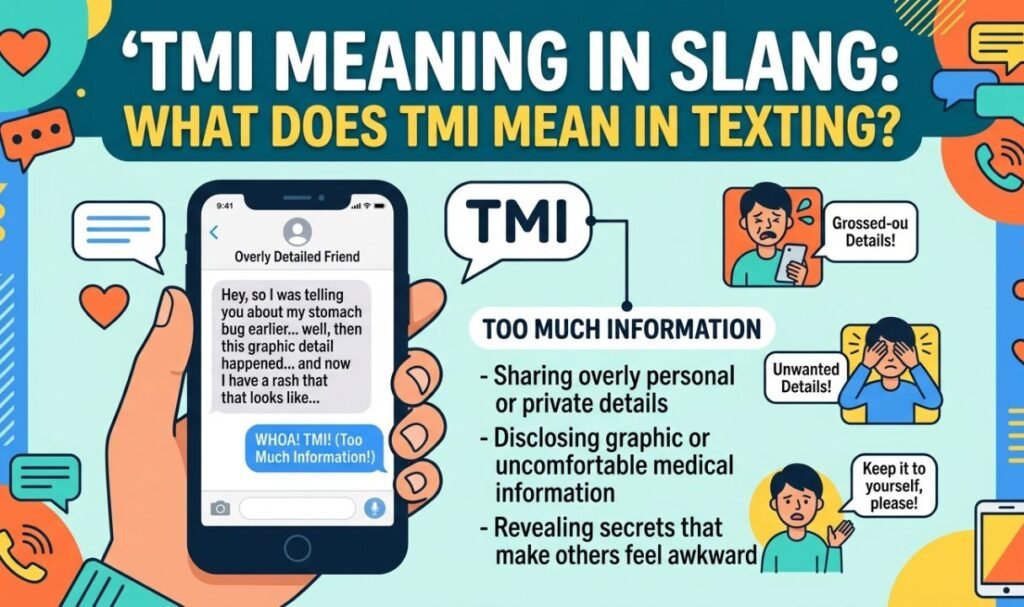

If someone has ever replied to your text with just “TMI,” you already know the feeling. Was that funny? Was it rude? Should you have kept that story to yourself? This guide breaks down exactly what TMI means, where it came from, how it shows up on Snapchat, TikTok, and in K-pop fandoms, and how to reply to it without making things awkward.
The Straight-Up Meaning of TMI | No Fluff Needed
TMI stands for Too Much Information. It’s what people say when someone shares a detail that’s more personal, graphic, or awkward than the conversation actually called for. It’s not a compliment, but it’s rarely meant as a genuine insult either — most of the time it’s a quick, half-joking way to set a boundary.
Here’s the simple version: oversharing is the action, and TMI is the reaction. Someone tells you more than you wanted to hear, and you respond with three letters instead of an awkward silence.
What does TMI mean in slang meaning in text?
In texting, TMI flags a message as more personal or graphic than needed. It usually appears right after someone shares an embarrassing, medical, or private detail.
TMI slang meaning
As slang, TMI works like a social speed bump. It tells the other person, in a lighthearted way, that they’ve crossed from “relatable” into “more than I signed up for.”
What does TMI mean in chat?
In group chats and DMs, TMI is a quick reaction — often paired with a laughing emoji — that lets someone know their story landed on the “too much” side of casual conversation.
How It Sneaked Into Our Everyday Language
TMI isn’t a brand-new invention. Language references trace the phrase “too much information” back to casual American speech in the late 20th century, and it picked up steam as internet forums and chat rooms exploded in the 1990s. Early adopters shortened it the way most slang gets shortened: because typing three letters is faster than typing three words.
By the early 2000s, the abbreviation had made its way into online slang dictionaries, which is usually a sign that a term has fully crossed over from niche chatroom talk into everyday internet vocabulary. From there, texting culture picked it up, and it never really left.
TMI in Texting and Social Media – Where It Thrives Most
Shows up almost everywhere people type TMI casually, but the tone shifts slightly depending on the platform.
| Platform | Typical Use of TMI | Common Tone |
| Texting (iMessage/SMS) | Quick reaction to a friend’s overshare | Playful, teasing |
| Snapchat | Reply to a snap with too much personal detail | Casual, joking |
| Comment on an overly personal caption or story | Humorous, sometimes sarcastic | |
| TikTok | Caption or comment reacting to a relatable overshare video | Exaggerated, meme-driven |
| Group chat reaction, often with laughing emojis | Friendly, informal |
TMI meaning on Snapchat
On Snapchat, TMI is used the same way it’s used in texting — as a quick, low-effort response to a snap that includes something a little too personal, like a bathroom story or an oversharing caption.
TMI meaning on Instagram, TikTok, WhatsApp
On Instagram and TikTok, TMI often becomes part of the joke itself, with creators intentionally labeling a video “storytime: TMI” to hook viewers. On WhatsApp, it stays closer to its original texting use, mostly appearing in group chats.
What is TMI in Gen Z slang?
For Gen Z, TMI isn’t really about shock or offense anymore. It’s closer to a social commentary shortcut — a way of poking fun at how much people share online versus how much anyone actually wants to know.
What does TMI mean for girls?
There’s no separate “girl version” of TMI. It’s used the same way across genders — as a reaction to oversharing — though it does come up often in conversations about periods, relationships, or body-related topics, simply because those are common areas where people overshare with close friends.
What is TMI in internet slang?
Broadly, TMI belongs to the same family as other reaction acronyms like LOL or SMH. It’s a quick, typed shorthand for a specific social reaction — in this case, secondhand embarrassment or discomfort.
What is TMI in a relationship?
In relationships, TMI usually points to one of two things: oversharing details about an ex with a new partner, or oversharing details about your current relationship with friends, family, or coworkers who didn’t ask for the play-by-play.
TMI meaning from a girl
When a woman uses TMI in a text, it carries the same core meaning as when anyone else uses it — a signal that a detail felt like more information than the conversation needed, usually said with humor rather than harshness.
TMI meaning Medical
In a medical or clinical setting, TMI can describe a patient or provider sharing more detail than is clinically relevant to the issue at hand — for instance, someone giving a long personal backstory when a doctor only asked about a specific symptom.
TMI Around the World – The Korean K-Pop Surprise
Here’s the twist that trips up a lot of international fans: in Korean pop culture, TMI doesn’t carry the same weight it does in English. Instead of signaling something shocking or graphic, Korean idols and hosts use “TMI” to introduce a small, often mundane fact — like what someone ate for breakfast or which socks they’re wearing.
What does TMI mean in kpop
On variety shows and in interviews, hosts frequently ask idols to “give a TMI,” meaning share a random, low-stakes personal fact to lighten the mood. It’s closer to an icebreaker than a confession. This is why international fans sometimes feel let down when an idol’s “TMI” turns out to be something as simple as “I had ramen this morning” instead of something dramatic.
Other Meanings of TMI – It’s Not Always Slang
TMI has a few unrelated meanings outside of texting slang, and context makes it obvious which one applies.
Is TMI an acronym or abbreviation?
Technically, TMI is an initialism — it’s pronounced letter by letter (tee-em-eye) rather than as a single word, which is what separates an acronym like NASA from an initialism like TMI or FYI.
Outside of texting, TMI can also stand for things like Total Market Index in finance, Toastmasters International, or refer to unrelated organizations and technical terms entirely separate from the “too much information” slang usage. If you see TMI in a business or technical document, it almost certainly isn’t the texting slang version.
Tone & Context Variations
The letters never change, but the feeling behind TMI shifts completely depending on tone.
- Funny Tone: “TMI 😂 I did NOT need to know that.”
- Sarcastic Tone: “Wow, TMI. Thanks for that mental image.”
- Romantic Tone: “Haha TMI, but I kind of like knowing that about you.”
- Angry Tone: “TMI. Seriously, stop.”
- Playful Tone: “TMI alert 🚨 storytime incoming.”
Real Chat Examples
- Friend: “I haven’t showered in three days.” You: “TMI, but also… go shower 😭”
- Friend: “My ex used to do this weird thing where—” You: “TMI, I don’t need the ex lore.”
- Coworker: “I threw up in the office bathroom.” You: “Okay that’s a hard TMI from me.”
Grammar & Language Role
Part of speech
TMI functions as an interjection or a noun phrase standing in for “too much information.” It’s not a verb, and it doesn’t get conjugated.
Sentence position
Most often, TMI opens or stands alone in a reply (“TMI!” or “TMI, but…”), though it can also close a sentence for emphasis (“That story was total TMI.”)
Does it replace a full sentence?
Yes. Instead of typing “That’s more information than I needed to know,” people simply type “TMI.” It’s efficient shorthand for a full reaction.
Tone impact
Because it’s so short, TMI reads as casual and light by default. Adding punctuation, emojis, or caps (“TMI!!!”) shifts it toward more exaggerated reactions.
Formal vs informal use
TMI is strictly informal. It fits texting, social captions, and casual conversation, but it doesn’t belong in professional emails, reports, or formal writing.
How to Reply When Someone Says “TMI”
Getting called out with “TMI” doesn’t have to be awkward. Here are a few directions you can take.
Funny Replies
- “Sorry, forgot you’re not my diary 😂”
- “You asked how my day was, this IS how it was.”
Serious Replies
- “Fair, I’ll spare you the rest.”
- “Noted, I’ll keep that one to myself next time.”
Flirty Replies
- “Only sharing my deepest secrets with you 😉”
- “Guess you’ll just have to get used to my oversharing.”
Neutral Replies
- “Haha okay, moving on.”
- “Got it, changing the subject.”
Comparison Table: TMI vs Similar Slang Terms
| Term | Meaning | When It’s Used |
| TMI | Too Much Information | Reacting to an overshare |
| IYKYK | If You Know You Know | Referencing an inside joke |
| NGL | Not Gonna Lie | Prefacing an honest opinion |
| SMH | Shaking My Head | Reacting to something frustrating or silly |
| STFU | Reaction of disbelief | Reacting to shocking or surprising news |
Who Uses This Term?
Age group
TMI is used across age groups, but it’s most common among Millennials and Gen Z, who grew up texting and chatting in abbreviations.
Region
The slang usage is strongest in the U.S. and other English-speaking countries, though the Korean pop-culture version has its own distinct, milder meaning.
Platforms
Texting apps, Snapchat, Instagram, TikTok, WhatsApp, and Discord are where TMI shows up most frequently in everyday conversation.
Origin & Internet Culture Insight
Possible origin
The phrase “too much information” existed in casual speech before it became internet shorthand, and it moved into chatrooms and forums as people looked for faster ways to react to oversharing online.
Meme culture role
TMI eventually became meme fodder itself — “storytime: TMI edition” is now a recognizable format on TikTok, where creators intentionally frame a story as an overshare to grab attention.
Fast typing culture
Like most three-letter acronyms, TMI survived because it’s fast to type and instantly understood, which matters a lot in quick back-and-forth texting.
Why People Say “TMI” on TikTok
On TikTok, TMI often works as a hook rather than a genuine complaint. Creators label videos “TMI story” to signal that something juicy, awkward, or personal is coming, which pulls viewers in rather than pushing them away.
Safety & Appropriateness
Is TMI rude?
Usually not. It’s typically playful, but tone and relationship matter — said harshly, it can come across as dismissive.
Is it a bad word?
No, TMI is not considered offensive or a swear word. It’s casual slang, not profanity.
Should you use it in school or office?
It’s fine among friends, but it’s best avoided in formal school assignments or professional workplace communication, where informal slang generally doesn’t fit.
Real-Life TMI Stories That’ll Make You Laugh (or Cringe)
Some of the most shared TMI moments online come from people casually revealing bathroom mishaps, oversharing about a first date, or texting a group chat about a health scare that really only needed a one-word update. These stories work because almost everyone has either sent or received one.
Pop Culture and TMI – From Movies to Memes
TMI has shown up as episode titles, show names, and even song titles over the decades, which shows how deeply the phrase settled into everyday language well beyond just texting.
The Psychology Side – Why Do We Overshare Anyway?
Oversharing often comes from comfort, nerves, or the instant nature of texting itself — when there’s no pause button, people sometimes type out details they’d never say out loud in person. Digital conversations can also lower our usual filters, making TMI moments more common online than face-to-face.
Tips to Avoid Dropping TMI Yourself
- Pause before sending anything graphic or deeply personal.
- Ask yourself if the person actually needs this detail to understand your point.
- Save medical or relationship specifics for people who’ve asked or clearly want to know.
- When in doubt, summarize instead of narrating every detail.
How to Reply to TMI Without Being Rude
Keep it light. A quick laugh, a joking deflection, or a simple “noted” usually smooths things over without making the other person feel embarrassed for sharing.
Related Slang You Should Know
- IYKYK – If You Know You Know
- NGL – Not Gonna Lie
- SMH – Shaking My Head
- FR – For Real
- ICYMI – In Case You Missed It
TMI in the Workplace – Handle With Care
Oversharing at work — about health issues, relationship drama, or personal finances — can affect how coworkers perceive your professionalism. It’s smart to keep personal updates brief and save the full story for close friends outside of work.
TMI on Dating Apps and Relationships
Early in dating, oversharing about exes, trauma, or overly intimate details can overwhelm a new match. Pacing personal disclosures builds trust gradually, rather than triggering a “TMI” reaction on date one.
The Evolution of TMI – From 80s Offices to 2026 TikTok
What started as a casual phrase in office and everyday speech grew into internet chatroom shorthand in the 90s, became standard texting slang in the 2000s, and by 2026 has turned into a full-blown content format on TikTok, complete with its own storytelling style and even a distinct, gentler meaning within K-pop culture.
TMI BioWiki Table
| Attribute | Detail |
| Full Form | Too Much Information |
| Type | Initialism / Slang |
| First Popularized | Late 1990s–early 2000s internet culture |
| Common Platforms | Texting, Snapchat, Instagram, TikTok, WhatsApp, Discord |
| Primary Users | Millennials, Gen Z |
| Tone | Playful, sarcastic, sometimes serious |
| Formality | Informal only |
| K-pop Meaning | A small, random personal fact (milder than English usage) |
| Related Terms | IYKYK, NGL, SMH, FR |
Frequently Asked Questions
What does TMI mean in a text message?
It means “Too Much Information,” used when someone shares more personal detail than the conversation called for.
Is TMI always meant to be rude?
No, it’s usually lighthearted and joking rather than genuinely harsh.
What does TMI mean on Snapchat specifically?
The same as everywhere else — a reaction to an oversharing snap or caption.
Does TMI mean something different in Korean or K-pop contexts?
Yes, in Korean pop culture it usually refers to a small, random fact rather than something shocking.
Can TMI be used in professional settings?
It’s best avoided in formal or workplace writing since it’s strictly casual slang.
Is TMI the same as oversharing?
Not quite — oversharing is the action, while TMI is the reaction someone gives in response to it.
Final Thoughts
TMI has stuck around for decades because it does one simple job really well: it names that exact moment when a conversation tips from relatable into “more than I needed.” Whether you’re seeing it on a text, a Snapchat reply, a TikTok caption, or a K-pop interview clip, the core idea stays the same — someone shared a little too much, and everyone knows it. Knowing how to use TMI, and how to respond to it gracefully, keeps your digital conversations a lot more comfortable for everyone involved.