
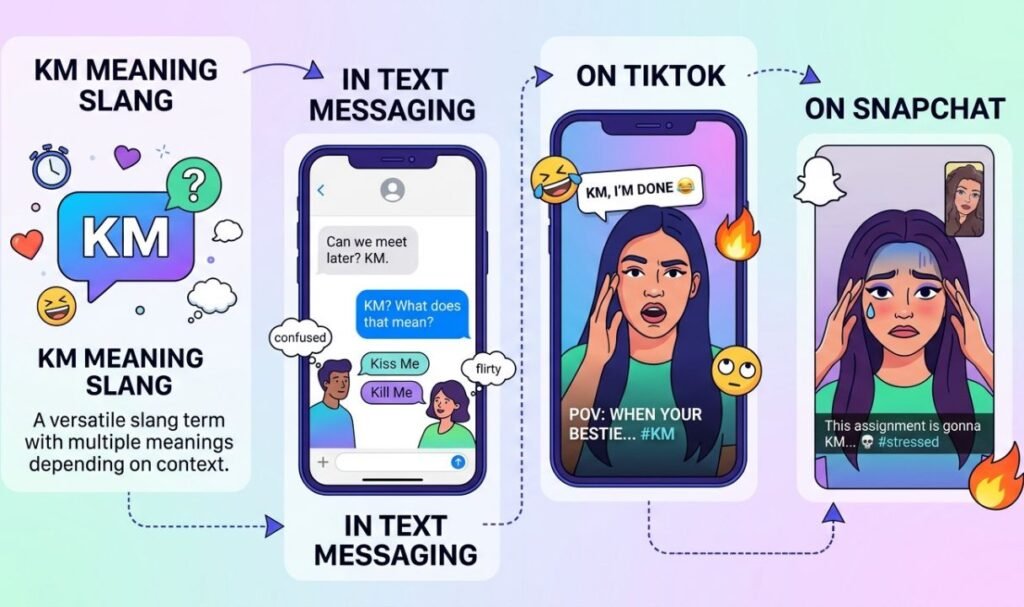

Getting a one-letter text like “km” can stop a conversation cold. Is it about distance? It is a joke? Is it something you should be worried about? If you’ve landed here after squinting at your phone trying to figure out what someone just sent you, you’re in good company — this term shows up constantly in DMs, comment sections, and group chats, and it rarely means what a dictionary would tell you.
This guide breaks down every real-world meaning of KM, how it shifts by platform and tone, and how to reply without sounding out of touch. No filler, no guesswork — just how people actually use it in 2026.
Slang like this evolves fast, and a term that meant one thing last year can pick up a second or third meaning within months. KM is a good example: it started as a plain distance abbreviation, picked up a dramatic slang meaning through fast-paced texting culture, and now carries a handful of context-dependent uses depending on who sends it, which app it lands in, and what was said right before it.
KM Meaning Slang in Text
In everyday texting, KM most often stands for “Kill Me.” It’s not a threat or a cry for help — it’s a dramatic, joking way to react to something embarrassing, exhausting, or absurd. Think of it as the texting cousin of rolling your eyes and groaning out loud.
A second, less common meaning is “Kiss Me,” which shows up in romantic or flirty exchanges between couples or people testing the waters with each other. Context — who’s texting, the tone of the conversation, and what came before the message — almost always makes the intended meaning obvious within a second or two.
Outside slang, KM can simply mean kilometer, especially in messages about distance, travel, fitness, or directions. And in professional threads, particularly in corporate or business tools, KM sometimes refers to Knowledge Management, a term used for systems that organize company information.
KM Meaning Slang on Snapchat
On Snapchat, KM leans almost entirely toward “Kill Me.” Snap captions and chat replies tend to be quick, reactive, and dripping with exaggeration, so KM fits naturally after a cringe moment, a bad photo, or an awkward Snap someone sent by accident. It’s rarely literal — it’s a punchline, not a warning sign.
Because Snapchat conversations move fast and disappear, users lean on short, expressive slang like KM instead of typing out full reactions. You’ll often see it paired with emojis (💀, 😭, 😂) that reinforce the joking tone rather than anything serious.
KM Meaning Slang on Instagram, TikTok & WhatsApp
The core meaning of KM doesn’t change much across apps, but how often it appears and what it’s reacting to does shift depending on the platform’s culture.
On TikTok
TikTok comment sections are where KM thrives the most. Viewers drop it under cringe clips, relatable fails, or oddly specific videos that hit too close to home. It’s become shorthand for “this is so real it hurts,” used the same way people type “I’m deceased” or “not this.” Creators sometimes use it in captions too, signaling self-aware embarrassment about their own content.
On Instagram
On Instagram, KM shows up most in comments and DMs rather than captions. It’s common under relatable meme posts, awkward story replies, or reaction comments to a friend’s post. Instagram’s more curated, image-first environment means KM often reacts to a photo or moment rather than a fast-moving trend.
On WhatsApp
WhatsApp conversations tend to be more personal and ongoing, often between friends, family, or partners. Here, KM can lean either way — “Kill Me” in response to a stressful day or annoying situation, or the literal “kilometer” when discussing travel time, distance to a location, or directions. WhatsApp’s group-chat culture also means KM sometimes gets used self-deprecatingly, like reacting to your own bad decision.
Is KM an Acronym, Short Form, or Typo?
KM is best described as an internet short form, not a formal acronym and definitely not a typo. Acronyms usually get pronounced as words or have fixed, dictionary-recognized meanings (like NASA or laser). KM doesn’t meet that bar — it’s a casual abbreviation that emerged from fast typing habits and spread through repeated use in chats and comments.
It functions more like slang shorthand, similar to “idk” or “smh,” where the letters stand in for a full phrase that’s understood through shared context rather than an official definition.
Tone & Context Variations of KM
The same two letters can carry very different weight depending on tone. Here’s how KM shifts across common conversational moods.
Funny Tone
Used after a silly mistake or an over-the-top embarrassing moment. “I called my teacher mom km 😭” is a classic example — light, self-deprecating, and meant to get a laugh.
Sarcastic Tone
Sometimes KM pokes fun at something that isn’t actually that big a deal, exaggerating a minor annoyance for comedic effect. “He texted ‘k’ after my paragraph, km” reads as playful sarcasm, not real distress.
Romantic Tone
In flirty exchanges, KM leans toward “Kiss Me,” often typed quickly between people who are comfortable being a little bold. It usually appears alongside playful emojis or teasing follow-up messages.
Angry Tone
Occasionally KM expresses genuine frustration, though still short of anything serious. “He canceled again, km” reads more like exasperation than humor, but it’s still clearly hyperbolic.
Playful Tone
A softer, teasing version used between friends who joke around a lot, often paired with inside jokes or ongoing banter rather than a strong reaction.
Real Chat Examples (Natural & Relatable)
Seeing KM in real conversation makes the meaning click faster than any definition.
- “I tripped in front of the whole class km 😭”
- “My mom read my texts out loud at dinner, km”
- “How far is the venue?” — “About 5 km from here”
- “He liked her photo from 2019, km”
- “I said ‘you too’ when the waiter said enjoy your meal, km”
- “Come here rn km 😘”
- “She’s ignoring my texts again, km”
- “Upload the reports to the KM system by Friday”
- “I sent a voice note instead of typing, km”
- “You’re so annoying km 😂”
- “We ran 10 km this morning, legs are dead”
- “He called me by his ex’s name, KM”
- “Miss you, km 🥺”
- “I forgot to unmute for the whole meeting, km”
- “Bro really said ‘lol’ to my breakup text, km”
Grammar & Language Role of KM
Part of Speech
KM functions as an interjection in its slang form — a standalone expressive reaction rather than a noun, verb, or adjective. As “kilometer,” it’s a noun and unit of measurement.
Sentence Position
It typically appears at the end of a sentence, tacked on as a reaction, though it can also stand entirely alone as a one-word reply.
Does It Replace a Full Sentence?
Yes. In slang use, KM substitutes for a longer phrase like “I’m so embarrassed” or “this is unbearable,” compressing an emotional reaction into two letters.
Tone Impact
Adding KM to a message instantly signals informality and exaggeration. It softens complaints into jokes and turns mundane updates into something more expressive.
Formal vs Informal Use
KM in its slang sense belongs strictly to casual, informal writing. The kilometer and Knowledge Management meanings are the only versions appropriate for formal or professional contexts.
How to Reply When Someone Says KM
Funny Replies
“Same energy lol,” “I felt that,” or simply mirroring it back with “km fr.”
Serious Replies
If the context feels genuinely upsetting rather than exaggerated, a caring check-in like “you good?” or “what happened?” reads better than matching the joke.
Flirty Replies
If KM was used romantically, playful responses like “make me 😏” or a simple “come get it” keep the tone consistent.
Neutral Replies
A laughing emoji, “lmaooo,” or “same” works when you’re not sure how invested to get in the reaction.
KM Meaning Slang Comparison Table
| Meaning | Common Context | Platform | Tone |
| Kill Me | Embarrassment, frustration | TikTok, Snapchat, texting | Humorous, dramatic |
| Kiss Me | Romantic exchanges | WhatsApp, DMs, texting | Flirty, playful |
| Kilometer | Distance, travel, fitness | WhatsApp, general texting | Neutral, factual |
| Knowledge Management | Workplace systems | Email, corporate chat tools | Formal, professional |
Who Uses the Term KM?
KM Meaning in Text From a Guy
When a guy sends KM, it’s usually reactive humor — responding to something awkward, teasing a friend, or occasionally flirting if the conversation already has that tone. It rarely carries deeper meaning unless the rest of the message suggests otherwise.
What Does KM Mean in Texting From a Girl
From a girl, KM tends to follow the same pattern: dramatic reaction to embarrassment or annoyance, or a flirty nudge in a romantic thread. Gender doesn’t change the meaning much — context does.
Age Group
Gen Z vs Millennials
Gen Z uses KM more casually and frequently, often layering it with other slang and emojis in the same message. It shows up almost automatically in comment sections, sometimes several times in a single thread, functioning less like a deliberate word choice and more like a reflex reaction.
Millennials tend to use it more sparingly. Many either type “kill me” out in full for clarity or default to the kilometer meaning when discussing distance, since the slang usage wasn’t as embedded in their early texting habits. Older users who do adopt the slang version usually picked it up by seeing it repeatedly in younger relatives’ or coworkers’ messages.
Regional Usage
The slang meaning is strongest in English-speaking online spaces, particularly the US, UK, and parts of South Asia and Southeast Asia, where texting culture heavily favors abbreviations and character-saving shorthand. In regions using the metric system daily, the kilometer meaning stays dominant in everyday conversation, especially around travel, commuting, and fitness tracking, where distance comes up constantly.
In workplaces across many countries, the Knowledge Management meaning holds steady regardless of region, since it’s tied to specific software and internal business terminology rather than local slang trends.
Platforms Where KM Is Most Common
TikTok comments and Snapchat chats show the highest concentration of the slang usage, followed by Instagram DMs and WhatsApp group chats.
Origin & Internet Culture Insight
Fast Typing Culture
KM grew out of the same texting habits that produced “brb,” “omw,” and “idk” — a need to communicate quickly on small keyboards and within character or attention limits. Shortening “kill me” to two letters fit that pattern naturally.
Meme Culture Role
As reaction memes and relatable content took over social feeds, short expressive phrases like KM became a fast way to signal “I feel this” without writing a full comment. It works alongside similar terms like “I’m deceased” or “not me,” all of which exist to express secondhand embarrassment or humor without sounding overly earnest.
These terms tend to travel together — someone who uses KM regularly will likely also drop “I’m screaming,” “not this,” or “the way I—” in similar situations. They form a loose vocabulary of reaction slang rather than isolated one-off terms, which is part of why KM has stuck around instead of fading after a single trend cycle.
Why People Say KM on TikTok
TikTok’s comment culture rewards quick, relatable reactions over lengthy responses. KM fits that format perfectly — it’s short enough to type in seconds, universally understood by regular users, and carries built-in humor that matches the platform’s self-aware, meme-driven tone.
Is KM Rude or Offensive?
Is It a Bad Word?
No. KM isn’t offensive or vulgar. It’s exaggerated slang, not a genuine expression of harm, and is generally understood as lighthearted within casual conversations.
Should You Use It in School or Work?
Avoid it in academic or professional writing. Teachers, professors, and employers won’t read it the way friends do, and it can come across as unclear or unprofessional outside of casual texting.
Is It Safe for Social Media?
Yes, in casual comment sections and DMs among friends. It’s not something platforms flag or restrict, since it’s widely recognized as harmless internet slang.
Experience-Based Insight
Anyone who spends regular time in TikTok comments or group chats has likely seen KM used dozens of times without a single instance meaning anything literal. It’s become so normalized that most users don’t even pause to interpret it — the reaction is instant.
Common Mistakes People Make With KM
Assuming It Always Means One Thing
The biggest mistake is locking in on a single definition. A message about “5 km away” and a comment saying “km 😭” under a cringe video mean completely different things, even though the letters match.
Using It Professionally
Typing KM in an email or work Slack message (unless referring to Knowledge Management or kilometers) risks confusing coworkers or looking unprofessional.
Ignoring Context
Reading KM in isolation, without checking the surrounding message, tone, or platform, is how misunderstandings happen — especially between people from different age groups or texting habits.
When to Use KM — And When to Avoid It
Use It When
- Chatting casually with friends who already use similar slang
- Reacting to something embarrassing, awkward, or funny
- Texting someone you’re flirting with, if the tone already supports it
- Commenting on relatable TikTok or Instagram content
Avoid It When
- Writing professional emails or work messages
- Talking to someone unfamiliar with texting slang
- The conversation is genuinely serious or emotionally heavy
- You’re unsure how the other person will interpret it
Frequently Asked Questions
Does KM always mean “Kill Me”?
No. It’s the most common slang meaning, but context can shift it toward “Kiss Me,” kilometer, or Knowledge Management.
Is KM only used by Gen Z?
Mostly, but millennials use it too, often more sparingly and sometimes with the literal kilometer meaning.
Can KM be used in a serious message?
It’s possible, but it usually softens even serious complaints into something lighter and more exaggerated.
Is KM appropriate for work chats?
Only if you mean kilometers or Knowledge Management — avoid the slang version in professional settings.
How do I know which meaning someone intends?
Check the platform, the relationship between you and the sender, and the message right before or after it.
Is KM the same as “I’m dead”?
They’re similar in expressing overwhelm or embarrassment, though “I’m dead” leans slightly more toward laughter than frustration.
Final Thoughts
KM is one of those small texting terms that carries a surprising amount of range. Most of the time, it means “Kill Me” — a joking, exaggerated reaction to something embarrassing or frustrating. In romantic chats it can mean “Kiss Me,” and outside slang it simply refers to kilometers or, in workplace settings, Knowledge Management.
The safest way to read it is to look at who’s texting, what platform you’re on, and what was said right before it. Once you get a feel for the pattern, KM stops being confusing and starts reading exactly the way it’s meant to: quick, expressive, and a little dramatic.