

If you have ever paused mid-sentence wondering whether to write “shiny” or “shiney,” you are not alone. This is one of the most common spelling mix-ups in English, and it trips up native speakers just as often as learners. The good news is that the answer is simple once you see the pattern behind it.
In this guide, you will learn which spelling is correct, why the other one keeps showing up anyway, and how to use the word confidently in everyday writing, schoolwork, and professional documents. We will also cover grammar rules, real examples, a comparison table, and a short self-test so you can check what you have learned.
Comparison Overview
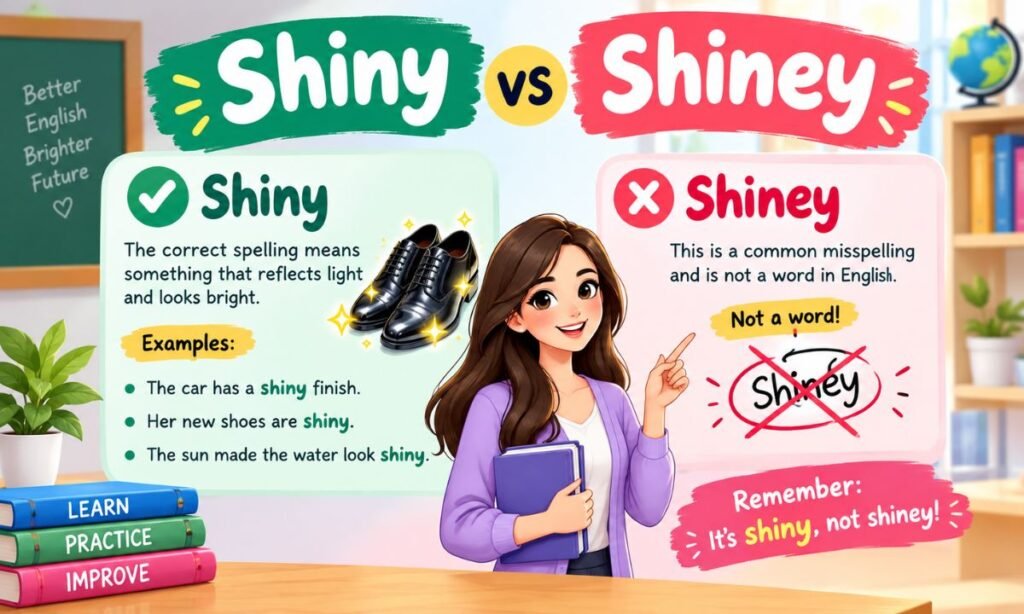
Before going deeper, here is the short answer: shiny is correct, and shiney is a spelling mistake.
Both words are meant to describe something that reflects light, looks bright, or has a polished, glossy surface. But only one of them exists in dictionaries, style guides, and standard grammar references. The confusion happens because “shiney” sounds exactly like “shiny” when spoken aloud, so writers assume the extra “e” belongs there. It does not.
Here’s a quick snapshot before we break things down further:
- Shiny — the standard, dictionary-approved adjective.
- Shiney — a phonetic misspelling with no formal grammatical standing.
- Both are pronounced the same way, which is exactly why the error is so widespread.
- Only one of them will pass a spell-check, a style guide review, or a grammar audit.
Definition of Shiny
Shiny is an adjective. It describes an object or surface that reflects light, looks bright, glossy, smooth, or polished. Think of a freshly washed car, a new coin, a polished floor, or hair that catches the light.
Merriam-Webster and Oxford both list shiny as the standard form, built from the verb “shine” plus the suffix “-y.” The word has been part of everyday English for centuries, and it appears constantly in fiction, journalism, academic writing, and casual conversation.
Shiny also carries a figurative meaning. People often use it to describe something new, exciting, or attractive, even when nothing is physically glossy. A “shiny new gadget” or a “shiny new idea” doesn’t need to reflect actual light — it just needs to feel fresh and appealing.
Common contexts where shiny appears:
- Describing metal, glass, jewelry, or polished wood
- Talking about hair, skin, or clean surfaces
- Referring to vehicles, shoes, and clothing
- Describing something new or exciting in a figurative sense
Definition of Shiney
Shiney has no independent definition of its own. It is not a separate word with a distinct meaning — it is simply an incorrect spelling of shiny. You will sometimes see it used as a surname or a nickname (there are people whose last name is spelled this way), but as an adjective meaning “bright” or “glossy,” it does not exist in any recognized dictionary.
Writers usually reach for “shiney” because English has a general habit of keeping a silent “e” when adding certain suffixes — think of words like “cutey” or “homey.” That pattern feels intuitive, so the brain applies it to “shine” without realizing that this particular word doesn’t follow it.
If you search for shiney in a dictionary, you will typically be redirected to shiny, with a note that the form you searched for is a common misspelling.
Main Differences Between Shiny and Shiney
The core difference isn’t about meaning at all — both words, when used the same way, are trying to describe the same thing. The difference is about correctness. One is standard English. The other is not.
Here is what separates them:
- Recognition: Shiny appears in every major dictionary. Shiney does not.
- Formation: Shiny drops the silent “e” from “shine” before adding “y.” Shiney keeps the “e,” which breaks the standard spelling rule for this word.
- Usage in formal writing: Shiny is accepted in academic papers, business documents, and published books. Shiney is flagged as an error by spell-checkers and editors.
- Origin of the mistake: Shiney exists mainly because it matches the sound of the word, not because it follows any accepted spelling convention.
Comparison Table
| Feature | Shiny | Shiney |
|---|---|---|
| Correct spelling | Yes | No |
| Found in dictionaries | Yes | No |
| Formed from “shine” | Drops the silent “e” + adds “y” | Keeps the “e” (incorrect) |
| Acceptable in formal writing | Yes | No |
| Acceptable in casual texting | Yes (recommended) | Sometimes seen, still wrong |
| Comparative form | Shinier | Not applicable |
| Superlative form | Shiniest | Not applicable |
| Scrabble-valid | Yes | No |
| Pronunciation | /ˈʃaɪni/ | Same as shiny |
Grammar Guide
How each term is used in sentences
Shiny functions as a descriptive adjective, usually placed before a noun or after a linking verb like “is,” “looks,” or “seems.”
- Before a noun: “She polished the shiny table until it sparkled.”
- After a linking verb: “The floor looks shiny after mopping.”
- In a figurative sense: “He couldn’t resist buying the shiny new laptop.”
Shiney would technically follow the same sentence patterns if someone chose to use it, but doing so introduces a spelling error into an otherwise correct sentence. There is no grammatical structure where shiney is the required or preferred form.
Common mistakes learners make
Several patterns explain why this error keeps happening:
- Sound-based spelling: Learners often spell words the way they sound rather than checking the actual written form, and “shiney” sounds identical to “shiny.”
- Overgeneralizing suffix rules: Some English words do keep the “e” before adding “y” (like “homey”), so learners assume “shine” follows the same pattern.
- Autocorrect gaps: Not every keyboard or app flags “shiney” as wrong, especially on mobile devices, which lets the mistake slip through.
- Confusing it with proper nouns: Since “Shiney” appears as a surname or nickname in some contexts, learners sometimes assume it’s an accepted variant of the adjective too.
Simple rules to remember
- Drop the silent “e” from “shine” before adding “y.” This gives you shiny, not shiney.
- If a spelling feels like it should have an extra letter because of how it sounds, double-check it against a dictionary rather than trusting your instinct.
- Comparative and superlative forms follow the “y” spelling: shinier and shiniest, never shineyer or shineyest.
- When in doubt, picture the base verb “shine” and ask whether the “e” survives the transformation. For this word, it never does.
Quick tips for writing and speaking
- Read your sentence aloud before finalizing it — pronunciation won’t catch the error, but a visual scan of the word will.
- Keep a short list of commonly misspelled words (like definitely, separate, and shiny) somewhere visible while you write.
- Use a grammar checker, but don’t rely on it completely, since some tools still miss less common typos.
- Practice writing the word in context a few times until “shiny” becomes automatic muscle memory.
When to Use Each One
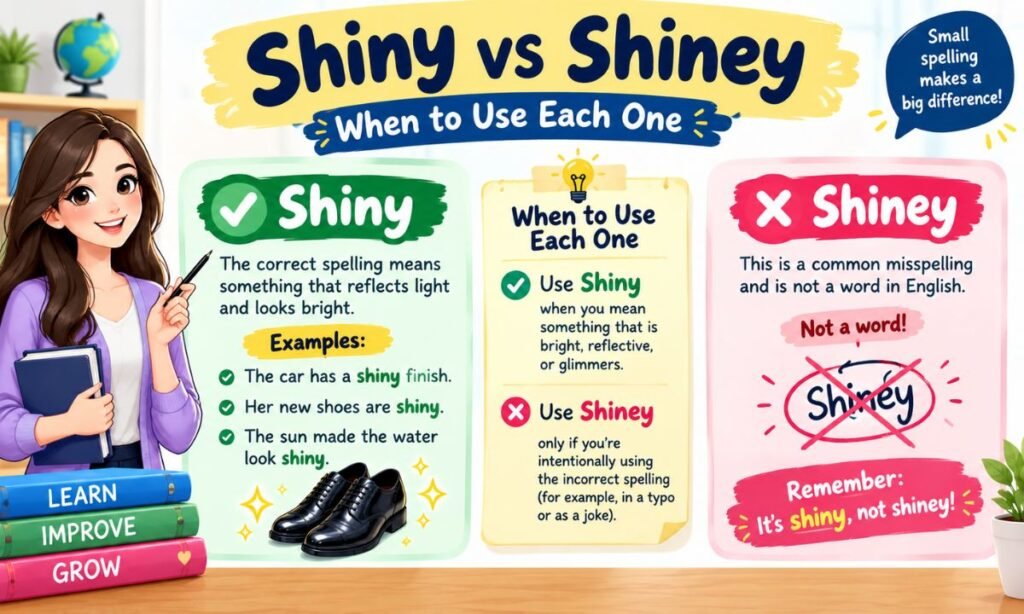
Use shiny whenever you need to describe something that reflects light, looks polished, or feels new and appealing in a figurative sense. This applies to:
- Formal writing, including essays, reports, and articles
- Everyday conversation and texting
- Marketing copy describing products
- Creative writing and storytelling
There is no scenario in standard English where shiney is the correct choice. The only time you might reasonably type it is if you are quoting someone’s surname or a specific brand name that intentionally uses that spelling.
When NOT to Use Each One
Avoid shiney entirely in:
- Academic papers and essays
- Resumes, cover letters, and business emails
- Published articles, blog posts, and website content
- Any context where spelling accuracy affects credibility
Avoid using shiny only in cases where you actually mean a different word — for instance, if you’re referring to a person’s surname spelled “Shiney,” or a specific product name that uses the nonstandard spelling on purpose. Outside of proper nouns, shiny is always the safer, correct option.
Which One to Use (Decision Guide)
If you’re still unsure which spelling fits your sentence, walk through this quick checklist:
- Are you describing something that reflects light, looks polished, or feels new and exciting? Use shiny.
- Are you referring to a specific person’s name, brand, or title that is spelled with an “e”? Then that specific spelling applies, but only as a proper noun.
- Are you writing anything formal — an email, an essay, a report, a resume? Use shiny, without exception.
- Are you texting a friend casually? Shiny still works perfectly and won’t confuse anyone.
In nearly every situation, the decision comes down to one simple fact: shiny is the word English actually recognizes.
Real-World Practical Examples
Shiny Examples
- The new car had a shiny red finish that caught everyone’s eye.
- Her earrings were small but shiny enough to sparkle under the lights.
- After the rain stopped, the wet street looked shiny under the streetlamps.
- He handed her a shiny coin from his collection.
- The kitchen counter was shiny and spotless after cleaning.
- The company unveiled a shiny new logo for its rebrand.
- The puppy’s fur was soft and shiny after the bath.
- She wore a shiny black dress to the awards dinner.
Shiney Examples
There are no correct grammatical examples of “shiney” used as an adjective, because the spelling itself is nonstandard. The only legitimate use case looks like this:
- “Mr. Shiney taught our English class last semester.” (used here strictly as a surname)
- “The band’s setlist included a track by an artist named Shiney.” (used strictly as a stage name or brand)
If you ever see “shiney” used to mean bright or glossy, treat it as a typo that should be corrected to shiny.
Self-Assessment (Fill in the Blanks)
Test what you’ve learned. Fill in each blank with either “shiny” or “shiney.”
- The mirror was so _______ that I could see my reflection clearly.
- My brother bought a _______ new bicycle for his birthday.
- Please spell it correctly: it’s _______, not _______.
- The lake looked _______ under the afternoon sun.
- Which is _______ — the gold ring or the silver one?
- Her _______ shoes matched her outfit perfectly.
- The apple looked _______ after she polished it with a cloth.
- That’s a common misspelling — always write _______ instead.
Answers
- Shiny
- Shiny
- Shiny, shiney
- Shiny
- Shinier (comparative form, used when comparing two things)
- Shiny
- Shiny
- Shiny
Frequently Asked Questions
Which is correct, shiny or shiney?
Shiny is correct. Shiney is a common misspelling with no standing in standard English dictionaries.
Is “shiney” a word?
No, it is not a recognized word. It is a phonetic misspelling of shiny.
Is shiney a scrabble word?
No, shiney is not valid in Scrabble. Shiny is the accepted form and can be played.
Is it more shiny or shinier?
Shinier is correct for comparisons between two things. “More shiny” is grammatically understandable but not the standard comparative form.
Conclusion
The difference between shiny and shiney comes down to one clear rule: shiny is standard English, and shiney is a spelling error that happens to sound exactly right. Once you remember that the silent “e” in “shine” disappears before adding “y,” the confusion disappears with it.
Whether you’re writing a school essay, a work email, or a quick text to a friend, sticking with shiny keeps your writing accurate and polished — which, fittingly, is exactly what the word describes.