
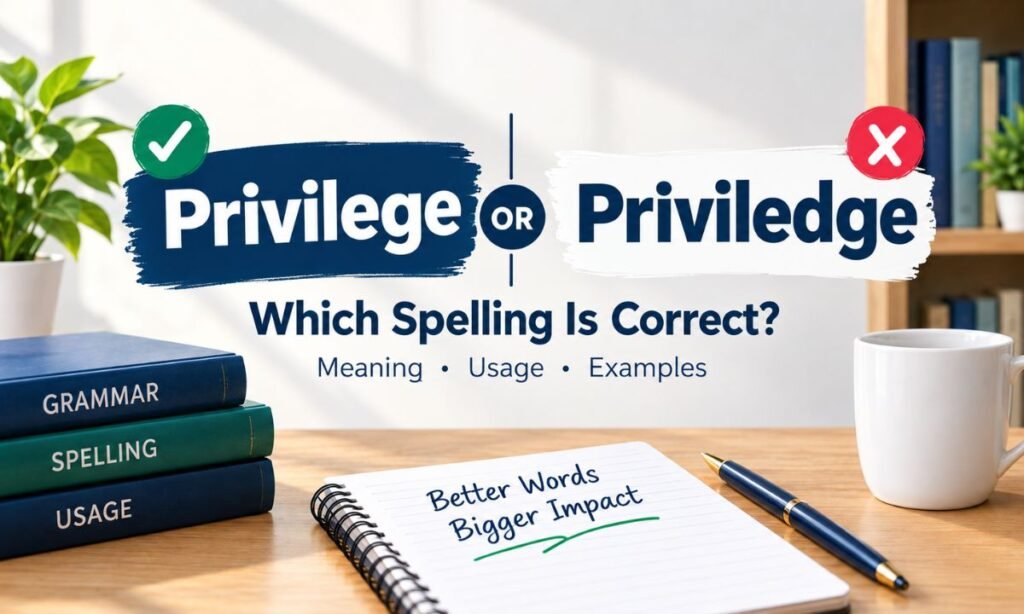

If you’ve ever paused mid-sentence, unsure whether to write “privilege” or “priviledge,” you’re not alone. This is one of the most commonly misspelled words in English, and the confusion makes sense once you look at how the word is built. The short answer: privilege is correct. Priviledge is not a word — it’s a spelling error, though a very common one.
This guide breaks down exactly why the mistake happens, how to spell and use the word correctly in every context, and how to make sure you never second-guess yourself again.
Comparison Overview
Before diving into definitions and rules, here’s the quick version.
- Privilege — the correct, dictionary-recognized spelling of the noun and verb.
- Priviledge — an incorrect spelling caused by adding an extra “d” before “ledge.”
Both words are pronounced the same way, which is exactly why so many writers add that extra letter. English has plenty of words that end in “-ledge,” such as knowledge and acknowledge, and the brain naturally borrows that pattern for privilege. But privilege doesn’t follow the “-ledge” family. It ends in “-lege,” with no “d” anywhere near the final syllable.
Definition of Privilege
Privilege is a noun that refers to a special right, benefit, or advantage granted to a specific person or group, often one that isn’t available to everyone else. It can describe something earned, something inherited, or something simply given by circumstance.
The word also works as a verb. To “privilege” something means to give it special status or to treat it as more important than something else, as in academic or legal writing.
Merriam-Webster and Oxford both list privilege as coming from the Latin “privilegium,” a combination of “privus” (private) and “lex” (law) — literally a “private law” that applied to one person or group rather than everyone.
Examples of Privilege
- It was a privilege to attend the ceremony.
- Voting is a privilege that many people take for granted.
- Employees at the company enjoy several privileges, including flexible hours.
- The judge ruled that the conversation was protected by attorney-client privilege.
- Growing up with financial stability is a privilege not everyone shares.
- The professor privileges close reading over quick summaries in her seminar.
Each sentence uses the correct spelling, and each shows a slightly different shade of meaning — an honor, a right, a legal protection, or an academic emphasis.
Definition of Priviledge
Priviledge has no definition because it isn’t a real word. It doesn’t appear in Merriam-Webster, Oxford, Cambridge, or Collins. Spell-checkers flag it automatically, and style guides treat it strictly as an error to correct, not a variant to accept.
That said, it’s worth understanding why the mistake is so widespread. Writers usually aren’t guessing randomly — they’re applying a spelling pattern that works for other English words but happens to fail here.
Examples of Incorrect Usage
- ❌ It’s a priviledge to be here today.
- ❌ Not everyone has the priviledge of a good education.
- ❌ She felt priviledged to be chosen.
- ❌ The company offers special priviledges to loyal customers.
Every one of these should replace “priviledge” or “priviledged” with “privilege” or “privileged.”
Main Differences Between Privilege and Priviledge
| Feature | Privilege | Priviledge |
|---|---|---|
| Correct spelling | Yes | No |
| Found in dictionaries | Yes | No |
| Pronunciation | /ˈprɪv.əl.ɪdʒ/ | Same as privilege |
| Accepted in formal writing | Yes | Never |
| Origin | Latin “privilegium” | Misspelling based on “-ledge” pattern |
| Used as noun and verb | Yes | No |
Key Difference
The core difference isn’t about meaning — it’s purely about spelling. Priviledge carries no separate definition, no regional variant, and no historical usage that dictionaries recognize. If you mean “special advantage” or “special right,” privilege is the only correct choice, in every English-speaking country and every writing context.
Why Do People Misspell Privilege?
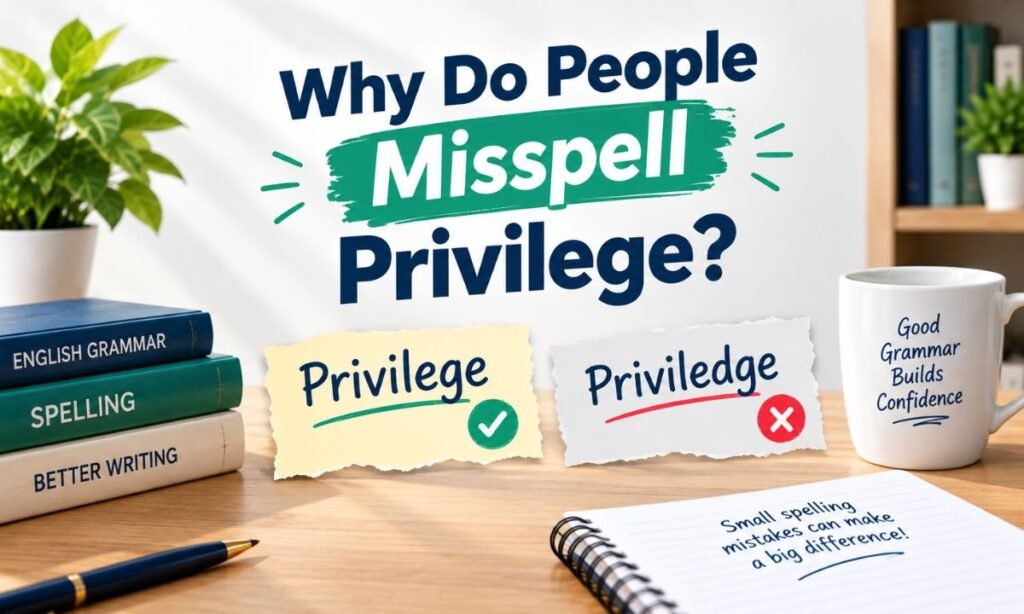
The mistake almost always comes down to sound-alike confusion with other, more common “-ledge” words. Think about how frequently these appear in everyday writing:
- knowledge
- acknowledge
- ledge
Each of those words genuinely contains a “d” before “ledge.” Since privilege ends in a sound that seems to match, writers often assume the spelling should match too. Add in the fact that privilege is a longer, less phonetic word, and the extra letter creeps in without anyone noticing.
Autocorrect tools catch this error most of the time, which is part of why the mistake still shows up so often in handwritten notes, quick emails, and informal social posts where spell-check isn’t running.
Memory Trick
Here’s a simple way to lock in the correct spelling: think of the phrase “I get a privilege, not a priviledge, because it’s LEGAL.” Privilege ends in “-lege,” the same three letters that start the word “legal.” Since a privilege is historically tied to a “private law” (privi + lege), connecting “lege” to “legal” gives your brain a real reason to skip the extra “d.”
Another quick check: say the word slowly and count the syllables you actually pronounce — priv-i-lege. There’s no “d” sound at all when you say it correctly, which is your cue that there shouldn’t be one in the spelling either.
Comparison Table
| Aspect | Privilege | Priviledge |
|---|---|---|
| Word type | Noun / Verb | Not a word |
| Dictionary status | Standard entry | Not listed |
| Common in | Formal and informal writing | Typos, informal writing only |
| Grammar checkers | Accept it | Flag it as an error |
| Example sentence | “Education is a privilege.” | “Education is a priviledge.” (incorrect) |
Grammar Guide
How Each Term Is Used in Sentences
Privilege functions in three main ways:
- As a singular noun: “It was a privilege to meet you.”
- As a plural noun: “The club offers members several privileges.”
- As a verb: “The policy privileges long-term employees over new hires.”
Priviledge doesn’t function grammatically at all, since it isn’t a recognized word. Any sentence using it is grammatically incorrect regardless of structure.
Common Mistakes Learners Make
- Adding a “d” before “ledge” because of words like knowledge.
- Writing “priviledged” instead of “privileged” in the past tense or adjective form.
- Confusing privilege with “privledge” or “privilage,” two other frequent misspellings.
- Assuming British or Australian English spells it differently (it doesn’t).
- Mixing up privilege with “prestige” or “previlege,” which are unrelated or incorrect forms.
Simple Rules to Remember
- Privilege ends in “-lege,” not “-ledge.”
- There is only one “d” in the entire word, and it appears in “privileged,” never doubled or shifted.
- The word is spelled the same in American, British, Canadian, and Australian English.
- When adding suffixes such as “-d” or “-ing,” keep the base spelling intact: privileged, privileging.
Quick Tips for Writing and Speaking
- Run a spell-check before submitting formal documents, but don’t rely on it entirely.
- Read your sentence aloud — if you hear “priv-i-lidge” with no “d” sound, write it that way too.
- Keep a short list of your own frequent typos, including this one, and glance at it before sending important emails.
- When in doubt, search the word in a dictionary rather than guessing from memory.
When to Use Each One
Use Privilege When
- You’re describing a special right, benefit, or advantage.
- You’re writing formally — essays, resumes, business emails, reports.
- You’re referring to legal protections, such as attorney-client privilege.
- You’re using it as a verb to describe giving something special status.
- You’re discussing social, economic, or educational advantages.
Use Priviledge When
Never. There is no context, formal or informal, academic or casual, where “priviledge” is the correct choice. If you’re tempted to use it, replace it with “privilege” every time.
When NOT to Use Each One
Do Not Use Privilege Incorrectly
Privilege is spelled correctly on its own, but it can still be used awkwardly. A few things to watch for:
- Don’t confuse it with “right.” A right is guaranteed to everyone; a privilege is granted conditionally and can be revoked. Saying “breathing is a privilege” would be inaccurate, since breathing is a biological necessity, not a granted advantage.
- Don’t overuse the word as a filler in writing where “benefit” or “opportunity” fits better.
- Don’t forget the correct verb forms: privileged, privileging — not “priviledged” or “priviledging.”
Do Not Use Priviledge
There’s no scenario, exception, or regional spelling where priviledge is acceptable. Whether you’re texting a friend, writing a college essay, or drafting a legal document, correct it to privilege every single time you see it.
Which One to Use (Decision Guide)
Ask yourself these quick questions:
- Am I referring to a special right, honor, or advantage? → Use privilege.
- Am I about to type a “d” before “ledge”? → Stop. Remove the “d.”
- Does spell-check underline the word in red? → It’s likely priviledge. Fix it.
- Am I unsure? → Default to privilege. It’s the only correct spelling in every situation.
Real-World Practical Examples
Privilege Examples
- “Working with this team has truly been a privilege,” she said at the retirement dinner.
- Attending college was a privilege that not everyone in her family had access to.
- The senator argued that diplomatic privilege shouldn’t shield officials from accountability.
- As a longtime customer, he was privileged with early access to the sale.
- Freedom of speech is a right, while a press pass to a private event is a privilege.
Priviledge Examples
There are no correct examples, since the word doesn’t exist. Below are common incorrect sentences, each followed by its fix:
- ❌ “It’s a great priviledge to speak here.” → ✅ “It’s a great privilege to speak here.”
- ❌ “She felt priviledged after winning the scholarship.” → ✅ “She felt privileged after winning the scholarship.”
- ❌ “Members get priviledged access to events.” → ✅ “Members get privileged access to events.”
Self-Assessment (Fill in the Blanks)
Test yourself before checking the answers below.
- It was a great _______ to work alongside such a talented team.
- The lawyer cited attorney-client _______ during the hearing.
- Not every child has the _______ of a stable home.
- She was _______ enough to travel the world before turning twenty.
- The company grants special _______ to its longest-serving staff.
- He never took his education for granted; he saw it as a _______.
- The committee discussed whether the policy unfairly _______ certain applicants.
- Access to clean water should be a right, not a _______.
Answers
- privilege
- privilege
- privilege
- privileged
- privileges
- privilege
- privileges
- privilege
Frequently Asked Questions
Is there a D in privilege?
There is exactly one “d,” and it only appears when forming “privileged” or “privileging.” The base word “privilege” itself has no “d” before “lege.”
How do you spell privilege in the UK?
The same way as in the US: privilege. There is no separate British spelling variant.
How do you spell privilege in Australia?
Also privilege, with the identical spelling used across American, British, Canadian, and Australian English.
Is it an insult to call someone privileged?
Not inherently. It’s a neutral, descriptive term for having advantages others may lack; whether it feels like criticism usually depends on tone and context, not the word itself.
Conclusion
The debate between privilege and priviledge isn’t really a debate at all — privilege is correct, and priviledge is a misspelling that comes from mixing up two different English spelling patterns. Once you connect “privilege” to words like “legal” instead of “knowledge,” the correct spelling becomes much easier to remember for good. Keep this guide handy, run through the self-assessment occasionally, and you’ll never second-guess this word again.