
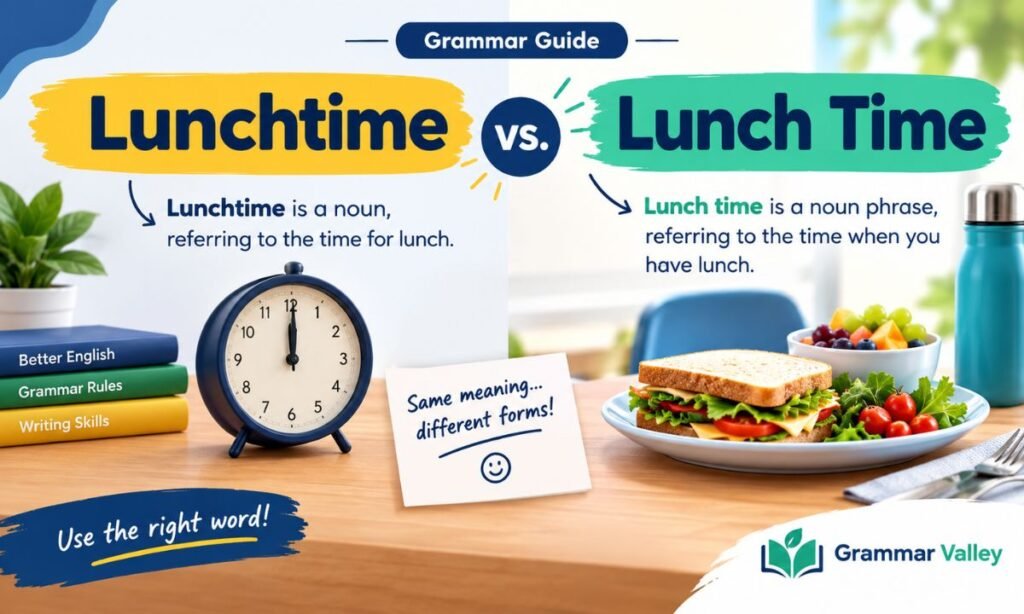

You’re typing an email, and you pause. Should it be “lunchtime is at noon” or “lunch time is at noon”? That tiny space between two letters has confused writers, students, and even seasoned editors for years.
The good news: both forms exist for a reason, and once you understand the grammar behind them, you’ll never second-guess yourself again. This guide walks through the meaning, the rules, the history, and the everyday usage of both “lunchtime” and “lunch time,” with real examples you can apply right away.
Understanding Lunchtime vs. Lunch Time
At the core, both terms describe the same idea: the part of the day set aside for eating lunch. The difference isn’t about meaning — it’s about form.
“Lunchtime” is a single compound word. “Lunch time” is two separate words functioning as a noun phrase. English does this constantly. Words start out as two separate terms, get used together so often that people start writing them close together, and eventually merge into one word entirely. Think of “any more” becoming “anymore,” or “every day” versus “everyday.”
Lunch followed the same path. As the word became common in daily speech during the 19th and 20th centuries, writers gradually dropped the space, and “lunchtime” became the standard, dictionary-recognized spelling.
What Each Term Really Means
Here’s a simple side-by-side look at how each version behaves in a sentence.
| Feature | Lunchtime | Lunch Time |
|---|---|---|
| Word type | Compound noun | Noun phrase (two words) |
| Formality | Preferred in formal and everyday writing | Slightly more casual or descriptive |
| Dictionary status | Recognized in major dictionaries | Recognized, but less standard |
| Common use | “It’s lunchtime already.” | “What’s the lunch time policy here?” |
| Typical tone | Neutral, natural | Slightly more literal or emphatic |
Definition of “Lunchtime”
“Lunchtime” refers to the general period of the day — usually somewhere between 11 a.m. and 2 p.m. — when people typically stop working or studying to eat their midday meal. It functions as a single noun, much like “bedtime” or “playtime.”
Because it’s treated as one word, it can sit comfortably in almost any sentence without sounding forced. Dictionaries such as Cambridge and Oxford list “lunchtime” as the standard entry, and most style guides recommend it for professional and published writing.
Quick Example
“The office gets quiet during lunchtime because most people leave their desks.”
Definition of “Lunch Time”
“Lunch time,” written as two words, technically means the same thing but is built as a noun phrase — “lunch” modifying “time.” It’s grammatically correct and still shows up often in casual writing, older texts, and informal conversation. Some writers also use it when they want to draw more attention to the word “time” itself, such as when discussing a specific scheduled slot rather than the general concept of the midday break.
Quick Example
“Please confirm the exact lunch time for tomorrow’s meeting.”
Grammar Rules Behind Both Forms
English compound words don’t form randomly. There’s a predictable pattern behind how two separate words merge into one, and lunch is a textbook case.
Compound Nouns Becoming One Word
Compound nouns typically go through three stages:
- Open form – two separate words (lunch time)
- Hyphenated form – joined with a hyphen (lunch-time)
- Closed form – fully merged into one word (lunchtime)
Not every compound reaches stage three, but the ones used frequently enough in daily speech usually do. “Lunchtime” has already reached the closed form, which is why it now appears as the default spelling in dictionaries, news style guides, and grammar checkers.
Other examples that followed the same journey include:
- Break + fast → breakfast
- Week + end → weekend
- Note + book → notebook
- Break + time → breaktime
Hyphenation Notes
You may occasionally see “lunch-time” with a hyphen, especially in older books or certain British publications. This form isn’t wrong, but it’s considered outdated. Modern style guides, including AP style, skip the hyphen entirely and use “lunchtime” as one word. If you’re writing anything meant for a wide audience today, the hyphenated version is best avoided.
Formality Levels
Neither form is “incorrect,” but each carries a slightly different tone:
- Lunchtime fits formal writing, business communication, school policies, news articles, and everyday conversation.
- Lunch time leans casual or emphatic. It sometimes appears in spoken English, older documents, or when a writer wants to stress the word “time” specifically, such as “lunch time slots” on a booking form.
A related question people often search is whether there’s a true lunch time synonym. The closest equivalents are “midday break,” “noon break,” or simply “lunch hour,” all of which describe the same window of the day without changing the core meaning.
Practical Usage: When to Choose One Over the Other
Everyday Usage
In day-to-day writing — emails, texts, articles, social posts — “lunchtime” is almost always the safer, more natural choice. It reads smoothly and matches how most native speakers actually write the word.
Use “lunchtime” when you’re:
- Describing a general daily routine (“I usually go for a walk at lunchtime”)
- Writing for a blog, brochure, or business document
- Referring to the broader concept of the midday break rather than a specific clock time
When “Lunch Time” Makes Sense
“Lunch time” still has its place. It works well when:
- You’re filling out a form with separate labeled fields, such as “Start Time” and “Lunch Time”
- You want to emphasize the exact scheduling detail rather than the general concept
- You’re quoting older text or matching a specific house style that prefers the open form
Historical Development of the Term
Early Appearances
The word “lunch” itself grew out of “luncheon,” a term with roots stretching back to Middle English, where it originally referred to a small piece or thick slice of something, often food. By the 1800s, “lunch” had settled into its modern meaning: a light midday meal.
As factories and offices adopted fixed working hours during the Industrial Revolution, workers needed a shared term for their designated meal break. “Lunch time,” written as two words, started appearing in newspapers, factory schedules, and household guides throughout the late 1800s.
Language Trend
Over the following decades, as the phrase appeared constantly in print, the space between the words naturally began to disappear — a pattern linguists call lexicalization. By the mid-20th century, “lunchtime” had become common enough that dictionaries recognized it as the primary spelling, and it has stayed that way ever since.
Regional and Cultural Usage Differences

Usage in English-Speaking Countries
Spelling preference doesn’t vary much by country, but cultural habits around the meal itself do.
United States
American workplaces generally treat lunchtime as a short, efficient break — often 30 to 60 minutes — squeezed between morning and afternoon tasks. “Lunchtime” is the standard spelling in American publications, and lunch time hours in the USA typically fall between 12:00 p.m. and 1:00 p.m.
United Kingdom
British English also favors “lunchtime” as one word, though “dinner” sometimes refers to the midday meal in certain regional or older usages, which can confuse learners. School lunchtimes in the UK are often longer than American ones, sometimes stretching close to an hour.
Canada
Canadian English mirrors both American and British conventions, with “lunchtime” as the dominant spelling. Office lunch breaks tend to run similarly to those in the US, generally around 30 to 60 minutes.
Australia
Australians commonly use “lunchtime” in everyday speech and writing, and workplace lunch breaks are often protected by law, with a minimum unpaid break required after a set number of work hours.
Cross-Cultural Interpretations of Lunchtime
Mediterranean Countries
In countries like Spain, Italy, and Greece, lunchtime is treated as a major event of the day rather than a quick pause. Meals often start later, sometimes between 1 and 3 p.m., and can last well over an hour, occasionally paired with a traditional afternoon rest period.
Northern Europe
Countries such as Germany, Sweden, and the Netherlands tend to keep lunch shorter and earlier, often between 11:30 a.m. and 1 p.m., with an emphasis on returning to work promptly.
Asian Countries
In many parts of Asia, lunchtime is a communal event. In Japan, for example, workplace and school lunches are often eaten together at a set time, while in countries like China and South Korea, lunch breaks frequently include a short rest period afterward.
Lunchtime in Daily Life
Workplace Lunchtimes
Workplace lunch breaks vary widely depending on industry, country, and company culture. Some businesses schedule a fixed lunchtime for the entire team, while others allow flexible timing based on workload.
Interesting Workplace Patterns
- Many office workers eat lunch at their desks rather than taking a full break
- Remote workers often report longer, more flexible lunchtimes than in-office staff
- Some companies now offer “wellness lunch hours” that include time for a short walk or exercise
School Lunchtimes
Elementary School
Younger students usually have shorter, more structured lunchtimes, often paired with supervised recess immediately before or after the meal.
Middle & High School
Older students typically get a slightly longer lunch period, sometimes with more freedom to choose where and with whom they eat.
University
College lunchtimes are usually unstructured. Students pick their own schedule, and lunch might happen anywhere from 11 a.m. to 3 p.m. depending on class timing.
Lunchtime Etiquette and Social Expectations
General Etiquette
A few habits are widely expected across most English-speaking workplaces and schools:
- Avoid strong-smelling food in shared spaces when possible
- Don’t linger too long if others are waiting to use a break room
- Silence phone calls or step away from shared tables when taking one
Cultural Etiquette Examples
- In Japan, it’s common to say a short phrase of gratitude before and after eating, even during a quick workplace lunch
- In France, eating at your desk is often frowned upon; lunch is treated as a proper sit-down break
- In the US, a fast, casual lunch — sometimes eaten while working — is widely accepted
Common Misconceptions
❌ “Lunchtime” always means noon.
Lunchtime refers to a general window of the day, not one fixed clock time. It can start as early as 11 a.m. or run past 2 p.m., depending on the person, workplace, or country.
❌ “Lunch time” is incorrect.
Both forms are grammatically valid. “Lunch time” is simply less common in modern formal writing, not wrong.
❌ Both terms mean the exact same thing.
They share the same core meaning, but “lunchtime” reads as a general concept, while “lunch time” can sound more like a specific, scheduled moment.
❌ “Lunchtime” is British and “lunch time” is American.
This is a myth. Both American and British English favor the closed form, “lunchtime,” in dictionaries and formal writing.
Related Mealtime Expressions
Lunch isn’t the only meal with a compound-word cousin. Here’s how similar terms compare:
| Meal | Compound Form | Two-Word Form |
|---|---|---|
| Lunch | Lunchtime | Lunch time |
| Dinner | Dinnertime | Dinner time |
| Breakfast | Breakfast time* | Breakfast time |
| Tea (UK) | Teatime | Tea time |
*Note: “breakfast” doesn’t have a widely accepted single-word compound with “time,” so it usually stays as two words.
Examples in Real Sentences
Using “Lunchtime”
- “Lunchtime traffic near the office gets heavy every day.”
- “She always reads a few pages at lunchtime.”
- “What time is lunchtime at your school?”
Using “Lunch Time”
- “Please list your preferred lunch time on the form.”
- “The lunch time for the conference has changed to 1 p.m.”
- “We’re still finalizing the lunch time schedule for staff.”
Side-by-Side Comparison
| Sentence Purpose | Better Choice | Example |
|---|---|---|
| Everyday conversation | Lunchtime | “See you at lunchtime!” |
| Scheduling a specific slot | Lunch time | “Enter your lunch time below.” |
| Formal writing or articles | Lunchtime | “Lunchtime habits vary by country.” |
| Emphasizing exact timing | Lunch time | “Confirm the lunch time before Friday.” |
Frequently Asked Questions
Is lunchtime 1 word or 2?
It’s one word in modern, standard English. “Lunch time” as two words is still grammatically correct but less common today.
What is the time for lunchtime?
There’s no fixed hour, but most people eat lunch somewhere between 11 a.m. and 2 p.m., depending on their country and schedule.
Which is correct: “in lunch time” or “at lunchtime”?
“At lunchtime” is correct. English pairs the preposition “at” with specific times and periods, not “in.”
Is it “lunchtime” or “lunch break”?
Both are correct but mean slightly different things. “Lunchtime” refers to the general period of the day, while “lunch break” refers to the actual pause from work or class.
Conclusion
So, lunchtime or lunch time — which one should you use? For nearly every situation, “lunchtime” is the safer, more modern, and more widely accepted choice. It’s the form dictionaries recognize, the form style guides recommend, and the form that fits naturally into everyday writing.
“Lunch time” isn’t wrong, though. It still has a place in specific scheduling contexts or when you want to slow the sentence down and emphasize timing rather than the general concept. Once you understand the small grammatical difference between a compound noun and a noun phrase, choosing between the two becomes second nature — no more pausing mid-sentence to wonder which one looks right.