
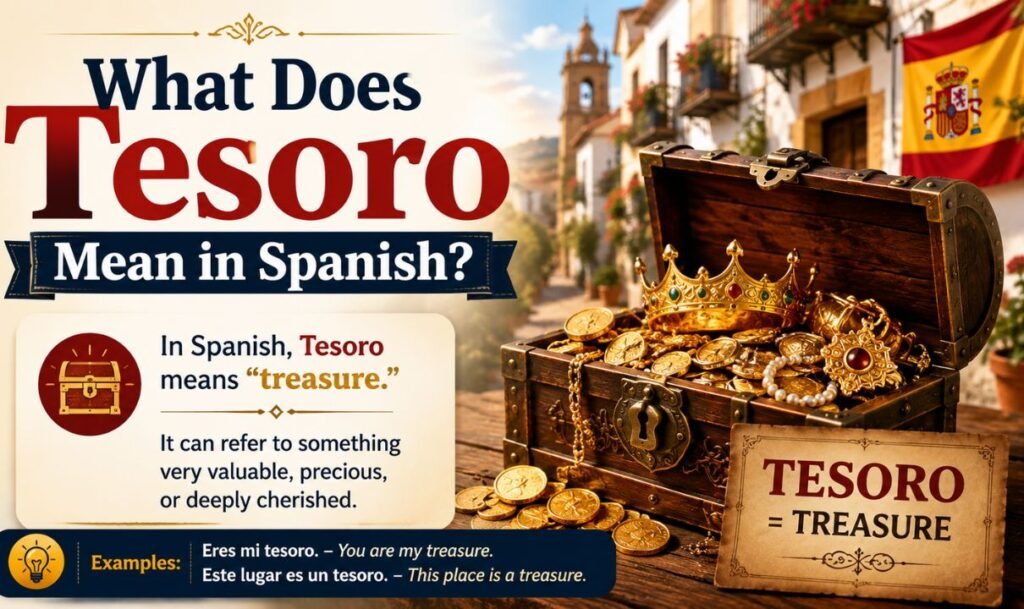

Someone just called you “tesoro,” and now you’re stuck between smiling and grabbing your phone to look it up. That’s a normal reaction. The word sounds soft, a little old-fashioned, and clearly affectionate but affectionate in what way, exactly?
Here’s the short version: tesoro is a Spanish word that has carried real weight for centuries, and the way people use it today still reflects that history. This guide breaks down the literal meaning, the emotional layers, and the situations where it shows up from a grandmother’s text message to a caption on Instagram so you know exactly what’s being said to you, and how to respond.
What Does Tesoro Mean | Quick Meaning
Simple definition
Tesoro is the Spanish word for “treasure.” At its root, it describes something of great value gold, jewels, a hidden stash of coins in an old pirate story. But Spanish speakers stretched that meaning long ago to cover people too. When tesoro is aimed at a person instead of an object, it works like “sweetheart,” “darling,” or “my precious one” in English.
Short examples
- “Eres mi tesoro.” — “You are my treasure.”
- “Gracias, tesoro.” — “Thanks, sweetheart.”
- “¿Cómo estás, tesoro?” — “How are you, darling?”
Notice that tesoro doesn’t need “mi” (my) in front of it to function as a nickname. Spanish speakers often drop the possessive and use tesoro on its own, the same way an English speaker might just say “sweetheart” without adding “my.”
Origin & Background
Tesoro traces back to the Latin word thesaurus, meaning a store of valuable things — the same root that gave English the word “thesaurus” (a treasury of words). Spanish inherited the term directly, and for a long time it referred strictly to material wealth: gold, silver, jewels, buried riches.
The shift toward using tesoro as a term of endearment happened gradually, the way most affectionate language does. Parents began describing their children as their greatest treasure. That phrasing eventually shortened into direct address — instead of saying “you are my treasure,” people started simply saying “tesoro” as a name in itself. From there it spread into romantic relationships, close friendships, and family speech across the Spanish-speaking world.
It’s worth noting that tesoro isn’t slang, and it isn’t a recent internet invention. It has been part of everyday Spanish for generations, which is part of why it still feels sincere rather than trendy.
You May Also Like: Cracked Slang Meaning: What It Really Means in Gaming, Texting, and Social Media
Real-Life Conversations
Seeing tesoro used in actual exchanges makes the meaning click faster than any dictionary definition.
WhatsApp Conversation (Mother & Daughter)
Mamá: ¿Ya comiste, tesoro? Hija: Sí, mamá, no te preocupes ❤️
(Translation: “Did you eat already, sweetheart?” / “Yes mom, don’t worry.”)
Instagram DM (Romantic)
Person A: Te extraño mucho. Person B: Y yo a ti, tesoro.
(Translation: “I miss you a lot.” / “Me too, my love.”)
Text Message (Grandparent)
Abuela: Feliz cumpleaños, tesoro. Que Dios te bendiga siempre.
(Translation: “Happy birthday, treasure. May God bless you always.”)
TikTok Comment
User: Le dice tesoro en cada video, qué lindo 🥹
(Translation: “He calls her tesoro in every video, so sweet.”)
Across all four examples, the word itself never changes — but the feeling behind it shifts with the speaker. A mother’s tesoro carries worry and care. A grandparent’s carries tenderness built over decades. A romantic partner’s carries intimacy. That flexibility is exactly what makes tesoro so common in Spanish.
Emotional & Psychological Meaning

Calling someone “tesoro” isn’t just giving a compliment — it’s sending a subtle signal that they are rare and worth protecting. Linguists who study terms of endearment explain that people use pet names like this to strengthen relationships. Every time someone says “tesoro,” they reinforce closeness, almost like offering a verbal handshake that quietly says, “You matter to me,” without stating it outright.
When someone uses tesoro with you regularly, it usually points to a few things:
- They see you as valuable, not replaceable.
- They feel comfortable enough to be openly affectionate.
- The relationship has moved past strictly formal territory.
That said, the emotional weight varies by relationship. From a parent, it signals unconditional care. Then from a partner, it often signals romantic attachment. From a friend, it can simply mean warmth and familiarity. Context always does more work than the word itself.
You May Also Like: What Does Delegate Mean? Definition, Examples & Synonyms
Usage in Different Contexts
Social Media
On Instagram and TikTok, tesoro shows up constantly in captions, comment sections, and anniversary posts — often paired with a heart emoji. Even English-speaking couples sometimes borrow the word because it reads as more tender than “babe” without sounding overly formal.
Friends & Relationships
Among close friends in many Latin American countries and Spain, tesoro can be used platonically, especially between women. It signals fondness, not romance, and tone of voice usually makes that distinction obvious to native speakers.
Work or Professional Settings
Tesoro has no place in professional communication. Using it with a coworker, client, or employee — even as a joke — can come across as inappropriate or overly familiar. Stick to first names or standard professional titles in that setting.
Casual vs Serious Tone
| Tone | Example | Feel |
|---|---|---|
| Casual | “Oye, tesoro, ¿qué haces?” | Light, everyday affection |
| Serious | “Eres el mayor tesoro de mi vida.” | Deep, deliberate declaration |
The same word can sound throwaway or profound depending on delivery, phrasing, and who’s speaking.
Common Misunderstandings
It always means romantic love. Not true. Parents, grandparents, and close friends use it just as often as romantic partners do.
It’s only used in Spain. Also false. Tesoro is used across Spain and Latin America, though how frequently it comes up can vary by country and generation.
It’s outdated. It isn’t. Tesoro remains active in daily conversation, music lyrics, and social media captions across Spanish-speaking communities.
Anyone can use it in any situation. Context still matters. Using tesoro with a stranger, a coworker, or someone you’ve just met can feel forward or out of place.
Tesoro in Italian, and Other Related Questions
Because tesoro looks and sounds similar in more than one language, a lot of confusion comes from mixing them up. Here’s a quick clarification.
Mi tesoro meaning Italian: “Mi tesoro” is actually the Spanish phrasing. In Italian, the equivalent is “il mio tesoro” or, more commonly said aloud, “tesoro mio.” Both mean “my treasure,” but the word order differs between the two languages.
What does tesoro mean in English: Treasure — literally. As a nickname, it translates closest to “darling,” “sweetheart,” or “precious.”
Tesoro meaning in love: In a romantic context, tesoro functions like “my love” or “my darling,” expressing that the other person is deeply cherished.
What does tesoro mean in Italian: Just as in Spanish, tesoro means “treasure” in Italian, and it’s used as an affectionate nickname for children, partners, and close family.
Tesoro pronunciation: In Spanish, it’s pronounced teh-SO-roh. In Italian, it’s very similar — teh-ZO-ro, with a softer “s” sound.
What does tesoro mio mean: This is the Italian phrasing for “my treasure” or “my darling.” Spanish speakers would instead say “tesoro mío” or “mi tesoro.”
Tesoro meaning in Japanese: Tesoro isn’t a native Japanese word, but it has been borrowed into Japanese pop culture and branding (including product and shop names) because of its warm, romantic sound — not because it carries a literal Japanese meaning.
Tesoro meaning in Korean: Similarly, tesoro has no native Korean meaning. It occasionally appears in Korean media or branding as a loanword valued for its tone rather than its dictionary definition.
Key Insight
Tesoro exists in both Spanish and Italian with nearly identical meanings and emotional uses, but the grammar differs — Spanish favors “mi tesoro,” while Italian favors “tesoro mio.” Outside these two languages, tesoro is a borrowed word chosen for how it sounds, not for any built-in meaning.
Variations & Related Terms
- Mi tesoro — “My treasure,” a more personal, intimate version.
- Tesoro mío — A slightly poetic Spanish variation with the possessive placed after the noun.
- Cariño — “Affection” or “sweetheart,” a softer, more general endearment.
- Mi amor — “My love,” carrying a stronger romantic charge than tesoro.
- Cielo — Literally “sky,” used the way English speakers might say “sweetie.”
- Reina — “Queen,” used to express admiration, often romantically.
- Rey — “King,” the masculine counterpart to reina.
- Mi vida — “My life,” signaling deep emotional attachment.
- Corazón — “Heart,” a warm, affectionate nickname.
- Princesa / Príncipe — “Princess” / “Prince,” often playful rather than serious.
Each of these terms overlaps with tesoro but carries its own shade of meaning — some lean more romantic, others more familial or platonic.
How to Respond When Someone Uses It
Casual Replies
- “Aww, gracias.”
- “Qué lindo, gracias.”
- “You’re too sweet.”
Funny Replies
- “Does that make me gold or just really shiny?”
- “Careful, I might start expecting a treasure chest.”
Mature / Confident Replies
- “That means a lot, thank you.”
- “I appreciate you saying that.”
Private / Respectful Replies
- “That’s really kind of you.”
- “I feel the same way.”
The right response depends entirely on who’s speaking. A playful reply works well with a partner or close friend, while a simple “gracias” is safer with someone you don’t know as well.
You May Also Like: DPWM Meaning: What Does DPWM Mean in Texting and Social Media?
Regional & Cultural Usage
Western Culture
In English-speaking countries, tesoro tends to appear in bilingual relationships, Spanish-language learning communities, and romantic social media captions. It often carries an exotic or especially tender quality precisely because it’s borrowed rather than native.
Asian Culture
Direct romantic language is expressed differently across Asian cultures, often more privately than publicly. Still, younger audiences exposed to Spanish-language music and shows have picked up tesoro as an expressive, romantic-sounding word in online spaces.
Middle Eastern Culture
Affectionate terms are common within families throughout the Middle East, but tesoro specifically tends to surface mainly through global media, music, or online interactions rather than everyday local speech.
Global Internet Usage
Spanish-language music, telenovelas, and social media have carried tesoro well beyond Spanish-speaking countries. Many non-Spanish speakers now recognize and use it casually online, drawn to its soft, romantic sound even without full awareness of its cultural depth.
Frequently Asked Questions
Can you say tesoro to a girl?
Yes. Tesoro is commonly used for women and girls, both romantically and platonically, without changing form.
Is Tesoro Italian or Spanish?
It’s used in both languages with nearly the same meaning, though it originated from the same Latin root, thesaurus, independently adapted by each.
Does Tesoro mean darling?
As a nickname, yes — tesoro functions similarly to “darling,” “sweetheart,” or “precious” in English.
Is tesoro a romantic term?
It can be, but it’s just as commonly used by parents, grandparents, and close friends without any romantic meaning at all.
Conclusion
Tesoro means “treasure” — but by the time it reaches someone’s ears as a nickname, it’s really saying something closer to “you matter to me.” Whether it comes from a parent checking in over text, a partner signing off a message, or a grandparent wishing you a happy birthday, the intent behind the word stays remarkably consistent: you are valued.
Understanding tesoro means understanding that Spanish, like most languages, uses everyday words to carry emotional weight far beyond their dictionary definition. Next time someone calls you tesoro, you’ll know exactly what’s behind it.