
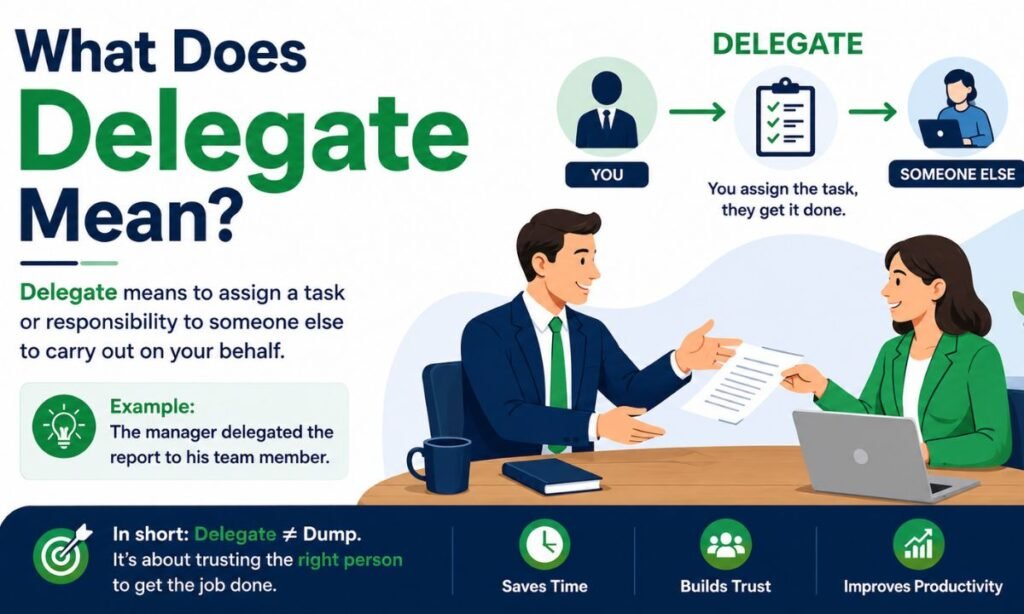

If someone just texted you “I can’t come, I’ll delegate it to Sara” and you paused for a second you’re not alone. “Delegate” is one of those words everyone half-understands but rarely explains well. This guide breaks it down in plain language, with real conversation examples, workplace context, and the exact situations where the word shows up in everyday life.
What Does Delegate Mean: Quick Meaning
In simple terms, to delegate means to hand over a task, responsibility, or decision to someone else, while still keeping overall accountability for the outcome. People also use delegate as a noun to describe a person who represents a larger group at a conference, union meeting, or political convention.
So the word carries two jobs:
- Verb – to assign work, authority, or a decision to another person (“She delegated the report to her assistant.”)
- Noun – a representative acting on behalf of others (“Each state sent a delegate to the summit.”)
Both meanings share one root idea: someone is acting in place of someone else.
Origin & Background of the Word “Delegate”
The word traces back to the Latin term delegare, built from de- (“away”) and legare (“to send as an envoy” or “to appoint”). Latin speakers used it for sending an official representative on someone’s behalf, which is exactly why the noun form still means “representative” today.
The noun entered English in the 1300s, describing a person sent to act for others. The verb form followed centuries later, around the early 1500s, gradually taking on its modern meaning of assigning tasks or authority. Words like legacy, colleague, and relegate share the same Latin ancestor, which explains why they all carry a sense of “passing something on.”
A fun fact: the pronunciation of delegate changes depending on whether it functions as a noun or a verb. As a noun, it rhymes with “delicate” (DEL-uh-git). As a verb, it rhymes with “elongate” (DEL-uh-gate). Native speakers rarely notice they’re doing this, but it’s a useful trick if you want to sound natural.
Real-Life Conversations (How People Actually Use “Delegate”)
Dictionary definitions are useful, but people rarely talk like a textbook. Here’s how the word actually shows up in daily messages.
WhatsApp Chat (Office Team)
Amir: Can’t finish the client deck today, swamped with calls. Hina: No worries, delegate the design part to Zara, she’s free after 3. Amir: Good call, doing that now.
Here, “delegate” simply means passing off a specific piece of work to a teammate who has time.
Instagram DMs (Freelancer Friends)
Sara: Girl how do you manage 5 clients at once?? Noor: Honestly, I delegate the editing to a VA now. Best decision ever.
Among freelancers, delegating often means outsourcing repetitive tasks so you can focus on higher-value work.
Text Message (Family)
Mom: Who’s picking up the cake for the party? You: I delegated that to Dad lol, he loves feeling important 😂
In casual family talk, “delegate” is often used half-jokingly, poking fun at handing off a small errand.
Emotional & Psychological Meaning of Delegation
Delegating goes beyond management skills. It reflects how much you trust others, how you handle control, and how you view your own value. Many people avoid delegating because they fear losing control or believe no one else can do the job as well as they can. That anxiety is common, especially among perfectionists and new managers.
On the flip side, being delegated a task can feel like a vote of confidence. It signals “I trust you enough to handle this.” That’s why good delegation, done with clear expectations, tends to build stronger relationships, while poor delegation (dumping work without guidance) can breed resentment.
Learning to delegate well is really about learning to let go of the belief that everything has to run through you.
Usage in Different Contexts
The word flexes depending on where it’s used. Below is a breakdown of how tone and meaning shift across settings.
Social Media
Online, “delegate” is often used loosely and humorously — like joking about “delegating” the dishes to a roommate, or captioning a photo of a pet “helping” with chores. It rarely carries formal weight here.
Friends & Relationships
Among friends, delegating usually means splitting responsibilities for a shared plan — a trip, a group gift, or a party. It’s casual and rarely needs explanation; everyone just understands their assigned piece.
Work & Professional Settings
This is where the word carries its most serious weight. In offices, delegation is a core leadership skill tied to productivity, trust, and team growth. Managers are often evaluated on how well they delegate rather than how much they personally handle.
Common Misunderstandings About Delegation
Common myths:
- Delegating means dumping unwanted work on someone else.
- Good leaders do everything themselves to “prove” their value.
- Delegating means losing control of the outcome entirely.
- Only managers or bosses can delegate.
Reality:
Delegation is about matching tasks to the right skills, not offloading things you dislike. You can delegate a task while still setting the direction, checking progress, and remaining accountable for the final result. Anyone — a student, a parent, a team member — can delegate, not just people with formal authority.
When NOT to delegate:
- Tasks requiring your unique expertise or legal signature
- Sensitive, confidential, or highly personal matters
- Decisions where accountability legally can’t be transferred
- Situations where the other person hasn’t been given proper context or training
You May Like
What Is ML Meaning? Full Definition, Slang Uses & Examples
Comparison Table: Delegate vs Similar Terms
| Term | Core Meaning | Key Difference from “Delegate” |
|---|---|---|
| Delegate | Assign a task/authority to someone; or a representative | Keeps overall accountability with the delegator |
| Assign | Give a task to someone | Doesn’t necessarily include authority or decision-making power |
| Outsource | Hand a task to an external party or company | Usually involves paying a third party outside the organization |
| Empower | Give someone confidence and authority to act independently | Focuses on building autonomy, not just handing off a task |
| Deputize | Officially appoint someone to act on your behalf | More formal/legal, often tied to titles or official roles |
| Delegate (noun) | A person representing a group | Refers to a person, not an action |
Variations / Types of Delegation
- Task delegation – handing over a single, specific job (e.g., writing an email)
- Authority delegation – giving someone decision-making power, not just a task
- Full delegation – the person owns the entire process start to finish
- Partial delegation – you stay involved and review before it’s finalized
- Political delegation – a group of representatives, like delegates at a convention or MUN
How to Respond When Someone Uses the Word “Delegate”
Casual Replies
- “Smart move, delegate away.”
- “Good, one less thing on your plate.”
Funny Replies
- “Delegating? Look at you, acting like a CEO.”
- “So basically you’re passing the problem to me, got it.”
Mature & Confident Replies
- “Sounds good, send me the details and I’ll take it from here.”
- “Happy to take this on — let me know the deadline.”
Private or Respectful Replies
- “Thanks for trusting me with this.”
- “I appreciate you looping me in, I’ll handle it carefully.”
Regional & Cultural Usage
Western Culture
In the US and UK, delegation is taught as a core leadership skill in business schools and management training. It’s seen as a sign of good leadership, not weakness.
Asian Culture
In many Asian workplaces, hierarchy plays a bigger role, so delegation often flows strictly top-down, and employees may hesitate to delegate upward or sideways out of respect for seniority.
Middle Eastern Culture
Delegation is common in business and government, but personal relationships and trust often matter as much as job title when deciding who gets a task.
Global Internet Usage
Online, especially in memes and casual posts, “delegate” is frequently used jokingly to describe handing off chores, parenting duties, or group project work.
Delegate as a Verb
As a verb, delegate means to give a task, duty, or decision-making power to another person while remaining responsible for how it turns out. Example: “The director delegated the budget review to her finance team.”
Did you know? The verb and the noun forms of “delegate” are pronounced differently, even though they’re spelled the same — a rare quirk in English vocabulary.
Synonyms of Delegate
- Assign
- Entrust
- Appoint
- Authorize
- Commission
- Depute
- Hand over
- Outsource (informal, task-specific)
- Representative (for the noun form)
- Envoy (for the noun form)
Delegate Meaning in Farsi
In Farsi, people use namāyandeh (نماینده) to mean “delegate” in the sense of a representative or agent who acts on someone else’s behalf. To express the verb “to delegate a task,” they typically use vagozār kardan (واگذار کردن), which means to hand over or entrust a task to someone else.
Delegation Meaning
Delegation is the broader concept behind the word — the process of assigning tasks, authority, or decision-making to someone else while keeping accountability for the final result. People consider it a core management and leadership skill
Delegate Meaning in MUN
In Model United Nations (MUN), a delegate is a student who represents an assigned country or organization in a simulated UN committee. Delegates research their country’s stance, negotiate with others, draft resolutions, and vote mirroring how real diplomats operate.
Delegate Meaning in Law
In legal contexts, delegation refers to transferring authority or a specific duty to another person or body, while the original authority (like a government agency or a company’s board) usually retains ultimate responsibility for the outcome.
Work Meaning Delegate
“Delegate work” simply means assigning specific job tasks to someone else, based on their skills or availability, so the work gets done efficiently without one person carrying the entire load.
Delegate Meaning in Business
In business, delegation means distributing responsibilities across a team so leaders can focus on strategy while trained employees handle day-to-day execution — a practice tied closely to scaling and efficient operations.
Delegate Meaning in Management
In management theory, delegation is viewed as a leadership competency: the ability to assign the right task to the right person, provide clear expectations, and monitor progress without micromanaging.
Delegate Meaning in Event (Events & Conferences)
At conferences and events, a delegate is an attendee officially registered to represent an organization, company, or country, often participating in discussions, workshops, or voting sessions.
You May Also Like
What Is PHU Meaning? Definition, Texting Uses & Examples
Frequently Asked Questions
What does it mean to delegate someone?
It means assigning them a specific task, responsibility, or decision-making authority on your behalf.
What is the meaning of delegate?
As a verb, it means to hand over a task or authority; as a noun, it means a person representing others.
What does it mean to be a delegate?
It means you’ve been chosen to act, speak, or vote on behalf of a larger group.
What is a delegate example?
A manager assigning a report to an employee, or a country sending a representative to a UN conference, are both examples.
What does it mean to call someone a delegate?
It means recognizing them as an official representative of a group, organization, or country.
What does delegate mean for kids?
For kids, it simply means asking someone else to help with a task, like assigning chores among siblings.
Is delegate a positive or negative word?
It’s generally a positive, neutral term associated with trust, teamwork, and efficient leadership.
Is delegate good or bad?
Delegating is considered a good practice when done with clear communication — it builds trust and improves productivity.
Final Thoughts
“Delegate” carries more weight than most people realize — it’s a verb about trust and workload, and a noun about representation. Whether you’re assigning a task at work, texting a friend about splitting errands, or reading about MUN conferences, the core idea stays the same: someone is acting, deciding, or working on behalf of someone else. Understanding both the practical and emotional sides of delegation can make you a better communicator, teammate, and leader.