
A short, practical guide to the one-C spelling of “across”, with its meaning, grammar, common mistakes and a practice quiz.
The Correct Spelling Explained
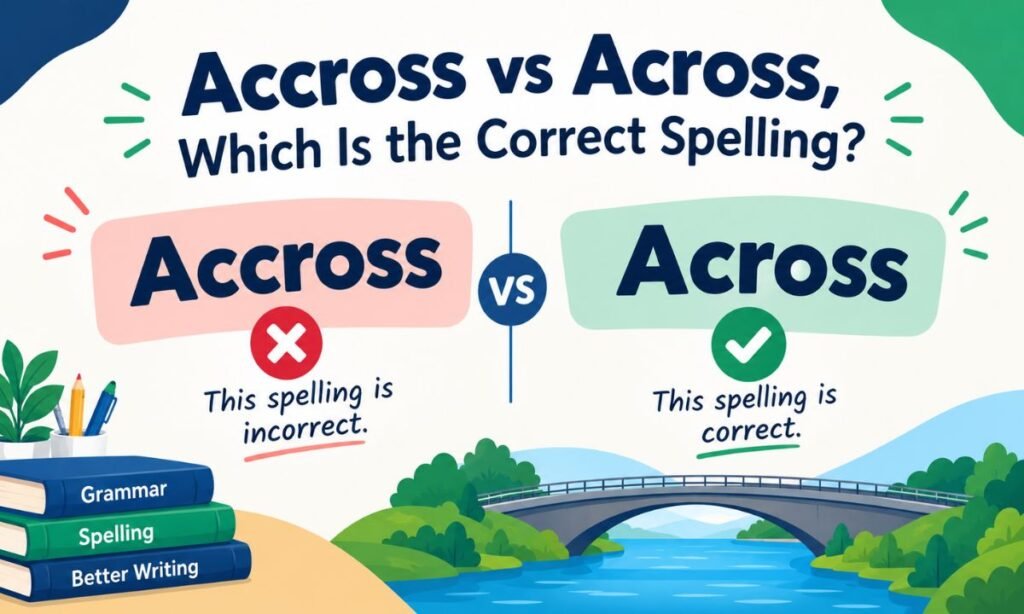
“Across” (with one C in the middle and a double S at the end) is the only correct spelling. “Accross” is a very common misspelling, and no major dictionary lists it as a variant.
The letter pattern is a-c-r-o-s-s: six letters, one C, two S’s. A quick way to remember it is that the word is just a + cross, and “cross” has only one C.
| Spelling | Status |
|---|---|
| across | Correct |
| accross | Incorrect (extra C) |
| acros | Incorrect (missing S) |
| acorss | Incorrect (letters swapped) |
| accros | Incorrect (extra C, missing S) |
What Does Across Mean in English?
“Across” means from one side of something to the other, or on the opposite side. It works as a preposition and as an adverb.
- Preposition: to or on the opposite side of something, as in across the street, or passing over or through the width of something, as in a bridge across the river.
- Adverb: to or on the other side, as in He swam across, or so as to be understood, as in get the message across.
- Other uses: in a crossword, “across” refers to the horizontal answers. It also means spread over a whole group or area, as in across the country or across all departments.
The word has been in English for roughly 700 years. Dictionary histories trace it to Middle English a-croiz and acros (early 14th century), which came from Anglo-French an cros, literally “on cross”. So the word was built from the prefix a- plus cross, and that is the easiest way to remember its spelling.
Accross vs Across Meaning Explained
There is no difference in meaning, because “accross” is not a real word. It is simply “across” with an extra C added by mistake.
If you see “accross” in an email, a school essay or a website, read it as “across” and treat it as a typo. Spell checkers will underline it and offer “across” as the fix.
Why Is Across Spelled With One “C”?
There are three simple reasons.
- It is built from a- + cross. The prefix a- meant “on” or “in”, and it was attached to cross. Joining them gives a-cross, with just one C after the A.
- No second C is needed for the sound. The “cr” is pronounced as a normal blend (uh-KROSS), so there is nothing to double.
- The double letter is the S. The doubled letter in this word is the final S (acro-ss), which is the same ending as in cross, loss and boss.
Contrast with words that do have two C’s. These come from Latin ad- + c, where the D changed to match the next letter: accept, accident, accommodate, account, accurate, accuse. Words such as across, acre, acrobat and acrid do not follow that pattern.
Why Do People Spell Across Wrong?
- Confusion with “ac-” words. Many common words start with acc-, so the brain predicts a double C.
- Pronunciation. The word sounds like “uh-KROSS”, and the first sound is hard to tie to either one C or two.
- Typing speed. Fast typing and autopilot make doubled letters easy to slip in.
- Seeing the error often. Misspellings that appear on social media and in comments start to look normal.
- Second-language learners. Speakers of languages such as Urdu or Hindi may spell by sound, and English sound-to-letter patterns are inconsistent.
- Autocorrect trust. Writers sometimes assume the tool will catch it, but it can miss errors when a different word is a close match.
Other Common Misspellings of Across
- acros (one S) — the double S is missing
- accros / accross — extra C
- acorss — letters swapped
- a cross (two words) — a different phrase, meaning one cross, as in a cross on the hill
- acrossed — not a word; “across” is not a verb
- acrost — a dialect form, not used in standard writing
Accross vs Across Grammar Rules Explained
Rule 1: Across is a preposition or an adverb, never a verb. The verb is cross. So write He crossed the road, not He acrossed the road.
Rule 2: As a preposition, it needs an object. She walked across the bridge. (object = the bridge)
Rule 3: As an adverb, it stands alone. The river was narrow, so we swam across.
Rule 4: It pairs with verbs of movement, position or spread. Common partners: walk, run, swim, travel, stretch, spread, lie, sit, look, reach.
Rule 5: “Across from” means “opposite”. The bank is across from the post office. This is common in American English; British English often says opposite.
Rule 6: Do not add “of”. Write across the road, not across of the road.
Rule 7: Figurative use is fine. Across the board, across cultures, across generations all describe something that covers a whole range.
How to Use Across in a Sentence Correctly
Physical movement
- She walked across the street to the market.
- The children ran across the field.
- The ferry travels across the lake twice a day.
Position
- The shop is across from the station.
- A long scratch ran across the table.
Spread or range
- The company has offices across the country.
- Prices have risen across the board.
- The idea spread across social media in hours.
Communication
- It took a while to get the message across.
- His enthusiasm came across clearly.
Encountering by chance
- I came across an old photo yesterday.
- She ran across a former classmate at the airport.
Common phrases with across
| Phrase | Meaning |
|---|---|
| across the board | applying to everyone or everything |
| across the pond | on the other side of the Atlantic (informal) |
| come across / run across | find or meet by chance |
| get (something) across | make it understood |
| come across as | give a certain impression |
| cut across | go against or affect several groups or areas |
Across vs Through vs Over: Key Differences
These three words overlap, but each pictures the movement differently.
| Word | Picture | Typical use | Example |
|---|---|---|---|
| Across | Side to side over a surface or line | Rivers, roads, rooms, regions | We walked across the bridge. |
| Through | Inside something, entering and leaving | Tunnels, forests, crowds, tubes | We drove through the tunnel. |
| Over | Above, higher than, or covering | Flying above, passing a barrier | The plane flew over the mountains. |
Quick test: if you stay on top of a surface, use across. If you are enclosed or surrounded, use through. If you are higher than it, use over.
Where they overlap. Walk across the bridge and walk over the bridge are both natural, and the meaning is nearly the same. Across stresses the width or the other side, while over stresses going above it. And Across and through differ more: you swim across a river (on its surface) but travel through a forest (inside it).
Across vs Cross
| Word | Part of speech | Example |
|---|---|---|
| cross | verb, noun, adjective | We cross the river here. / A red cross marks the spot. / She was cross with me. |
| across | preposition, adverb | We walked across the river. |
Easy rule: use cross when you need an action (a verb) and across when you need a position or direction word.
- ✓ I will cross the road. (verb)
- ✓ I will walk across the road. (preposition)
- ✗ I will across the road.
Synonyms and Similar Words to Across
| Meaning | Words you can use |
|---|---|
| On the other side | opposite, beyond, over, facing |
| From side to side | crosswise, transversely, athwart, over the width of |
| Spread throughout | throughout, all over, around, spanning |
| To the other side | over, to the far side |
| Understandably | clearly, effectively (as in get it across) |
Careful: synonyms are not always interchangeable. Throughout suggests coverage of a whole area, and opposite suggests facing something. Use the one that fits the sentence.
Across Spelling UK vs US: Any Difference?
No. “Across” is spelled the same in British and American English. There is no alternate spelling in either variety.
The only real differences are in usage:
- “Across from” is common in American English, while British English often says “opposite”.
- The dialect form “acrost” exists in some regions but is not standard.
- Pronunciation differs slightly by accent, but spelling does not.
So you can use “across” with the same spelling for any audience, including readers in the UK, US, Pakistan or elsewhere.
Is Accross Ever Correct to Use?
No. “Accross” is not accepted in standard English, in formal writing, or in any major dictionary.
The only legitimate reasons to write it are:
- quoting someone else’s misspelling exactly (usually with [sic]),
- teaching or discussing spelling mistakes, as in this article,
- using it deliberately as a joke or a stylized brand or username (which can make a brand look careless).
In all other cases, fix it to “across”.
The Impact of Spelling Errors on Writing
A missing or extra letter looks small, but readers notice. Research and surveys point the same way:
- Published research (October 2026): a study in the Journal of Economic Behavior & Organization found that spelling and grammar errors significantly reduced how economists rated research quality. The paper also reviews older work linking spelling errors to lower perceived writing ability and competence.
- First impressions: a Tidio survey of 1,839 participants found about 95% agreed grammar mistakes strongly influence how a person is perceived, and 97.2% said the same about a company’s image. (An online survey, not a representative sample.)
- Business trust: in the same research, 51.8% said grammar mistakes can ruin a company’s professional image, and 34.9% said they can hurt its credibility.
- Sales: a 2017 Entrepreneur column cited a BBC News report that a single spelling mistake can cut online sales in half. This is a secondary, older claim, so treat it as an example rather than a firm figure.
- Careers: an analysis cited by Allwork.Space found professionals with more promotions made fewer grammar errors. The sample was small.
Practical effects of errors like “accross”:
- They can lower readers’ trust in the writer or brand.
- They can distract from the message.
- They can cost marks in school and exams.
- They can weaken a CV, cover letter or proposal.
- They can reduce the polish of web pages and ads.
How to avoid the mistake: remember a + cross, switch on spell check, read your text aloud once, and keep a short list of the words you misspell most.
Practice Session
Fill in the Blanks
Choose across or accross (or the right form) for each sentence. Answers are at the end of the section.
- The shop is just ______ the street.
- She swam ______ the river in ten minutes.
- We have customers ______ the country.
- I ran ______ an old friend at the mall.
- He tried to get his idea ______ to the team.
- A beautiful bridge stretches ______ the bay.
- The word “______” has one C and two S’s.
- The bank is ______ from the post office.
- They will ______ the road at the lights. (cross / across)
- Prices went up ______ the board.
Answers: 1. across; 2. across; 3. across; 4. across; 5. across; 6. across; 7. across; 8. across; 9. cross; 10. across.
Multiple Choice Questions
Q1. Which spelling is correct?
(a) accross (b) across (c) acros (d) acorss
Q2. How many C’s are in “across”?
(a) 0 (b) 1 (c) 2 (d) 3
Q3. Which sentence is correct?
(a) She walked accross the field. (b) She walked across the field.
Q4. “Across” is mainly a…
(a) verb (b) noun (c) preposition or adverb (d) conjunction
Q5. Which word fits? “We drove ______ the tunnel.”
(a) across (b) through (c) accross (d) cross
Q6. Which is the verb form?
(a) across (b) acrossed (c) cross (d) accross
Q7. Which phrase means “applying to everyone”?
(a) across the pond (b) across the board (c) come across (d) cut across
Q8. Is “accross” ever correct in standard English?
(a) Yes, in British English (b) Yes, in American English (c) No
Answers: Q1 (b), Q2 (b), Q3 (b), Q4 (c), Q5 (b) through, Q6 (c), Q7 (b), Q8 (c).
Frequently Asked Questions
Does Across have two C’s?
No. “Across” has one C and two S’s: a-c-r-o-s-s.
What is the difference between “cross” and “across”?
“Cross” is mainly a verb (or noun), while “across” is a preposition or adverb meaning from one side to the other.
What is another word for “across”?
Common options are over, opposite, beyond, crosswise and throughout, depending on the meaning.
What does “across” mean?
It means from one side of something to the other, or on the opposite side.
Is “accross” a word?
No, it is a misspelling of “across”.
Is “acrossed” correct?
No, “across” is not a verb; use “crossed” instead.
Is “across from” correct?
Yes, it means “opposite” and is especially common in American English.