


You’re typing a text, a caption, or a quick note, and you pause. Is it “fav” or “fave”? Does it even matter which one you pick?This question shows up more often than you’d expect. People search for it while writing Instagram captions, filling out playlist titles, or double-checking a school assignment. The word “favorite” gets shortened constantly in casual English, yet most style guides never explain the rules clearly.
This guide breaks it down in plain language. You’ll learn the correct short forms, how British and American spelling changes things, when to avoid abbreviations altogether, and how real people use these words every day.
Favorite Short Form: Quick Answer ✅
The short answer: both “fav” and “fave” are correct informal abbreviations of “favorite.” Neither one is technically wrong, and dictionaries recognize both as legitimate slang terms rather than typos.
“Fav” is the clipped, four-letter spelling. It drops the vowel sound entirely and reads more like a tag or label. “Fave” keeps the long “a” sound from the original word, so it sounds closer to how “favorite” is actually pronounced.
Use whichever one fits your tone. Texting a friend, posting on social media, or labeling a list of favorites? Either spelling works fine.
Examples:
- “This is my fav song right now.”
- “That restaurant is my fave for date night.”
- “Add it to your favs list.”
- “She shared her top faves from the trip.”
British English vs American English Spelling 🇬🇧🇺🇸
Before shortening the word, it helps to know that “favorite” itself has two accepted spellings depending on where you’re writing from.
Key Difference
American English drops the letter “u,” giving you favorite. British English, along with Canadian, Australian, and most Commonwealth spelling conventions, keeps the “u,” producing favourite. The extra letter traces back to French influence on British spelling centuries ago, though linguists still debate exactly why it stuck around in the UK and disappeared in the US.
Here’s the part that trips people up: the short forms don’t change based on region. Nobody writes “favu” for British English. Both American and British writers use “fav” and “fave” identically.
Examples
| Region | Full Word | Short Form |
|---|---|---|
| United States | Favorite | Fav / Fave |
| United Kingdom | Favourite | Fav / Fave |
| Canada | Favourite | Fav / Fave |
| Australia | Favourite | Fav / Fave |
So if you’re writing a formal document, match your spelling to your audience’s region. If you’re texting or posting casually, the abbreviation stays the same no matter where you live.
Which Spelling Should You Use? 🌍
Choosing between the full word and a short form really comes down to context. A resume calls for different language than a group chat.
Use “favorite” if:
- You’re writing for a US-based audience, publication, or company
- The content is formal, academic, or professional
- You’re drafting a resume, cover letter, or business email
- Search engines or style guides in your industry follow American English
Use “favourite” if:
- Your audience is British, Canadian, Australian, or from another Commonwealth country
- You’re writing for a UK-based publication or brand
- Your company style guide specifically requests British spelling
- You’re localizing content for an international market outside the US
“fav” or “fave” if:
- You’re texting, messaging, or chatting casually
- You’re writing social media captions, hashtags, or bios
- The tone is playful, personal, or conversational
- You want to save characters in a tight word count, like a tweet or a title
Best Global Choice
If you’re unsure who’s reading your content, stick with the full word “favorite” (or “favourite” for a UK audience) in anything formal. Save the short forms for spaces where a relaxed tone is expected. This keeps your writing clear for readers everywhere, regardless of dialect or platform.
Common Mistakes with Favorite Short Form ❌⚠️
A few habits sneak into everyday writing and quietly undercut how polished your message looks. Here are the ones worth fixing.
1. Using Short Forms in Formal Writing
Slipping “fav” or “fave” into a cover letter, academic paper, or client email reads as careless, even if the rest of the writing is strong.
Why?
Abbreviations like these belong to informal, spoken-style English. Formal writing follows stricter conventions, and readers in professional settings often judge shortcuts as a sign the writer didn’t take the piece seriously.
2. Mixing British and American Spellings
Writing “favourite” in one paragraph and “favorite” in the next creates an inconsistent, unpolished feel. This happens a lot when writers copy text from different sources without proofreading.
Fix: Pick one spelling convention at the start of your document and stick with it from beginning to end.
3. Writing “Fave” in Academic Writing
Some students assume shortened words are acceptable if the meaning is obvious. It isn’t a safe assumption in essays, reports, or research papers.
Why?
Academic writing is graded partly on tone and register. Casual abbreviations lower the perceived quality of the work, even when the argument itself is solid.
4. Adding Unnecessary Periods
Some writers punctuate the short forms like traditional abbreviations, writing “fav.” with a period at the end. This isn’t standard. “Fav” and “fave” function as informal words on their own, not as clipped versions that require punctuation, so no period is needed.
5. Using Capital Letters Randomly
Capitalizing “Fav” or “FAVE” mid-sentence without a grammatical reason looks like a typo or an attempt at emphasis that doesn’t land. Treat these words like any other lowercase noun or adjective unless they start a sentence.
Favorite Short Form in Everyday Examples 📱
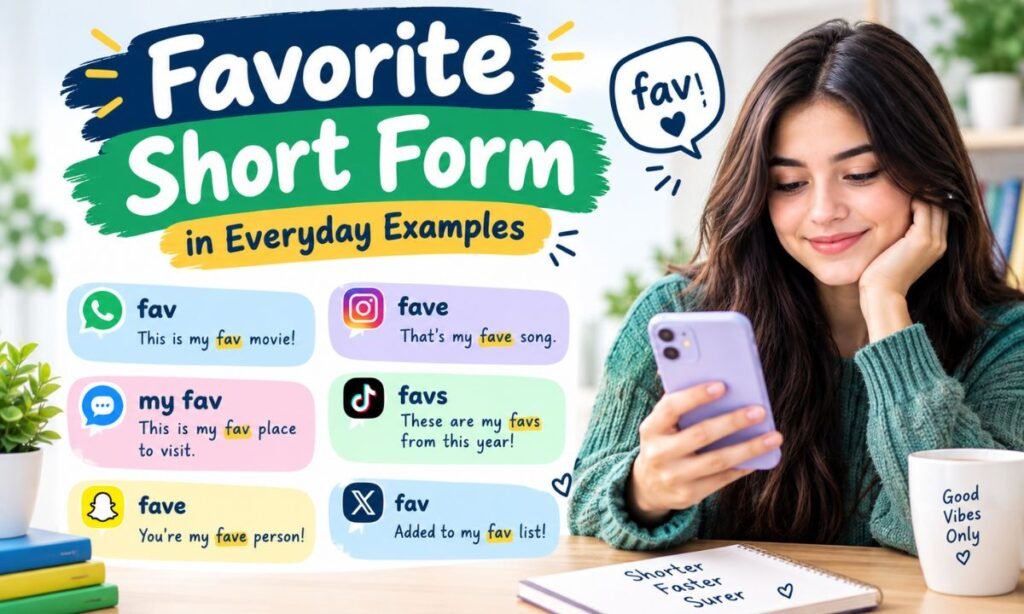
Seeing these words in real contexts makes the rules easier to remember than any list of guidelines.
In Text Messages
- “What’s your fav pizza topping?”
- “Sending you my fave playlist rn.”
- “This is def my new fav show.”
In Social Media
- Instagram caption: “Beach days are my fave 🌊”
- Twitter/X bio: “Coffee, books, and my fav people.”
- TikTok comment: “Adding this to my favs immediately.”
Emails
Casual emails between friends or coworkers with a relaxed relationship can get away with short forms occasionally, but it’s still worth reading the room first.
Professional Email
“Please find attached the report on our favorite [not fav] client accounts from this quarter.” Formal correspondence should always spell out the full word, even when the surrounding tone is friendly.
In School Notes
Students often use “fav” when jotting down quick notes or personal reminders, like “fav quote for essay” scribbled in a margin. That’s fine for a private note, but it should be expanded to “favorite” once it appears in a submitted assignment.
Favorite Short Form: Google Trends & Usage Data 📊
Search behavior around this word gives a useful window into how people actually write, versus how dictionaries say they should write.
Most Common Regions
Searches for “fav” and “fave” spike heavily in the United States, United Kingdom, Canada, Australia, India, and the Philippines. English-speaking, mobile-heavy markets tend to drive the bulk of this traffic, since abbreviations thrive wherever people type quickly on small screens.
Online Usage Trends
Short forms surged alongside the growth of social platforms. Flickr’s “favorites” feature in the mid-2000s helped push the word into everyday internet vocabulary, and Twitter, Tumblr, and later Instagram cemented “fav” and “fave” as standard casual English rather than fringe slang. Texting culture accelerated the trend further, since shorter words save time and character count.
Why “Fav” Is Popular
- It’s faster to type on a phone keyboard
- It fits neatly into hashtags and captions
- It matches the clipped, informal tone of most social platforms
- Autocorrect on most devices no longer flags it as an error
Comparison Table: Favorite Short Form Variations 📋
| Form | Type | Best Used In | Formality Level |
|---|---|---|---|
| Favorite | Full word (US) | Formal writing, business, academic work | High |
| Favourite | Full word (UK) | Formal writing for British/Commonwealth audiences | High |
| Fav | Short form | Texting, social captions, hashtags | Low |
| Fave | Short form | Texting, social captions, casual conversation | Low |
| Favs | Plural short form | Lists, app labels, casual chats | Low |
| Faves | Plural short form | Social captions, casual writing | Low |
Frequently Asked Questions
Is fav or fave correct?
Both are correct. “Fav” and “fave” are equally accepted informal short forms of “favorite,” and the choice comes doueqwne r personal preference.
What is fav in chat?
In chat, “fav” is a casual short form of “favorite,” used to describe something someone likes best, such as a song, show, or place.
How do you say favorite in a short way?
You can shorten “favorite” to “fav” or “fave” in informal writing, such as texts, captions, or casual conversations.
What is the shortcut of favourite?
The shortcut of “favourite” is the same as “favorite”: either “fav” or “fave,” since the abbreviation doesn’t change between British and American spelling.
Conclusion
There’s no single “correct” winner between “fav” and “fave.” Both are accepted, both mean the same thing, and both work fine in casual writing. The real rule to remember is about context, not spelling: save the short forms for texts, captions, and informal chats, and reach for the full word “favorite” (or “favourite,” depending on your audience) whenever the writing needs to look professional.
Once you know the difference between formal and casual settings, and between American and British spelling, choosing the right version becomes second nature.