
Procurement means obtaining the goods, services or works an organization needs from outside suppliers. It covers far more than buying. The work starts when someone spots a need and ends when the supplier is paid and the result is reviewed.
Many people use the word as a polite stand-in for purchasing, but the two are not identical. This guide explains the meaning of procurement in plain language, then walks through the process, types, methods, roles, examples and common problems.
You will also find comparison tables, a short glossary and quick answers to the questions readers ask most. Whether you are a student, a new buyer or a small business owner, you should finish knowing exactly what the term covers.
What Is Procurement?
Procurement is the process of finding, selecting, buying and receiving goods and services from outside suppliers, usually for business or government use. It includes planning, supplier selection, negotiation, ordering, delivery checks and payment, plus the ongoing management of supplier relationships.
Think of it as everything that happens between “we need this” and “the supplier has been paid.” A single laptop order, a multi-year software contract and a new hospital wing all pass through procurement, just at very different scales.
Procurement Meaning in Simple Words
Imagine a bakery owner who runs out of flour every second Friday. She decides how much flour to keep, compares two mills, agrees a delivery schedule, checks each sack on arrival and pays the invoice. That whole routine is procurement.
Now picture the bakery after it opens a second shop and an online store. Orders grow, suppliers multiply and someone must set rules for who may buy what. Procurement then stops being a habit and becomes a defined job.
Origin of the Word Procurement
The word comes from the Latin procurare, meaning to take care of or look after. It joins pro, meaning on behalf of, with curare, meaning to care for. The English verb procure grew from this root, and procurement followed.
Merriam-Webster records the first known use of procurement in the 14th century. Dictionary.com adds that the noun often carries a military flavor, as in obtaining weapons for a war, and that it can also mean a purchasing department.
Close synonyms include acquisition, purchase, obtaining and buying, though each differs slightly in scope. Procurement is the broadest of these because it covers the full acquisition cycle, not only the moment when money changes hands.
Procurement Meaning in Business
In business, procurement is the function that secures external goods and services so the company can operate and grow. It sets supplier strategy, runs sourcing, negotiates contracts, places orders and controls payment against evidence of delivery.
A procurement team is judged on more than price. Delivery reliability, quality, contract compliance and supplier risk all count. A cheap supplier that ships late can cost a factory more than a pricier one that ships on time.
Procurement Meaning in Government and Law
In law, procurement describes a government entering contracts with private firms for goods and services. Quimbee uses that meaning for state and federal contract law, while Law Insider defines it as buying, renting, leasing or obtaining supplies, services or construction.
US federal law takes the end-to-end view. Under 41 U.S.C. § 111, procurement covers every stage of acquiring property or services, from determining the need through contract completion and closeout. That scope explains why public buyers follow strict written rules.
Public procurement is also enormous. The World Bank estimates it at about 11 trillion dollars a year, roughly 12 percent of world GDP. Across OECD countries it made up 29.9 percent of total government spending in 2023.
Objectives of Procurement
Every procurement team works toward the same core aims, even when budgets and tools differ widely. These goals explain why companies invest in a formal function instead of letting each department buy on its own.
- Availability: the business has what it needs, when it needs it
- Fair value: the price is competitive for the quality received
- Reliable supply: suppliers deliver on time, even under pressure
- Spend control: purchases stay within budget and approval limits
- Lower risk: supply, legal and financial problems surface early
The Procurement Process Step by Step
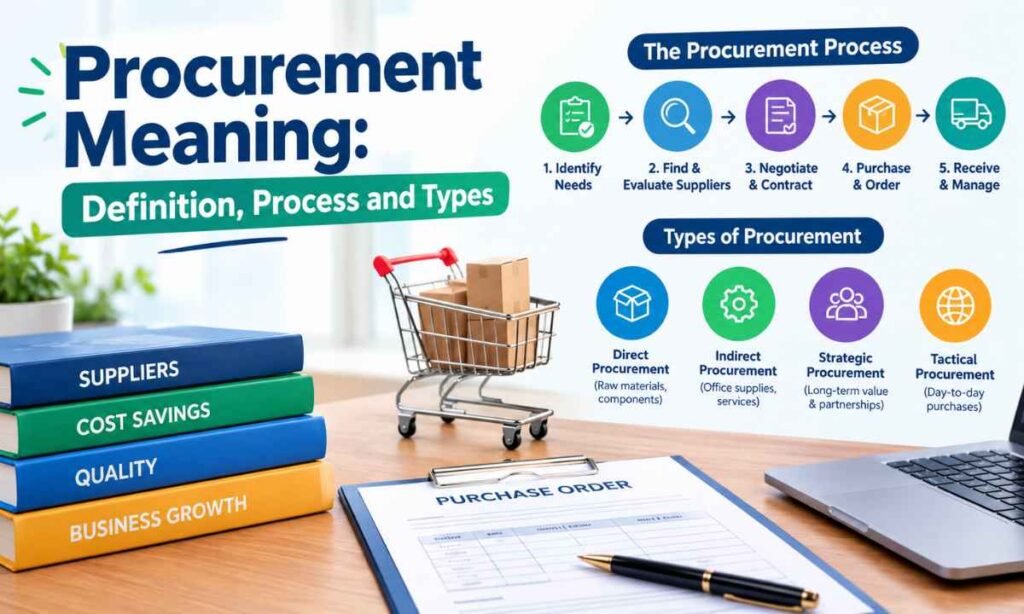
Most organizations follow a version of the same seven steps. Names vary by company, but the order stays familiar. Skipping a step usually creates a gap that later appears as a late delivery, a disputed invoice or an audit finding.
Step 1: Identify the Need
A team defines what it requires, how much, by when and at what quality. It also confirms that budget exists. A vague request at this stage causes most downstream confusion, so a clear specification saves time later.
Step 2: Check Existing Suppliers
Before going to market, buyers check whether an approved supplier or existing contract already covers the need. Using a contracted supplier usually means better prices, faster approval and fewer off-contract purchases that nobody can track.
Step 3: Source and Shortlist Suppliers
If no contract applies, the team researches the market and invites suppliers to respond. It may send a request for information, proposal or quotation. The result is a shortlist of vendors that meet basic capability and risk standards.
Step 4: Evaluate and Select
Shortlisted suppliers are scored against set criteria such as price, quality, capacity and financial stability. Writing the criteria before bids arrive keeps the decision fair, and documenting the reasoning protects the buyer if someone questions the choice later.
Step 5: Negotiate and Contract
The buyer and supplier agree on price, delivery terms, service levels and payment dates, then record them in a contract. A good contract sets the standard the relationship will be measured against, so both sides know what success looks like.
Step 6: Order and Receive
A purchase order is raised and approved, then sent to the supplier. When goods arrive, the receiving team records a goods received note confirming that quantity and condition match the order. Informal confirmation by email is where many problems begin.
Step 7: Match and Pay
Finance checks the supplier invoice against the purchase order and the goods received note. This is called three-way matching. When everything agrees, payment is released. When it does not, the gap is investigated before any money moves.
Types of Procurement
Procurement is sorted by what is bought and how it is used. The four common categories overlap, so one purchase can belong to more than one. A laptop bought for office staff is both a good and an indirect purchase.
| Type | What it covers | Example |
|---|---|---|
| Direct | Materials that become part of the product | Steel for a car maker |
| Indirect | Items that keep the business running | Software licenses |
| Goods | Physical items | Laptops, machinery |
| Services | External labor and expertise | Legal advice |
Direct Procurement
Direct procurement buys the raw materials and components that go straight into what a company sells. A food producer buying flour or a car maker buying steel are typical cases. Delays here can halt production the same day.
Indirect Procurement
Indirect procurement covers items that support operations without becoming part of the product. Examples include software subscriptions, facilities maintenance, marketing services and office supplies. Spend is spread across many small orders, making it harder to track and easier to waste.
Goods Procurement
Goods procurement covers physical items that can be counted and inspected. Because buyers can check quantity and quality on delivery, the focus falls on specifications, price comparison and inventory control. It includes both direct and indirect items.
Services Procurement
Services procurement brings in outside expertise, such as consultants, contractors, agencies and legal firms. Quality is harder to inspect than with goods, so contracts lean on clear deliverables and targets. Many firms use a master agreement plus statements of work.
Public and Private Procurement
Public procurement is buying by government and publicly funded bodies. It follows rules on competition, transparency and appeals, partly to prevent favoritism with taxpayer money. Private procurement is spending by businesses, which have more freedom to set their own rules.
Procurement vs Purchasing
Purchasing is a part of procurement, not a synonym. Purchasing places the order and settles the invoice. Procurement decides what to buy and from whom, agrees the terms, then manages the supplier relationship over time.
| Aspect | Procurement | Purchasing |
|---|---|---|
| Scope | End to end | Order and payment |
| Focus | Long-term value | Immediate cost and delivery |
| Approach | Strategic | Tactical |
| Timeline | Months or years | Days or weeks |
Procurement vs Sourcing
Sourcing sits inside procurement. It is the early stage of researching markets, comparing suppliers and choosing partners. Procurement carries on after that choice, handling contracts, orders, delivery and payment, so one sourcing win can feed years of purchases.
Procurement vs Supply Chain Management
So the procurement is the inbound side of the supply chain. It decides what to buy and from whom. Supply chain management then plans production, stores stock and moves finished products to customers. In small firms, one person often does both.
Procurement Methods
When no existing supplier fits, buyers choose a method for going to market. The right choice depends on how clearly the requirement is defined and how much competition is needed. Picking the wrong method wastes weeks.
| Method | Use it when |
|---|---|
| RFI | You are still learning what the market offers |
| RFP | The need is complex and suppliers must propose solutions |
| RFQ | The specification is fixed and price decides |
| Tender | Rules require sealed, formal competitive bids |
| E-auction | A standard product is bought on price alone |
For example, running a full RFP to buy printer paper slows everyone down for no gain. Sending an RFQ for a complex consulting project produces quotes that cannot be compared fairly. Match the method to the need.
Procurement Strategy in Brief
A procurement strategy is the plan for how a company will use its buying power to create value. It sets rules for each spend category, the level of risk the company accepts and how much to invest in supplier relationships.
Two choices shape most strategies. The first is whether to consolidate suppliers for better prices or spread orders across more suppliers for safety. The second is whether a category should be tuned for the lowest cost or for innovation.
Single-source critical parts and commodity office supplies need different treatment. The first deserves partnership and backup plans. The second deserves a simple catalog and fast approval. Treating both alike wastes effort in one place and creates risk in the other.
Centralized vs Decentralized Procurement
Centralized procurement puts buying in one team. It concentrates buying power, standardizes contracts and makes rules easier to enforce, though it can slow local decisions. Decentralized procurement lets business units buy for themselves, which is faster but fragments supplier power.
Most large organizations settle on a hybrid. A central team handles high-value and strategic categories, while local teams keep authority over low-risk purchases inside a clear policy. The table below compares the three models side by side.
| Model | Strength | Weakness |
|---|---|---|
| Centralized | Strong control | Slower local decisions |
| Decentralized | Fast local buying | Weak spend visibility |
| Hybrid | Balance of both | Needs clear limits |
Who Works in Procurement?
Team size depends on spend complexity, not just headcount. A small company may have just one person covering every task. A large enterprise splits the work across specialists, each with their own targets and budgets.
| Role | Main job |
|---|---|
| Buyer | Raises and tracks orders against agreed contracts |
| Category manager | Owns strategy for a spend area such as IT |
| Sourcing manager | Runs tenders and leads supplier negotiations |
| Contract manager | Drafts, stores and enforces supplier agreements |
| Procurement manager | Owns policy, process and team results |
| Chief procurement officer | Leads strategy and supplier risk at executive level |
Procurement Skills That Matter
Good procurement people combine commercial sense with careful record keeping. They read contracts closely, ask suppliers hard questions and keep files that someone else can follow a year later. Category knowledge helps, but it can be learned on the job.
- Negotiation: securing fair terms without damaging the relationship
- Data analysis: reading spend reports and spotting patterns
- Contract literacy: understanding liability, payment terms and exit clauses
- Communication: explaining rules to colleagues who just want their order
Relationship skills matter more than many newcomers expect. Suppliers give better terms to buyers who pay on time, specify clearly and give honest feedback. A reputation for fair dealing becomes a quiet advantage during shortages.
Real-Life Procurement Examples
Seeing the idea in action makes the definition easier to remember. These illustrative scenarios show how the same process looks in different settings. Each one follows the same logic of need, supplier, terms, delivery and payment.
Restaurant Group
A restaurant group buys produce weekly from two regional growers and dry goods monthly from a wholesaler. The procurement lead tracks price changes, checks delivery temperatures and shifts volume toward the supplier that fails the fewest orders.
Hospital
A hospital buys medical devices and drugs, along with cleaning and laundry services. Supply continuity matters more than the lowest price because a stockout can affect patient care. Contracts therefore include backup suppliers and strict delivery windows.
Construction Project
A builder orders materials and subcontractor work for a single project. Material prices move, subcontractors vary in reliability, and delays cascade across the schedule. Procurement locks prices early where possible and times deliveries to match progress on site.
Small Agency
A ten-person agency needs project software. The owner lists requirements, compares four tools, negotiates an annual discount and names one person to approve renewals. Even at this size, every step of procurement is present, just done quickly.
Procurement Meaning in Project Management
In project work, procurement means acquiring goods and services from outside the project team. A project manager plans what to buy, selects sellers, administers the contract and closes it out. Construction and software projects lean on this heavily.
The main difference from routine buying is the end date. Project contracts finish when the project does, so scope, deliverables and acceptance tests need clear wording from the start. Vague terms are a common cause of disputes and cost overruns.
Why Procurement Matters
Spending with outside suppliers is the largest cost for many companies. Kearney’s 2026 procurement assessment puts it above 60 percent of revenue in manufacturing and about 30 percent in services. Unlike payroll, much of it is negotiable line by line.
Procurement also protects supply. Checking supplier finances, adding backup sources and writing contingency clauses all reduce the odds of a halted production line or an empty shelf. Many firms now accept slightly higher costs in exchange for steadier supply.
A documented trail from request to payment supports audits and settles disputes. Without it, companies accumulate maverick spend, meaning purchases made outside contracts and approval rules. That spending is invisible in forecasts and hard to challenge when a supplier underperforms.
Procurement also shapes responsible sourcing. Because it decides which suppliers receive business, it influences labor standards, supplier diversity and emissions in the supply chain. Scoring these factors beside price and quality makes them part of the buying decision.
How Procurement Performance Is Measured
Measuring savings alone hides problems. A team can cut unit prices while delivery reliability drops, and the savings figure looks fine until a stockout happens. Most mature teams therefore track several families of metrics together.
| KPI group | Example metrics |
|---|---|
| Cost | Realized savings, price variance |
| Cycle time | Requisition-to-order time |
| Compliance | Contract compliance, maverick spend share |
| Supplier performance | On-time delivery, quality rejection rate |
| Risk | Single-source dependency, contract expiry exposure |
Common Procurement Challenges
Every team meets the same handful of problems sooner or later. Knowing them early helps you spot weak points in your own process before they cost money. Check each one against your own workflow and note where it already appears.
- Scattered data: orders, receipts and invoices sit in different systems, so matching them is slow and error prone
- Maverick spend: staff buy outside contracts, which weakens negotiating power
- Slow approvals: requests wait in inboxes, and staff start working around the process
- Supplier risk blind spots: financial or capacity trouble is found only after a missed delivery
- Tail spend: many small purchases from many vendors consume admin time out of proportion to their value
Common Procurement Mistakes to Avoid
Even experienced teams repeat a few errors. The list below reflects the most common gaps in the seven-step process described above, and each one maps to a step where a small check would have helped.
- Writing a vague specification, which invites mismatched quotes
- Choosing on price alone and ignoring delivery record
- Confirming receipt informally instead of recording it
- Letting contracts renew automatically without a review
Each of these is cheap to fix and expensive to ignore. A one-page specification template, a weighted scoring sheet, a formal receiving step and a renewal calendar solve most of them within about a month.
Procure-to-Pay vs Source-to-Pay
You will often see procure-to-pay, or P2P, used alongside procurement. P2P covers the day-to-day operational chain from requisition through approval, ordering, receiving, invoice matching and payment. It is the transactional backbone of the procurement function.
Source-to-pay, or S2P, adds the upstream work of sourcing events, supplier selection and contract setup. Think of P2P as running the orders and S2P as running the whole cycle, including how the supplier was chosen in the first place.
E-Procurement and Procurement Technology
E-procurement moves requests, approvals, orders and receipts onto one platform instead of email and spreadsheets. Approvals route automatically, approved suppliers appear in catalogs, and every step leaves a record. The main gains show up in cycle time and compliance.
Automation now extends to analysis. Many platforms classify spend, read invoice data and flag contracts nearing renewal. Results depend on data quality, though. In 2025, Gartner placed generative AI for procurement in its trough of disillusionment, citing fragmented data.
Small businesses do not need a heavy system. A shared approval rule, a supplier list and a simple purchase order template cover most needs. Add software when volume, not ambition, makes the manual process slow.
Procurement Terms Glossary
These terms appear constantly in contracts and job descriptions. Knowing them makes procurement conversations much easier to follow. Skim the table once, then return to it whenever an unfamiliar abbreviation shows up in a supplier email.
| Term | Meaning |
|---|---|
| PR | Internal purchase requisition, raised before any supplier is contacted |
| PO | Purchase order, the buyer’s binding commitment to a supplier |
| GRN | Goods received note, proof that delivery matches the order |
| Three-way match | Check that PO, GRN and invoice agree before payment |
| MSA | Master service agreement covering an ongoing relationship |
| SOW | Statement of work listing specific deliverables |
| SLA | Service level agreement setting measurable performance targets |
| MRO | Maintenance, repair and operations supplies |
| Tail spend | Low-value purchases spread across many suppliers |
| Maverick spend | Buying outside agreed contracts and approvals |
Frequently Asked Questions
What is the meaning of procurement?
Procurement is the process of sourcing, buying and receiving goods and services from outside suppliers, including the contracts, supplier management and payment that surround the purchase.
What is procurement in simple words?
It is everything a business does to get what it needs from suppliers, from spotting the need to paying the invoice.
What are the 7 steps of procurement?
Identify the need, check existing suppliers, source and shortlist, evaluate and select, negotiate and contract, order and receive, then match and pay.
What are the types of procurement?
The four main types are direct, indirect, goods and services procurement. Spending is also split into public and private procurement.
What is the difference between procurement and purchasing?
Purchasing is the transaction of ordering and paying. Procurement is the wider function, including sourcing, negotiation, contracts and supplier management.
What is e-procurement?
E-procurement is the use of online software to manage requests, approvals, orders, receipts and supplier records in one system.
What does a procurement officer do?
A procurement officer finds suppliers, negotiates terms, places orders, tracks deliveries and keeps spending within policy and budget.
What is public procurement?
Public procurement is the buying of goods, services and works by government bodies, governed by rules on competition and transparency.
What is P2P in procurement?
P2P means procure-to-pay, the chain from purchase requisition through ordering, receiving, invoice matching and supplier payment.
Conclusion
Procurement means getting what an organization needs from outside suppliers in a controlled way, from first request to final payment. Purchasing is one step inside it. Sourcing, contracting, supplier management and compliance complete the picture. Whether you run a bakery or a hospital, the logic stays the same: define the need, choose the supplier carefully, agree clear terms, verify delivery and pay against evidence. Get those habits right and the rest of the function follows.
Start by mapping your current process against the seven steps above. The first gap you find is usually the cheapest one to fix. Write down who owns each step and where approvals currently stall, even if the answer is nobody.