

Note: Educational information based on public health sources. It is not a substitute for medical advice.
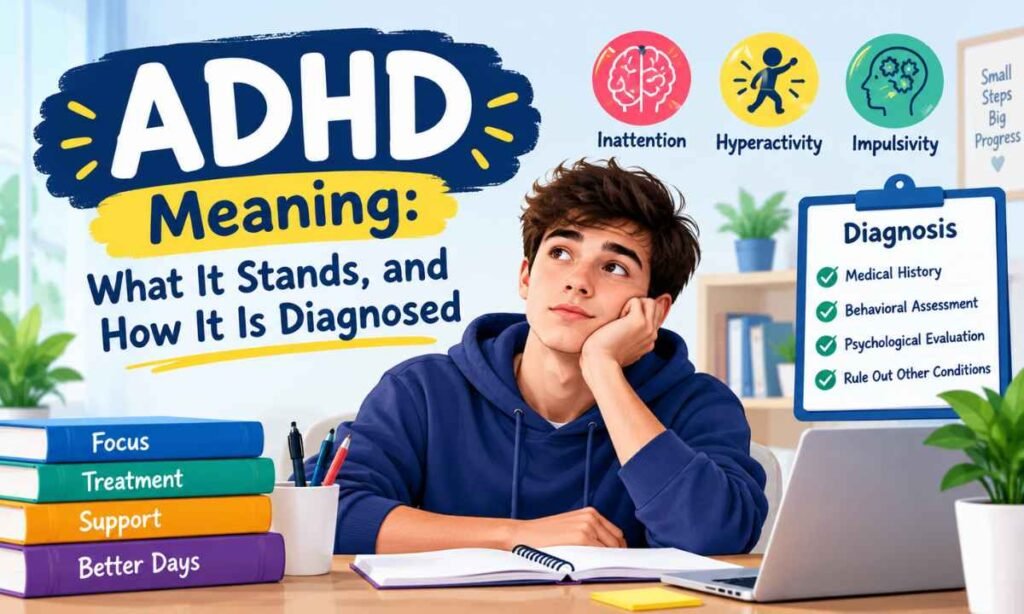
ADHD stands for attention-deficit/hyperactivity disorder. That answers the question in a line, but the name itself causes confusion. People with ADHD do not lack attention. Many can lock onto something interesting for hours, then struggle to begin a dull task that matters. The real difficulty is steering attention, holding back impulses and managing energy to fit the moment.
This guide explains the ADHD meaning in plain language: where the term came from, how clinicians define it, what symptoms look like at different ages, what causes it, how diagnosis works and which treatments have evidence behind them. The facts draw on the CDC, the National Institute of Mental Health (NIMH) and the American Psychiatric Association.
What Does ADHD Stand For?
ADHD stands for attention-deficit/hyperactivity disorder. It is a neurodevelopmental condition, meaning it relates to how the brain develops and works. A clinician diagnoses it when a person shows a lasting pattern of inattention, hyperactivity and impulsivity that is greater than expected for their age and interferes with school, work, home life or friendships.
Quick definition: ADHD is a brain-based condition that starts in childhood, often continues into adulthood, and affects focus, impulse control and activity level.
Where the Name Came From
The label has changed several times as understanding improved.
| Period | Term used | What changed |
|---|---|---|
| 1968 | Hyperkinetic reaction of childhood | Focused on visible overactivity |
| 1980 | Attention deficit disorder (ADD) | Attention became the central issue |
| 1987 | ADHD | One combined label; dictionaries date the term to this year |
| 2013 | ADHD with “presentations” | Adult criteria added; onset age raised to 12 |
You will still hear “ADD” in everyday speech, but it is no longer an official diagnosis. The CDC has noted that someone once told they had ADD would most likely fall under the predominantly inattentive presentation of ADHD today.
What ADHD Actually Is (and Is Not)
Researchers often describe ADHD as a difference in executive function. That is the set of mental skills that help us plan, start tasks, hold information in mind, switch focus and stop ourselves from acting on impulse. When those skills work unevenly, ordinary demands feel harder than they look from the outside.
The word “deficit” is the misleading part. Attention in ADHD is better described as hard to regulate than as missing. A child who cannot sit through a lesson may play a video game for two hours. An adult who forgets a bill deadline may spend a whole weekend absorbed in a hobby. Interest, novelty, urgency and reward pull attention in. Routine, delay and boredom push it away.
ADHD is also not:
- a sign of low intelligence
- laziness or a lack of willpower
- the result of poor parenting
- something children simply grow out of, since the CDC states that children with ADHD do not just grow out of these behaviors
Many people also describe strong emotional reactions, such as quick frustration or trouble calming down. Emotional regulation is not part of the formal diagnostic criteria, but clinicians discuss it often because it shapes how the condition feels day to day.
The Three Presentations of ADHD
Doctors describe three presentations, depending on which symptoms are strongest. Because symptoms shift over time, a person’s presentation can change too.
| Presentation | Main pattern | What others notice |
|---|---|---|
| Predominantly inattentive | Trouble sustaining focus, organizing and finishing tasks | Daydreaming, lost items, missed details |
| Predominantly hyperactive-impulsive | Restlessness and acting before thinking | Fidgeting, interrupting, trouble waiting |
| Combined | Both sets of symptoms strongly present | Both patterns together |
Inattentive Presentation
This is the quiet form. Because it rarely disrupts a classroom, it is often missed, particularly in girls and in adults who built workarounds early.
Hyperactive-Impulsive Presentation
This form is the easiest to spot, especially in younger children. The person seems driven by a motor, talks a lot and finds waiting physically uncomfortable.
Combined Presentation
Here the person meets the symptom count in both lists. Many people fall into this group at some point in life.
Common ADHD Symptoms
Everyone loses keys or fidgets in a long meeting. In ADHD, symptoms are frequent, last at least six months and cause real problems in daily life.
Signs of Inattention
- Makes careless mistakes or overlooks details
- Struggles to stay focused on tasks, reading or conversations
- Seems not to listen when spoken to directly
- Starts tasks but loses focus before finishing
- Has trouble organizing work and managing time
- Avoids or delays tasks that need sustained mental effort
- Loses items such as keys, phones or paperwork
- Is easily distracted by unrelated sights or thoughts
- Forgets routines like appointments and chores
Signs of Hyperactivity and Impulsivity
- Fidgets, taps or squirms
- Leaves a seat when expected to stay put
- Feels restless, which in adults often shows up as an inner sense of being wound up
- Has trouble with quiet activities
- Seems constantly “on the go”
- Talks excessively
- Blurts out answers before a question ends
- Struggles to wait a turn
- Interrupts or intrudes on others
How Symptoms Change With Age
| Life stage | Common signs |
|---|---|
| Young children | Constant motion, difficulty sitting, trouble taking turns |
| Teens | Unfinished homework, forgetfulness, risky choices, friction over responsibilities |
| Adults | Missed deadlines, chronic lateness, disorganization, inner restlessness |
ADHD in Adults
ADHD is often seen as a childhood condition, yet it affects many adults. The CDC explains that hyperactivity may fade or may appear as extreme restlessness, while symptoms can grow worse when adult demands increase. NIMH adds that inattentive symptoms tend to persist, whereas hyperactivity and impulsivity are more likely to decline.
A 2024 estimate from the National Center for Health Statistics found that about 6 percent of US adults have a current ADHD diagnosis, and roughly half of them were diagnosed in adulthood. Many learn about their own ADHD after a child is evaluated and the questions sound familiar.
Untreated ADHD can affect work performance, finances and relationships. NIMH reports that sleep problems affect up to 70 percent of adults with the condition. In the United States, adults whose symptoms impair them at work may qualify for reasonable accommodations under the Americans with Disabilities Act.
NIMH is clear on one point: it is never too late to seek a diagnosis and treatment.
ADHD in Girls and Women
Girls and women are diagnosed later, and less often, in childhood. The American Psychiatric Association points to two reasons. Women are more likely to have inattentive symptoms, which are less disruptive and so less likely to prompt a referral. Women are also more likely to build coping strategies that hide their symptoms.
The cost of missing it is personal. Women with ADHD are more likely than men to report lower self-esteem, difficulty with peer relationships and anxiety. A woman who has been called “scattered” or “too sensitive” for decades may be describing untreated ADHD without knowing it.
What Causes ADHD?
The exact cause is unknown. Scientists see ADHD as multifactorial, with genes and environment interacting during brain development.
- Genetics: The CDC says genes play an important role. Twin studies generally place heritability at roughly 70 to 80 percent.
- Prenatal and early exposures: Lead exposure, alcohol and tobacco use during pregnancy and certain pregnancy-related factors are linked to higher risk.
- Head injuries: Brain injury in childhood is another identified risk factor.
- Family factors: Parental mental health and family environment show associations in research.
Risk factors raise the odds. They do not decide the outcome. Sugar, screen time and parenting style are often blamed, but the CDC says the evidence is not strong enough to call them main causes, though they may worsen symptoms in some people.
How ADHD Is Diagnosed
There is no single test for ADHD. No blood test, brain scan or online quiz can confirm it. Diagnosis is a process that gathers information from several sources.
- Talk to a healthcare provider. A psychologist, psychiatrist or primary care provider such as a pediatrician can make the diagnosis.
- Rule out other causes. A medical exam, including hearing and vision checks for children, helps exclude problems that mimic ADHD.
- Collect history. The clinician uses symptom checklists and rating scales and gathers reports from parents, teachers, partners or the person.
- Check the criteria. Symptoms must meet the standards below.
- Look for coexisting conditions. Anxiety, mood and learning problems often travel with ADHD.
| Requirement | Children up to 16 | Age 17 and older |
|---|---|---|
| Inattention symptoms | 6 or more | 5 or more |
| Hyperactivity-impulsivity symptoms | 6 or more | 5 or more |
| Duration | At least 6 months | At least 6 months |
| Onset | Several symptoms before age 12 | Several symptoms before age 12 |
| Settings | Two or more (home, school, work) | Two or more |
| Impact | Clear interference with functioning | Clear interference with functioning |
For adults, the age-12 rule makes diagnosis harder, so clinicians lean on old report cards, family memories and past reports of behavior. Bringing those records to an appointment helps.
What Else Can Look Like ADHD?
Stress, other mental health conditions and physical illnesses can cause similar symptoms, which is why a full evaluation matters. These conditions can also occur alongside ADHD.
| Condition | Why it can resemble ADHD | Useful clue |
|---|---|---|
| Anxiety | Racing thoughts, poor concentration | Worry drives the distraction |
| Depression | Low energy, trouble focusing | Mood change is the main feature |
| Sleep problems | Fatigue, irritability, forgetfulness | Symptoms ease with better sleep |
| Learning disabilities | Avoids reading or writing tasks | Difficulty is tied to specific skills |
| Autism | Social and attention differences | Social communication differs from early on |
How ADHD Is Treated
The CDC states that, in most cases, ADHD is best treated with a combination of behavior therapy and medication. For children aged 4 to 5, behavior therapy that trains parents comes first, before medication is tried. What works best depends on the person, and sometimes several approaches are tested before one fits.
| Treatment | Who it helps | What it does |
|---|---|---|
| Behavior therapy and parent training | Children, especially preschoolers | Builds routines, rewards and consistent responses |
| Stimulant medication | Children and adults | Most common medication; reduces core symptoms |
| Non-stimulant medication | Those who cannot take stimulants | Alternative when stimulants are unsuitable |
| Psychotherapy such as CBT | Mostly teens and adults | Builds daily-life skills; NIMH notes it may not change core symptoms alone |
| School or workplace support | All ages | Adjusts tasks, time and environment |
| Sleep, exercise and routine | All ages | Supports other treatment |
Medication should always be prescribed and monitored by a clinician. NIMH notes that conditions such as high blood pressure, anxiety and depression may interact with stimulants, in which case a provider can suggest other options. Good treatment plans include close follow-up and adjustments over time.
Everyday Strategies That Help
Treatment works best alongside habits that reduce friction. These ideas come from common clinical advice, and they work better when tailored to the person.
- Put reminders outside your head. Use phone alarms, visible calendars and a single place for keys.
- Shrink big tasks. Replace “clean the kitchen” with “empty the dishwasher.”
- Use timers. Time can feel slippery, so a visible countdown makes it concrete.
- Work beside someone. Having another person present, even silently, helps many people begin.
- Build routines around anchors. Tie new habits to existing ones, like taking vitamins when the kettle goes on.
- Protect sleep. Poor sleep worsens focus, and sleep problems are common in ADHD.
- Move daily. Physical activity is part of the healthy habits the CDC recommends alongside treatment.
Common Myths About ADHD
| Myth | Reality |
|---|---|
| ADHD is just poor discipline | It is a recognized neurodevelopmental condition |
| Only children have it | It often continues into adulthood |
| People with ADHD cannot focus at all | Focus is hard to control, and can be intense on interesting tasks |
| Sugar causes it | Evidence does not support sugar as a main cause |
| Girls rarely have it | Girls are diagnosed later and less often, not less truly |
When to Seek Professional Help
Consider an evaluation if symptoms are persistent, began in childhood and cause trouble at school, at work or in relationships. Parents should speak with a pediatrician if a child’s focus and behavior seem well beyond what is typical for their age. Adults can begin with a primary care provider or a mental health professional. If you ever feel overwhelmed or unsafe, contact local emergency services or a crisis line right away.
Frequently Asked Questions
What does ADHD stand for?
ADHD stands for attention-deficit/hyperactivity disorder, a neurodevelopmental condition that affects attention, impulse control and activity level.
Is ADHD a mental illness or a disability?
It is classified as a neurodevelopmental disorder. It can qualify as a disability under laws such as the Americans with Disabilities Act when it substantially limits daily functioning.
What is the difference between ADD and ADHD?
ADD is an outdated term. Today the diagnosis is ADHD, with an inattentive, hyperactive-impulsive or combined presentation.
Can adults develop ADHD?
Symptoms must begin in childhood, but many adults are first diagnosed later in life. Hyperactivity often softens while inattention persists.
Is ADHD curable?
There is no cure, but treatment can reduce symptoms and improve daily functioning.
How is ADHD diagnosed?
A clinician reviews symptoms, history and other health factors, using rating scales and reports from people who know the person well. No single test exists.
Does ADHD go away with age?
Not for everyone. Symptoms often continue into adulthood, though they may look different.
What are the first signs of ADHD in children?
Common early signs are constant motion, trouble waiting turns, difficulty finishing tasks and frequent forgetfulness beyond what is typical for their age.
Is ADHD more common in boys or girls?
Boys are diagnosed more often in childhood, but girls are frequently diagnosed later because their symptoms tend to be less disruptive.
Conclusion
The ADHD meaning goes beyond the abbreviation. Attention-deficit/hyperactivity disorder is a neurodevelopmental condition that makes it hard to regulate attention, impulses and activity, and it shows up differently in boys, girls, men and women. It is not a character flaw, and it is not caused by bad parenting or sugar. It is diagnosed through a careful process, and it responds to treatment, including behavior therapy, medication, supportive routines and practical accommodations. If this description sounds familiar, the next step is a conversation with a qualified provider.
Note: Sources and Further Reading
CDC (About ADHD, Symptoms and Diagnosis, ADHD Across the Lifetime), NIMH (ADHD in Adults: 4 Things to Know), the American Psychiatric Association (ADHD in Adults) and CHADD (adult prevalence data from Staley et al., 2024). Heritability and the history table reflect widely cited research and the DSM editions; verify specifics with a qualified clinician.