
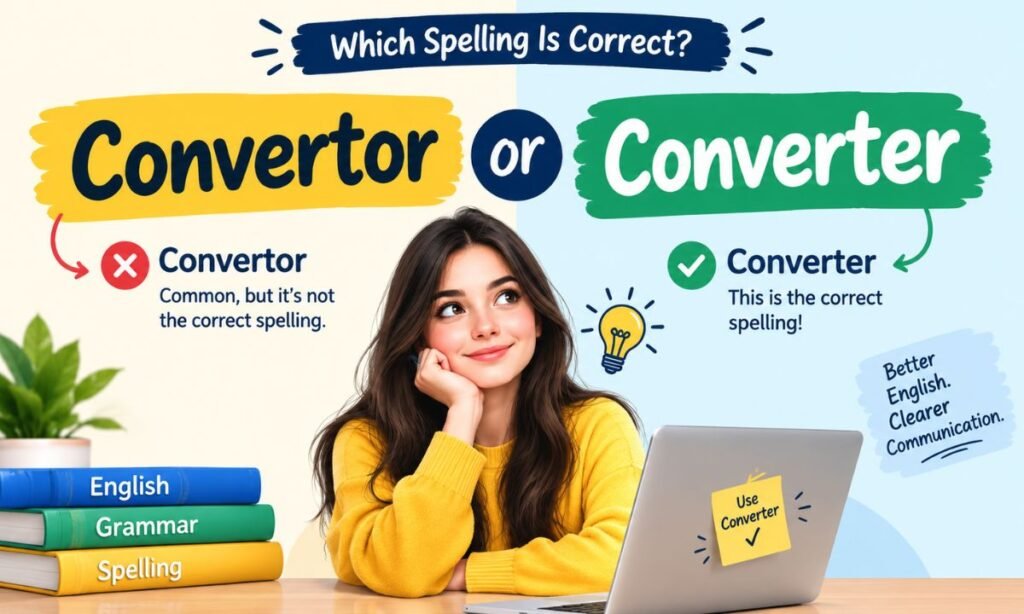

Typing this word out is trickier than it should be. You start writing “convertor,” pause, then wonder if it’s supposed to be “converter” instead. Spell check doesn’t always flag it, autocomplete suggests both, and half the websites you visit use one spelling while the other half use something else entirely.
This mix-up is one of the most common spelling questions in English, right up there with “advisor vs adviser” or “traveler vs traveller.” The good news is that the answer isn’t complicated once you see the reasoning behind it. This guide breaks down the difference in plain language, backed by dictionary standards, so you can stop second-guessing yourself.
Convertor
“Convertor” is the less common spelling. It shows up occasionally in older engineering texts, some European technical documents, and a handful of product names. Most style guides and dictionaries treat it as a variant rather than the standard form.
Converter
“Converter” is the spelling recognized by Merriam-Webster, Oxford, and Cambridge dictionaries. It’s the version used in software, journalism, textbooks, and everyday writing across both American and British English. If you only remember one spelling, make it this one.
Convertor or Converter: Quick Answer ✅⚡
Short on time? Here’s the answer without the backstory.
✔ Main Difference:
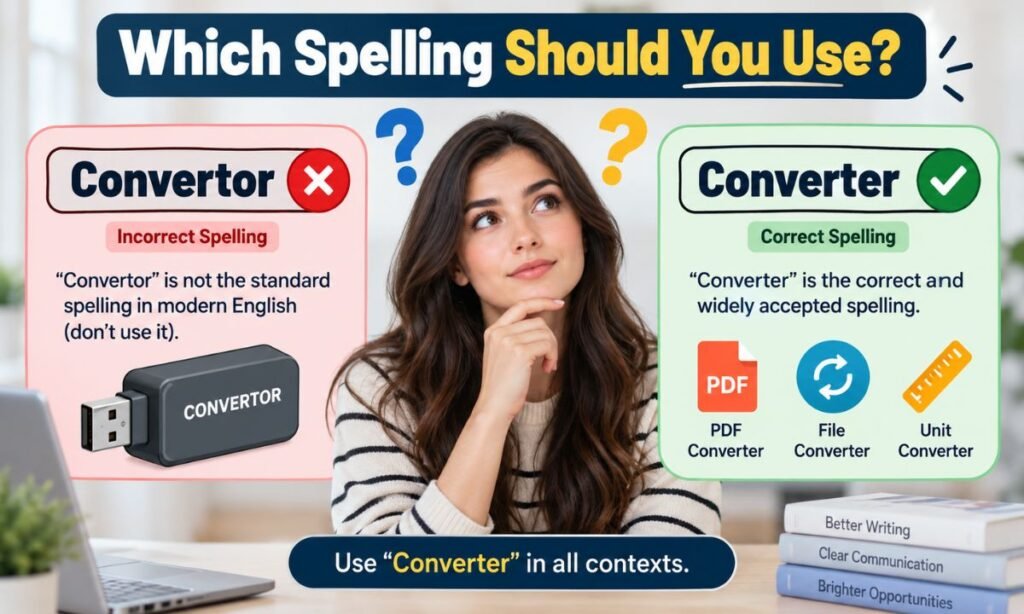
“Converter” is the correct, standard, and widely accepted spelling in modern English. “Convertor” is a rare variant that mostly survives in older technical writing and a few niche product names. Both trace back to the same root word, “convert,” but only one has stayed current.
📌 Examples:
- The app works as a PDF converter.
- My car needs a new catalytic converter.
- She used an online currency converter before the trip.
- The old manual referred to it as a rotary convertor, a term rarely seen today.
Definitions with Examples 📖✍️
Understanding what the word actually means makes the spelling choice easier to remember.
🟢 Converter (Definition)
A converter is a person, device, tool, or piece of software that changes something from one form, state, or format into another. It can refer to physical machines, digital tools, or even people who switch from one belief or practice to another.
📌 Examples:
- The electrician installed a voltage converter for the new appliance.
- This website has a free video converter.
- A currency converter helped him check the exchange rate instantly.
- The factory uses a frequency converter to adjust the power supply.
🔵 Convertor (Definition)
Convertor carries the exact same meaning as converter. It refers to a device or tool that changes one form of something into another. The only real difference is spelling, and even that difference is shrinking as fewer style guides recognize it. You’ll mostly find it in decades-old manuals, some Indian and European technical documents, and a few legacy product listings that never got updated.
📌 Examples:
- The old textbook described a rotary convertor used in early power stations.
- The manual labeled the part as a signal convertor, though modern versions call it a converter.
🟡 Simple Meaning
If a word ends in “-er” and describes something that performs an action, that’s usually the pattern English favors: teacher, writer, painter, converter. The “-or” ending tends to stick around in words borrowed more directly from Latin, like “actor” or “director,” but “convert” followed the more common “-er” route as it settled into modern usage.
Here’s how the word applies across a few common search phrases people use:
- Convertor or converter units — always written as “converter” when referring to unit conversion tools (length, weight, temperature).
- Converter calculator — a tool that calculates conversions between values, spelled with “-er.”
- Convertor or converter table — comparison charts almost always use “converter” as the header term.
- Convertor or converter to inches — length-based tools online are labeled “converter,” not “convertor.”
- Convertor or converter length — same rule applies; “converter” is standard for length tools.
- Currency converter — one of the most searched terms globally, and always spelled with “-er.”
- Catalytic converter — the correct, dictionary-listed term for the car part; “catalytic convertor” is a misspelling.
- Electric converter — used for devices that change voltage or current, spelled “converter” in nearly all technical writing today.
The Origin of Converter 📜⏳
Words don’t get their spelling by accident. There’s usually a pattern behind it, and “converter” follows one of the oldest tricks in English grammar.
📚 Formation Rule:
English frequently builds nouns from verbs by adding “-er” to describe a person or thing that performs the action. Teach becomes teacher. Build becomes builder. Convert becomes converter. This pattern is so common that native speakers apply it almost automatically, which is part of why “converter” feels more natural to read and write.
The word itself traces back to the Latin “convertere,” a combination of “con-” (meaning together or altogether) and “vertere” (meaning to turn). By the time it passed through Old French into Middle English, the verb “convert” had already taken shape, and English speakers simply attached the familiar “-er” ending to describe someone or something that does the converting.
📌 Meaning:
At its core, “converter” describes anything, mechanical, digital, or even personal, that changes one thing into another. A currency converter changes one form of money into another. A religious convert changes belief systems (note: a person is called a “convert,” not a “converter,” in that specific context). A power converter changes one type of electrical current into another. The thread connecting all these uses is transformation.
British English vs American English Spelling 🌍🇬🇧🇺🇸
A lot of spelling differences between British and American English come down to predictable patterns: color versus colour, organize versus organise, center versus centre. Naturally, people assume convertor/converter follows the same split. It doesn’t.
📌 Key Point:
Both British and American English use “converter” as the standard spelling. This isn’t a regional variation like “favorite” versus “favourite.” Dictionaries on both sides of the Atlantic, Oxford in the UK and Merriam-Webster in the US, list “converter” as the primary and preferred form. “Convertor” isn’t the British alternative; it’s simply an older or less common spelling that shows up in both regions from time to time, mostly in technical or historical contexts.
📊 Comparison Table:
| Region | Preferred Spelling | Common Usage |
|---|---|---|
| American English | Converter | Software, currency tools, electronics |
| British English | Converter | Technical writing, appliances, media |
| Older/Technical Texts | Convertor | Engineering manuals, legacy documents |
| Everyday Global Use | Converter | Websites, apps, dictionaries, education |
Convertor vs Converter: Key Difference Explained 📊⚖️
Since both words share a root and a meaning, the real distinction isn’t about definition. It’s about acceptance, frequency, and context.
📊 Comparison Table:
| Feature | Converter | Convertor |
|---|---|---|
| Dictionary Status | Standard, widely listed | Variant, rarely primary entry |
| Common Usage | Very high | Low |
| Formal Writing | Recommended | Not recommended |
| Technical/Legacy Docs | Sometimes used | Occasionally appears |
| Search Volume | Much higher | Much lower |
| Digital Tools & Apps | Almost always | Rarely |
📌 Example:
Compare these two sentences:
- “Download this free file converter for your documents.” (Correct and natural)
- “Download this free file convertor for your documents.” (Understandable, but reads as outdated or incorrect to most readers)
Both sentences communicate the same idea, but only one matches what readers expect to see in 2026.
Which Spelling Should You Use? 🎯📝
By now the pattern is clear, but here’s the practical breakdown so you never have to think twice again.
✔ Always Prefer:
Use “converter” in essays, emails, business documents, app descriptions, product listings, resumes, and basically any writing meant for a general audience. It’s the version dictionaries recognize, the version search engines favor, and the version readers expect.
⚠️ When You May See Convertor:
- Reprints or direct quotes from older engineering manuals
- Some legacy European or Indian technical product names
- A handful of niche industrial part numbers that were never renamed
- Informal typos where someone simply misspelled the word
📚 In Exams
Standardized tests, academic papers, and grammar exams almost always mark “converter” as correct. If a question asks you to identify the properly spelled word between the two, “converter” is the safe answer nearly every time.
⚖️ Easy Tip
If you’re ever unsure mid-sentence, picture other “-er” agent nouns you already know without hesitation: writer, reader, printer, teacher. “Converter” belongs in that same family. That mental shortcut works faster than trying to recall a spelling rule.
📌 Usage Tip (Very Important) 🧠✨
One habit fixes this problem for good: whenever you type “convertor,” pause and swap it for “converter” before you hit send or publish. Over time, this becomes automatic, and the correct spelling starts to feel like the only option.
Another helpful trick is running a quick search for the phrase you’re using. If ninety percent of results show “converter” and only a small fraction show “convertor,” that’s a strong signal about which one your readers expect to see.
📌 Examples:
- Wrong: “This tool works as a unit convertor for cooking measurements.”
- Right: “This tool works as a unit converter for cooking measurements.”
- Wrong: “He bought a new voltage convertor for his laptop.”
- Right: “He bought a new voltage converter for his laptop.”
Common Mistakes with Convertor or Converter ❌⚠️
Even careful writers slip up here. These are the patterns worth watching for.
1. Using Convertor Everywhere
Some writers default to “convertor” simply because they saw it once in a technical document and assumed it was standard. Repeating that spelling across blog posts, product pages, or resumes makes writing look inconsistent with modern usage.
2. Thinking Both Are Equal
Treating “convertor” and “converter” as fully interchangeable ignores how dictionaries and style guides actually rank them. They share a meaning, but one is the accepted standard and the other isn’t.
3. Copying Old Text
Pulling phrasing from decades-old manuals or outdated product catalogs can accidentally reintroduce “convertor” into fresh content. Always double-check inherited text before publishing it as your own.
4. Spelling Confusion
Fast typing leads to small slips: convertor, convertoir, cconvertor, covertor. None of these match the dictionary-approved form. If you’re typing quickly, it helps to glance back at the word before submitting a form, email, or document.
Converter in Everyday Examples 💬📱
The word “converter” shows up far more often than most people realize, once you start noticing it.
💻 Technology
- File converter (PDF to Word, image formats, video formats)
- Currency converter apps
- Unit converter tools for cooking, distance, and weight
🚗 Vehicles
- Catalytic converter (emissions control part)
- Torque converter (automatic transmission component)
- DC to AC power converter for electric vehicles
📱 Apps
- Voice-to-text converters
- Language converters and translation tools
- Document format converters built into productivity apps
📧 Work
- Spreadsheet-to-PDF converters for reports
- Time zone converters for scheduling meetings
- Currency converters used in invoicing and budgeting
🏠 Daily Use
- Plug and voltage converters for travel
- Recipe measurement converters in the kitchen
- Speed and temperature converters for weather apps
Converter: Google Trends & Usage Data 📊📈
🌍 Trends:
Search interest strongly favors “converter” across nearly every English-speaking region. The gap isn’t small either; “converter” consistently pulls in far higher search volume than “convertor,” and that gap has widened rather than narrowed over the past several years as digital tools (file converters, currency converters, unit converters) became part of daily online activity.
📊 Region Table:
| Region | Preferred Term | Notes |
|---|---|---|
| United States | Converter | Dominant in tech and finance searches |
| United Kingdom | Converter | Matches Oxford dictionary standard |
| India | Converter (mostly) | “Convertor” appears occasionally in technical listings |
| Australia | Converter | Consistent with British spelling norms |
| Europe (non-English) | Converter | Used in English-language tech content |
🔥 Top 10 Searches:
- Currency converter
- PDF converter
- Unit converter
- Video converter
- YouTube to MP3 converter
- Catalytic converter
- Voltage converter
- Length converter
- Temperature converter
- Time zone converter
Every single one of these commonly searched terms uses “converter,” not “convertor,” which reinforces just how settled this spelling question really is in practical, everyday use.
Comparison Table 📋⚖️
| Category | Converter | Convertor |
|---|---|---|
| Correct in Modern English | Yes | No (variant only) |
| Recommended for Writing | Yes | No |
| Found in Major Dictionaries | Yes, as primary entry | Sometimes, as secondary/variant |
| Common in Apps & Software | Yes | Rarely |
| Seen in Old Technical Docs | Occasionally | Yes |
| Safe Choice for Exams | Yes | No |
| Search Volume | High | Low |
Why This Spelling Question Keeps Coming Up 🔍💭
Part of the reason this confusion never really dies down is that “convertor” isn’t a made-up word. It genuinely appears in print, in patents, in old physics textbooks, and in a few product manuals that predate widespread digital spell-checking. When people stumble across those sources, they naturally assume both spellings carry equal weight today. They don’t, but the assumption is understandable.
Search engines add another layer to the confusion. Because “convertor” still gets typed into search bars fairly often, some websites intentionally include both spellings in their content just to capture that traffic, even while explaining that “converter” is correct. That’s a smart move for visibility, but it can leave readers with the impression that the two words are used equally in professional writing, which isn’t accurate.
There’s also a simple typing habit at play. Many multisyllabic English words that end in a similar sound get an “-or” ending: actor, doctor, editor, visitor. Someone typing quickly can subconsciously default to that pattern with “convertor” without stopping to think about it. The mistake is common enough that most editors and proofreaders catch it automatically and swap it out without a second thought.
Once you understand where the confusion comes from, spelling it correctly becomes far less of a guessing game and more of a habit you build over a few weeks of conscious effort.
Frequently Asked Questions
What is a convertor?
A convertor is an older or less common spelling of “converter,” referring to a device or tool that changes one form of something into another.
How do you spell convertor?
It’s spelled C-O-N-V-E-R-T-O-R, though the standard modern spelling is “converter” with an “-er” ending instead.
What does “converter” mean in English?
A converter is a person, device, or program that changes something from one form, format, or state into another.
What does it mean converter?
It means something that performs conversion, turning one type of value, format, or energy into a different one, such as a currency or file converter.
Conclusion
The bottom line is simple. “Converter” is the spelling worth using in nearly every situation, whether you’re writing a school essay, a product description, or a quick text to a friend. “Convertor” isn’t wrong in a historical sense, but it no longer matches how modern English is written, taught, or searched. Stick with “converter,” and you’ll never have to pause over this word again.