
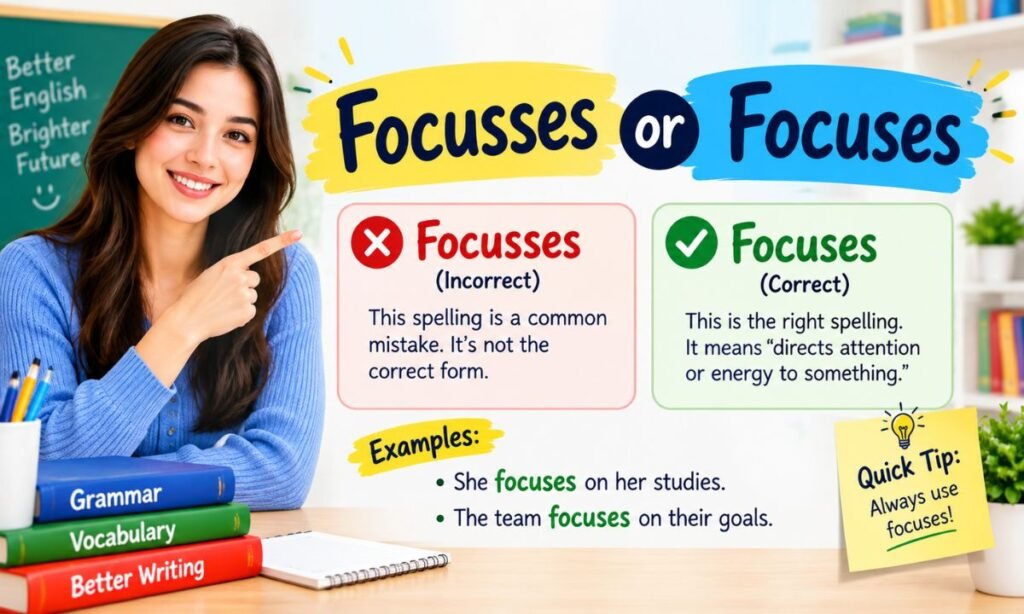

You’re typing an email, a report, or maybe a school assignment, and your fingers freeze on one word. Is it “the company focuses on customer service” or “the company focusses on customer service”? Spell-check flags one version. Your British colleague swears by the other. Neither of you is wrong, exactly, and that’s precisely why this word trips up so many writers.
The short version: both spellings exist, both are grammatically valid in certain contexts, and the correct choice depends almost entirely on which side of the Atlantic your audience sits on. But there’s more nuance here than a simple US-versus-UK split, and understanding it will stop you from second-guessing yourself every time the word shows up in your writing.
This guide breaks down where each spelling comes from, when to use which one, and how to avoid the small mistakes that make even confident writers pause.
Focusses
“Focusses” is the double-S spelling. It shows up as the third-person singular present tense of the verb “focus” (as in “she focusses on her studies”) and occasionally as a plural noun form. You’ll see it far more often in British, Australian, and older Canadian writing than in anything produced in the United States. Some UK style guides accept it, though even in Britain it’s the less common of the two options for this particular verb form.
Focuses
“Focuses” is the single-S spelling, and it’s the dominant form worldwide. It works as the third-person singular verb (“he focuses on his goals”) and as the plural of the noun “focus” (as in “the lecture had three focuses”). American, Canadian, and increasingly British publications default to this spelling, making it the safer choice if you’re writing for a general or international audience.
Focusses or Focuses: Quick Answer
If you only have ten seconds, here’s what you need to know:
- Focuses is correct almost everywhere, including American English, and it’s the spelling recommended by most modern British style guides too.
- Focusses is a recognized British variant, but it’s now the minority spelling even in the UK.
- For the verb’s other forms, the pattern repeats: focused/focusing (US and increasingly UK) versus focussed/focussing (traditional British, still common but declining).
- When in doubt, pick “focuses.” It reads naturally to American, British, Australian, and Canadian readers alike.
That covers the everyday question. The reasoning behind it is worth understanding too, especially if you write professionally or care about consistency across a document.
The Origin of Focusses or Focuses
The word “focus” entered English from Latin, where it originally meant “hearth” or “fireplace.” Johannes Kepler borrowed the term in the 1600s to describe a fixed point in geometry and optics, and from there it spread into everyday language to mean a center of attention or activity.
English spelling conventions for verbs ending in a single consonant preceded by a single vowel often double that consonant before adding “-ed,” “-ing,” or “-es.” Think “travel” becoming “travelled” in British English, or “cancel” becoming “cancelled.” Writers in Britain applied the same instinct to “focus,” producing “focussed” and “focussing.”
American English generally resisted this doubling rule for words like “focus,” “travel,” and “cancel” when the stress falls on the first syllable rather than the last. Since “FO-cus” is stressed on the first syllable, American style guides settled on the single-S forms as standard. That single difference in stress-based spelling logic is the root of the entire “focused versus focussed” debate you see today.
Older British texts lean more heavily on the double-S spelling, but usage has been shifting for decades. Publishers, newspapers, and dictionaries across the UK increasingly favor the single-S form, partly because of American media influence and partly because major British reference works themselves list “focused” first.
British English vs American English Spelling
Spelling differences between British and American English usually follow a handful of predictable patterns: “colour” versus “color,” “organise” versus “organize,” “travelled” versus “traveled.” “Focus” fits into that last category, but with an important twist: unlike “travelled,” where the double-L form is still firmly standard in the UK, the double-S form of “focus” has never been the clear British default.
Here’s how the two regions actually compare:
| Region | Preferred spelling (verb forms) | Notes |
|---|---|---|
| United States | focuses, focused, focusing | Single-S is the only standard form |
| United Kingdom | focuses/focusses, focused/focussed | Both accepted; single-S now more common in edited writing |
| Canada | focused, focusing (mixed with UK forms) | Leans American, though double-S appears regularly |
| Australia | focused, focusing (mixed with UK forms) | Similar mix to Canada; single-S dominant in media |
| New Zealand | focussed appears more than in the UK | One of the few places where double-S is holding steady |
The takeaway is that American English gives you exactly one correct option, while British and Commonwealth English technically allow two, with a clear and growing preference for the shorter spelling. This is different from most US/UK spelling pairs, where the British version is unambiguous.
Which Spelling Should You Use?
Your choice should come down to your audience, your style guide, and consistency within the piece you’re writing. A few practical scenarios:
- Writing for a US audience or publication: Always use “focuses,” “focused,” and “focusing.” The double-S forms will look like a typo to American readers and to most spell-checkers set to US English.
- Writing for a UK audience: Either spelling is technically accepted, but “focuses” and “focused” are the safer, more modern-looking choice. Many British newspapers and style guides, including sources like the Guardian and the BBC, favor the single-S spelling in practice.
- Writing academic or business content for an international audience: Stick with “focuses.” It’s the version recognized everywhere and won’t distract non-native English readers who learned American spelling conventions in school.
- Following a specific style guide: If your employer, publisher, or professor specifies British English, ask whether they want traditional double-S forms or the modern single-S British style. Not every UK institution agrees on this.
Focusses or focuses meaning
Both spellings carry the exact same meaning. There’s no shift in definition, tone, or grammatical function between “focuses” and “focusses.” The difference is purely orthographic, meaning it’s about how the word is spelled, not what it communicates.
Focusses or focuses examples
- Correct (US): The documentary focuses on climate change in the Arctic.
- Correct (UK, traditional): The documentary focusses on climate change in the Arctic.
- Correct (US): Her research has three main focuses: nutrition, sleep, and exercise.
- Correct (UK, traditional): Her research has three main focusses: nutrition, sleep, and exercise.
Focusses or focuses synonym
If you want to sidestep the spelling question entirely, synonyms like “concentrates on,” “centers on,” “zeroes in on,” or “emphasizes” can substitute for “focuses on” in many sentences.
Focussed or focused Oxford English Dictionary
The Oxford English Dictionary lists “focused” as the primary spelling and describes “focussed” as an irregular but recognized variant. Oxford’s own learner’s dictionaries list “focused” first, with “(also focussed)” noted alongside it.
Focussed or focused in British English
Both appear in British writing, but corpus data and style-guide trends both point toward “focused” as the more common choice in current, professionally edited British English.
Focusses or focuses reddit
Search any English-language forum thread on this topic and you’ll find the same pattern repeating: people from the US insisting “focusses” looks wrong, and people from the UK, Canada, or New Zealand explaining that they learned the double-S version in school. Neither side is incorrect; they’re just describing different regional norms.
Is focussed a word
Yes. “Focussed” is a legitimate, dictionary-recognized alternative spelling of “focused,” used primarily in British and Commonwealth English. It’s not a misspelling, though it will get flagged by American spell-checkers.
Focussed or focused us
In the United States, only “focused” is standard. “Focussed” doesn’t appear in American style guides, and using it in US-facing writing will almost always read as an error rather than a stylistic choice.
📌 Focuses vs Focusses and Related Forms (Complete Usage Guide)
The verb “focus” has several inflected forms, and each one has a single-S and double-S version. Here’s the full picture:
| Form | Single-S (US standard) | Double-S (British variant) |
|---|---|---|
| Present, third person | focuses | focusses |
| Past tense | focused | focussed |
| Past participle | focused | focussed |
| Present participle | focusing | focussing |
| Plural noun | focuses | focusses |
A few usage rules worth remembering:
- Never mix the two spelling systems within a single document. If you choose “focused” at the start of an essay, stay with the single-S forms throughout.
- The plural noun “focuses” (as in “two focuses of the study”) is standard; “foci” is the more formal, Latin-derived plural, used mainly in academic and scientific writing.
- Most word processors default to American English spell-check, so “focusses” and “focussed” will often be underlined even when they’re contextually acceptable for a British audience. Adjust your language settings rather than assuming the squiggly red line means an error.
- When editing someone else’s writing, match their established regional spelling rather than imposing your own preference.
Common Mistakes with Focusses or Focuses
Writers stumble over this word in a few predictable ways:
- Inconsistent spelling within one document. Switching between “focused” and “focussed” partway through a report looks careless, even though both are individually valid.
- Assuming “focusses” is simply wrong. It isn’t wrong; it’s regional. Correcting a British colleague’s “focussed” to “focused” without context can come across as presumptuous.
- Overcorrecting in academic writing. Some students double the S out of habit, applying the same rule they use for “travel” or “cancel,” without realizing “focus” behaves differently in American English because of where the stress falls.
- Confusing “focuses” the noun plural with “foci.” Both are correct, but “foci” tends to sound more technical and is generally reserved for scientific or medical contexts.
- Ignoring style guide instructions. If a publication specifies AP style, Chicago style, or a house style sheet, that guide’s preference overrides personal habit.
⚠️ Common Search Confusions About Focuses and Focusses
A lot of the confusion online comes from a handful of overlapping questions that all sound similar but aren’t quite the same thing:
- People ask whether “focusses” is a typo, when really it’s a valid but regionally limited spelling.
- People search for the “correct” spelling as if there’s one universal answer, when the honest answer depends on audience and location.
- People confuse the spelling debate with a grammar debate, assuming one version is somehow more formal or accurate. It isn’t; this is purely about regional convention.
- People searching “focussed or focused Australia” or similar phrases are often surprised to learn that Australian English, like British English, increasingly favors the single-S spelling despite historically following UK conventions.
Focusses or Focuses in Everyday Examples
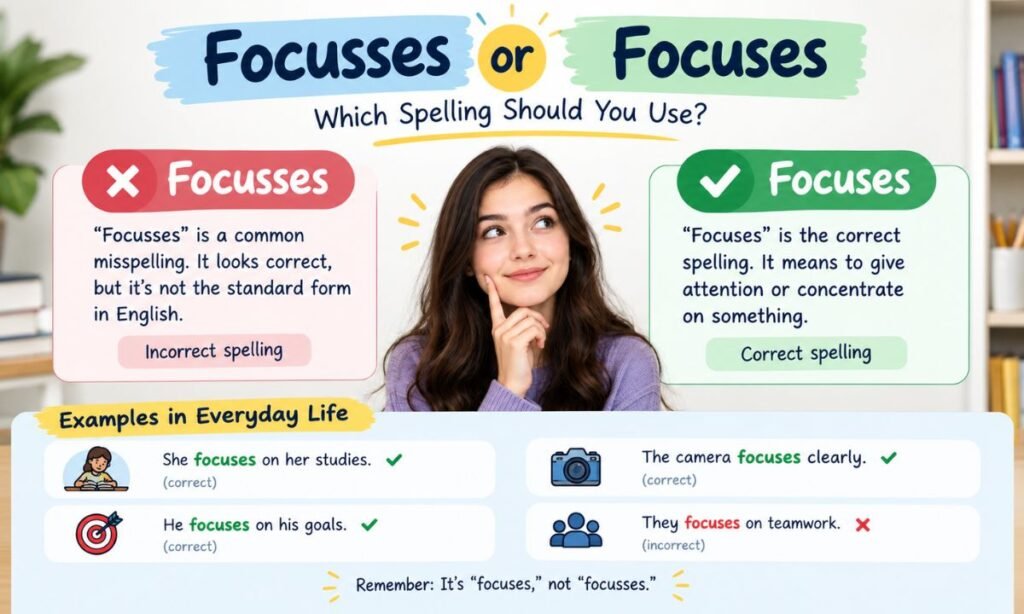
Seeing the word in realistic sentences makes the distinction easier to internalize.
Business writing:
- “Our team focuses on client retention this quarter.” (US/international)
- “Our team focusses on client retention this quarter.” (traditional UK)
Academic writing:
- “This paper focuses on three separate research questions.”
- “The study’s methodology has multiple focuses, ranging from behavioral analysis to statistical modeling.”
Everyday conversation:
- “She really focuses when she’s studying for exams.”
- “He focussed his energy on getting the promotion.” (traditional UK past tense)
Marketing copy:
- “Our new skincare line focuses on natural ingredients.”
Notice that in every case, swapping the single-S spelling for the double-S version (or vice versa) doesn’t change meaning, tone, or grammatical correctness. It only changes which regional convention the sentence follows.
Focusses or Focuses: Google Trends & Usage Data
Search interest and usage data both tell a consistent story. “Focuses” and “focused” dominate global search volume by a wide margin, reflecting both the size of the American English-speaking audience online and the growing preference for single-S spelling in Britain, Australia, and Canada.
Within English-language books and news archives, the double-S forms (“focussed,” “focussing,” “focusses”) have been declining steadily since the mid-20th century, even within British publications. Major UK outlets that once used “focussed” as a matter of course have gradually shifted toward “focused” in their style guides. This mirrors a broader trend across many British-American spelling pairs, where American conventions have gained ground globally due to the volume of American media, software defaults, and internet content.
Practically speaking, this means that “focuses” isn’t just the safer choice for an American audience. It’s increasingly the safer default choice, period, unless you have a specific reason to follow traditional British spelling.
Comparison Table: Focusses vs Focuses
| Feature | Focuses | Focusses |
|---|---|---|
| Region | US, international, modern UK | Traditional British, some Commonwealth |
| Dictionary status | Standard/primary spelling | Recognized variant, listed as secondary |
| Frequency of use | Dominant worldwide | Minority, declining even in the UK |
| Spell-check compatibility | Accepted by virtually all editors | Often flagged by US-default spell-checkers |
| Recommended for general use | Yes | Only if writing specifically in traditional British style |
| Past tense equivalent | focused | focussed |
| Present participle equivalent | focusing | focussing |
Common Mistakes Recap and Final Guidance
If you take away one rule from this entire comparison, let it be this: pick one spelling system and stay with it. “Focuses” is the safer, more widely recognized choice for nearly every writing context today, including most British publications. “Focusses” isn’t incorrect, but it’s a niche, traditional variant that’s fading even in the regions that once used it consistently.
For students, professionals, content writers, and anyone unsure which version to reach for, defaulting to “focuses,” “focused,” and “focusing” will serve you well in almost every situation you’ll encounter.
Frequently Asked Questions
Is focusses correct spelling?
Yes, it’s a recognized British English variant, though “focuses” is now more common even in the UK.
Is it correct to say “focuses”?
Yes, “focuses” is the standard spelling in American English and the most widely accepted form worldwide.
Is it focussed or focused in Australia?
Australian English accepts both, but “focused” has become the more commonly used spelling in current media and publishing.
What does the word “focuses” mean?
It means to direct attention, effort, or energy toward a specific point, task, or goal.
Conclusion
The “focusses or focuses” question isn’t really about right and wrong; it’s about audience and consistency. Both spellings are grammatically legitimate, rooted in real regional traditions, and recognized by major dictionaries. But if you want a single answer that works in nearly any context, from a college essay to a client email to a blog post read by people around the world, “focuses” is your best bet. Save “focusses” for situations where you’re deliberately writing in traditional British style, and even then, double-check your house style guide first. Spelling shouldn’t slow down your writing, and now it won’t.